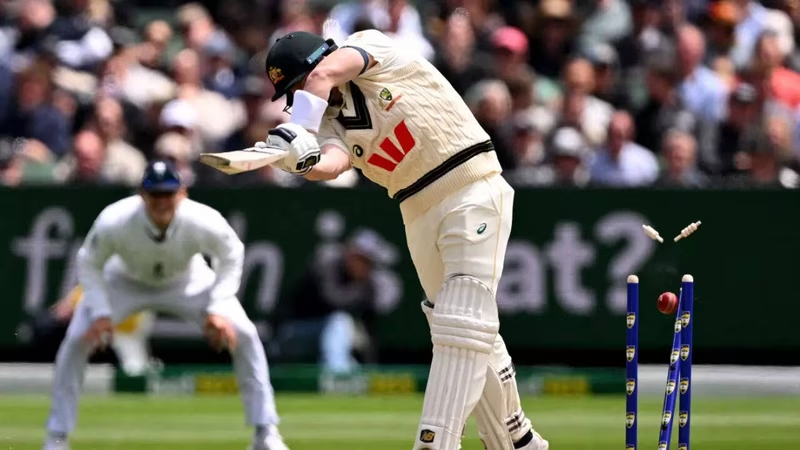
Test cricket is supposed to be a five-day chess match—a slow burn of strategy, endurance, and drama. But what happens when it’s over before lunch on Day 2? That’s exactly the crisis facing the game after a surreal opening day at the Melbourne Cricket Ground, where 20 wickets fell in a single day, turning a marquee Ashes Test into a two-day spectacle.
Now, Cricket Australia (CA) is sounding the alarm. CEO Nick Hockley has bluntly stated that these kinds of **short Tests bad for business**—not just for fans, but for broadcasters, sponsors, and the entire financial ecosystem that keeps the longest format alive .
And he’s not wrong. When tickets are sold for five days, hotels are booked for a week, and global broadcast slots are reserved, a 30-hour Test match doesn’t just disappoint—it damages trust in the product itself.
Table of Contents
- The MCG Mess: 20 Wickets and a Crisis
- Why ‘Short Tests Bad for Business’
- The Pitch Problem: Who Is to Blame?
- Global Precedents: When Test Cricket Fizzles Out
- What Needs to Change to Save Test Cricket?
- Conclusion: A Wake-Up Call for Cricket Governance
- Sources
The MCG Mess: 20 Wickets and a Crisis
On Day 1 of the fourth Ashes Test in December 2025, cricket fans witnessed something almost comical: Australia bowled out for 152, and England collapsed for just 110—all before stumps . By the end of the day, 20 wickets had fallen on a pitch that offered extreme seam movement, variable bounce, and little respite for batsmen.
What should have been a tightly contested battle turned into a lottery. Fast bowlers feasted, but fans were left wondering: Is this really Test cricket?
The match was effectively decided by Day 2, with England chasing a tiny target and wrapping up victory in under 31 hours of play. While dramatic, the brevity sparked immediate backlash—from fans, media, and now, administrators.
Why ‘Short Tests Bad for Business’
Nick Hockley didn’t mince words: “Short Tests are bad for business.” And from a commercial standpoint, he’s absolutely right. Here’s why:
- Ticket Revenue Loss: Fans who paid for a five-day experience got two days of action. Refunds or dissatisfaction are inevitable.
- Broadcast Contracts: Networks pay millions for five days of live coverage. Two-day Tests mean dead air and lost ad revenue.
- Tourism Impact: International fans plan vacations around full Tests. A shortened match undermines that economic flow .
- Sponsor Value Erosion: Brands expect visibility across multiple days. A 30-hour Test slashes their return on investment.
As Hockley emphasized, “We have to protect the integrity and commercial viability of Test cricket” .
The Pitch Problem: Who Is to Blame?
At the heart of this fiasco lies the pitch. The MCG wicket was prepared with excessive grass coverage, reportedly at the request of the Australian team, who wanted conditions favoring their pace attack . But the result was unplayable—not challenging, but chaotic.
Former players like Michael Vaughan and Ricky Ponting have criticized the preparation, calling it “unfair” and “damaging to the contest” . The ICC may now review whether the pitch met its own “Good Pitch” guidelines, which require surfaces to last a minimum of four days.
Global Precedents: When Test Cricket Fizzles Out
This isn’t the first time a Test has ended prematurely due to poor pitch conditions:
- Perth, 2013: South Africa vs. Australia ended in under two days on a green seamers’ track.
- Hamilton, 2020: New Zealand vs. India lasted just 148 overs—fans demanded refunds.
- Chennai, 2021: Dusty pitch turned the match into a spin-dominated farce by Day 2.
Each instance triggered commercial and reputational fallout. The MCG 2025 Test may be the tipping point.
What Needs to Change to Save Test Cricket?
To prevent future debacles, experts recommend:
- Independent Pitch Oversight: Remove home boards’ control over pitch preparation.
- ICC Sanctions: Penalize venues that produce substandard or excessively biased surfaces.
- Hybrid Pitch Development: Use technology to create surfaces that offer balance, not chaos.
As the [International Cricket Council](https://www.icc-cricket.com/) itself states, “Test cricket’s survival depends on compelling, multi-day contests” .
Conclusion: A Wake-Up Call for Cricket Governance
The MCG collapse wasn’t just a cricketing anomaly—it was a warning flare. If **short Tests bad for business** becomes the norm, the five-day format could lose its relevance in an increasingly fast-paced sports market. Cricket Australia’s public stance is a necessary first step. Now, the global custodians of the game must act decisively to ensure that Test cricket remains not just a tradition, but a viable, engaging spectacle.
For more on the future of the longest format, dive into our [INTERNAL_LINK:cricket-history] and [INTERNAL_LINK:analysis] sections.
Sources
- Times of India. “Short Tests ‘bad for business’: Cricket Australia boss” .
- ESPNcricinfo. “MCG pitch under fire after 20-wicket Day 1” .
- The Guardian. “Australia’s pitch gamble backfires spectacularly” .
- ABC Sport. “Vaughan and Ponting slam MCG surface as ‘unplayable’” .
- ICC Official Guidelines. “Pitch and Outfield Monitoring Protocol” .