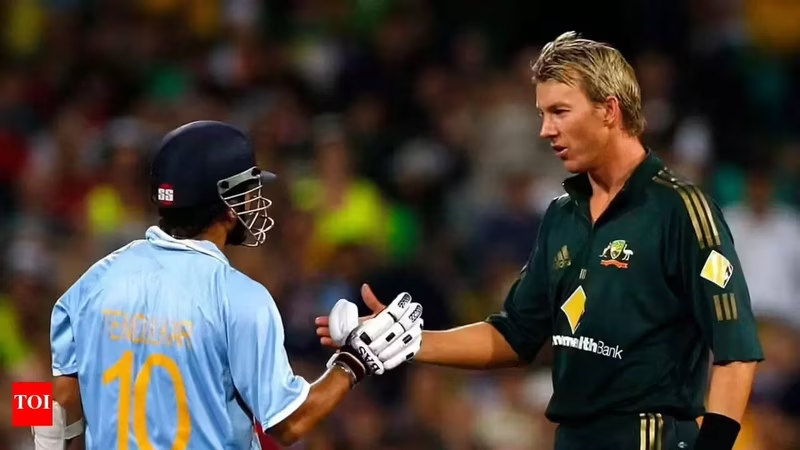
Why Bowling 160kmph Meant More to Brett Lee Than Taking Wickets
For most fast bowlers, the ultimate thrill is watching a batsman’s stumps cartwheel or hearing the umpire shout “Howzat!” But for Australian firebrand Brett Lee, the real victory wasn’t in the wicket column—it was on the speed gun. In a striking confession, Lee revealed that bowling 160kmph held more personal significance for him than any dismissal in his storied career .
“That (160kmph) means more to me than any wicket I’ve taken,” Lee told cricket.com.au, adding that while team success—like the 2003 World Cup win and Australia’s record 16 straight Test victories—remained the ultimate goal, his personal obsession was always about pushing the limits of human speed with a cricket ball .
This rare glimpse into Lee’s mindset offers more than just nostalgia—it reveals the psychology of a generation of fast bowlers who turned velocity into an art form.
Table of Contents
- The 160kmph Dream: Set in Childhood
- Bowling 160kmph: A Rare Club
- Speed vs. Wickets: The Psychology of Pace
- Lee vs. The Greats: How He Compares
- The Legacy of Raw Pace in Modern Cricket
- Conclusion: Why 160kmph Still Matters
- Sources
The 160kmph Dream: Set in Childhood
Brett Lee didn’t just stumble upon speed—he chased it from the moment he picked up a cricket ball. Growing up in New South Wales, he idolized fellow Aussie speedster Jeff Thomson and was inspired by the raw aggression of West Indies legends like Malcolm Marshall and Michael Holding.
But Lee set a different kind of benchmark. “I set my goal at such a young age,” he recalled. “I didn’t just want to be fast—I wanted to be the fastest.” That singular focus drove his training, his action, and even his recovery from multiple stress fractures—a common price for extreme pace.
His breakthrough came during the 1999–2000 international season when he clocked 157kmph against Pakistan. Soon after, he touched 160kmph in a domestic game—joining an elite global fraternity.
Bowling 160kmph: A Rare Club
Achieving bowling 160kmph isn’t just difficult—it’s almost mythical. Only a handful of bowlers in cricket history have officially crossed this threshold:
- Shoaib Akhtar (Pakistan): 161.3kmph – the fastest recorded delivery in international cricket (2003 World Cup vs England).
- Brett Lee (Australia): Multiple instances above 158kmph; unofficially hit 160kmph in domestic matches.
- Jeff Thomson (Australia): Estimated 160.6kmph in the 1970s (no radar gun, but widely accepted by contemporaries).
- Mitchell Starc & Lockie Ferguson: Regularly breach 155kmph but haven’t officially hit 160.
What makes Lee’s claim powerful isn’t just the number—it’s the emotional weight he attaches to it. For him, 160kmph wasn’t a statistic; it was a symbol of defiance, discipline, and identity.
Speed vs. Wickets: The Psychology of Pace
Most coaches emphasize that pace without control or movement is useless. Yet for Lee, speed was psychological warfare. “When you bowl 160, you don’t just beat the bat—you beat the mind,” he once said.
His philosophy flipped conventional wisdom: instead of using pace to take wickets, he used the pursuit of pace to define his worth as a bowler. This mindset resonates with many athletes in high-intensity sports—where personal milestones become proxies for greatness.
Lee finished his career with 310 Test wickets and 380 ODI scalps—impressive by any standard. But as he admits, those numbers never gave him the same rush as seeing “160” flash on the speedometer.
Lee vs. The Greats: How He Compares
While Wasim Akram and Glenn McGrath relied on swing and seam, Lee’s weapon was sheer velocity. His role in Australia’s golden era wasn’t just as a strike bowler—it was as a fear multiplier at the top of the innings.
Comparisons are inevitable:
- McGrath: More wickets, lower average, longer career.
- Lee: Higher peak speed, explosive short spells, iconic World Cup performances.
But Lee never wanted to be McGrath. He wanted to be *the thunder*. And in that, he succeeded.
The Legacy of Raw Pace in Modern Cricket
Today’s game sees a resurgence of speed—with bowlers like Jasprit Bumrah, Naseem Shah, and Jofra Archer blending pace with precision. Yet few openly chase the 160kmph mark, aware of the injury risks and diminishing returns in T20-dominated eras.
Lee’s revelation is a timely reminder: cricket isn’t just about results—it’s about passion, identity, and the personal mountains athletes climb. As he puts it, “The team always comes first… but that 160? That was mine.”
Conclusion: Why 160kmph Still Matters
Brett Lee’s confession reframes how we view sporting achievement. In a world obsessed with stats and trophies, his story celebrates the private victories—the goals set in childhood and achieved against all odds. Bowling 160kmph may not have won matches on its own, but it defined a legend. And sometimes, that’s enough.
Sources
- Times of India: Why bowling 160kmph mattered more to Brett Lee than wickets
- Cricket Australia: Official Site
- International Cricket Council (ICC) – Fast Bowling Records: ICC Official Website