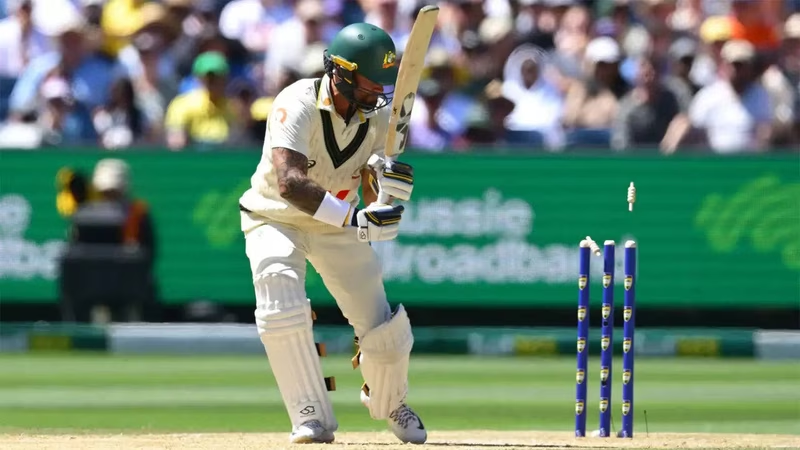
The Melbourne Cricket Ground, a fortress of cricketing tradition, became the epicenter of a seismic controversy this Boxing Day. In a stunning and chaotic display that defied the very spirit of a five-day contest, a mind-boggling 36 wickets crashed in a mere 142 overs across just two days of the Ashes Test.
The match, which concluded in the evening session of Day 2 with an England victory, has left everyone from fans to former captains questioning the integrity of the surface. At the heart of the storm is the MCG pitch, a strip of grass that has drawn sharp criticism for being far too lively for a premier Test match.
Table of Contents
- MCG Pitch Woes: A Test Meltdown
- Curator’s “State of Shock”
- Historical Context: MCG as a Batting Venue
- Expert Reactions and Future Implications
- Conclusion: A Defining Moment for the MCG?
- Sources
MCG Pitch Woes: A Test Meltdown
The narrative of the 2nd Test was written in the dirt of the MCG square from the very first ball. Day 1 alone produced a staggering 20 wickets, a statistic more befitting a county championship match on a green top than a marquee Ashes encounter. Batsmen from both Australia and England, seasoned professionals, looked utterly bewildered, playing and missing with alarming frequency or succumbing to deliveries that behaved more like gremlins than cricket balls.
The carnage was so complete that the entire contest was decided by the evening of the second day, giving it the feel of a prolonged first-class game rather than a Test. This was England’s first Test victory in Australia since January 2011 , a historic achievement that has been somewhat overshadowed by the central question: was the victory earned on a fair battleground?
Curator’s “State of Shock”
The man most directly responsible for the playing surface, MCG head curator Matt Page, has not shied away from the criticism. In a remarkably candid admission, Page told reporters, “I was in a state of shock,” a sentiment echoed in multiple reports [[3], [4]].
His shock is understandable. Curators prepare pitches months in advance, aiming for a balance that offers something for everyone—pace and bounce for the quicks, and enough consistency for batters to build long innings. The MCG pitch, however, offered excessive seam movement, unpredictable bounce, and variable pace from the outset. Page had reportedly left 10mm of grass on the wicket, a decision intended to create a seamer-friendly surface, but one that clearly went too far .
Former England captain Michael Vaughan was scathing in his assessment, labelling the pitch “a joke” and stating it had “done too much” to the point of creating an “unfair” contest [[1], [5], [21]]. This isn’t just fan frustration; it’s a serious indictment from a respected voice in the game.
Historical Context: MCG as a Batting Venue
The irony of this situation is that the MCG has historically been criticized for the opposite problem. In the 2017-18 Ashes, the pitch was rated “poor” by the ICC for being far too flat and lifeless, a “batter-friendly surface” that produced a tedious draw with only 24 wickets falling [[17], [19]].
The ground’s history is one of high-scoring draws and mammoth totals, a place where batsmen could feast. The dramatic swing to the other extreme in this Test has created a whiplash effect for the cricketing world. Fans are now left wondering if there is a consistent philosophy for pitch preparation at this iconic venue. The MCG is meant to host a balanced contest, not a lottery where the coin toss is the sole determinant of the outcome .
Expert Reactions and Future Implications
The fallout from this Test is significant and multi-layered:
- Player Safety & Morale: When a pitch offers unpredictable and excessive movement, it can become a genuine safety hazard for batters, and it demoralizes players who feel they can’t showcase their true skills.
- ICC Scrutiny: The International Cricket Council is almost certain to review the pitch. Given its recent history of both extremes, the MCG could face a formal rating—potentially another “poor” mark—which carries reputational and financial consequences .
- The Ashes Narrative: This controversy has injected a new, complex layer into the Ashes story. England’s victory, while brilliant in its own right, will forever carry an asterisk for some, while Australia will lament losing a home Test on a surface that offered no platform for their star-studded batting lineup to perform.
Key figures like Steve Smith and Ben Stokes have also weighed in, adding to the chorus of concern about the nature of the contest . This isn’t just about one bad pitch; it’s about the future of Test cricket on one of its most hallowed stages. For fans looking to explore more about the intricacies of the Ashes rivalry, our in-depth analysis on [INTERNAL_LINK:ashes-rivalry-history] provides valuable context.
Conclusion: A Defining Moment for the MCG?
The Boxing Day Test of 2025 will be remembered not for a heroic century or a devastating bowling spell, but for the 36 wickets that fell in a breathtaking, yet deeply concerning, two-day blur. The MCG pitch has become the central antagonist of this Ashes chapter, leaving its curator in a state of shock and the cricketing world demanding answers.
The MCG now stands at a crossroads. It must find a way to deliver a consistent, balanced, and true surface that honors its legacy as a Test venue. The alternative is a future where its iconic status is tarnished by the memory of pitches that create chaos, not cricket.
Sources
- Times of India: Ashes: 36 wickets in 2 days! MCG curator in ‘state of shock’
- Sportstar: Ashes 2025-26: Melbourne pitch performance shocks curator
- BBC Sport: ‘Unfair’ MCG pitch has ‘done too much’ – Vaughan
- The Guardian: Questions over MCG pitch after two-day Boxing Day Test
- ESPNcricinfo: Australia vs England, 2nd Test – Match Report