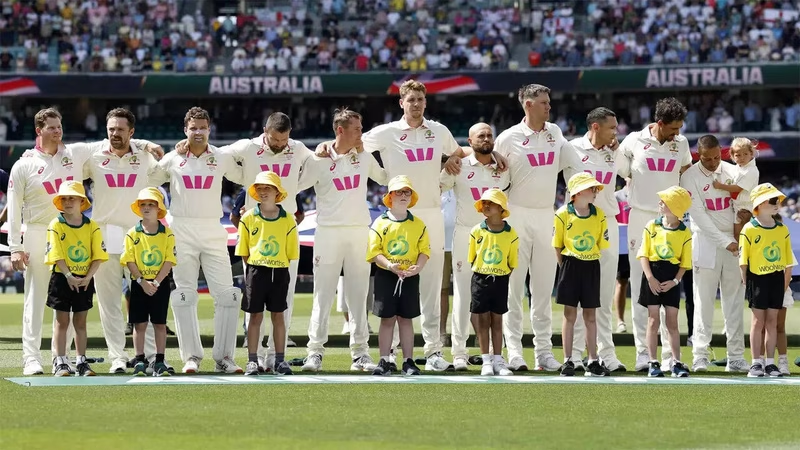
The hallowed turf of the Sydney Cricket Ground (SCG) has witnessed countless moments of cricketing history, but on this scorching January day in 2026, it became the stage for a truly unprecedented event. For the first time in an astonishing 138 years, Australia has named a Test match XI for a game at the SCG without a single specialist spinner . This seismic decision, made for the fifth and final Ashes Test against England, has sent shockwaves through the cricketing world and broken a tradition thought to be as permanent as the SCG’s iconic members’ stand.
Table of Contents
- Why Australia Ditched the Spinner
- Beau Webster: The Man Who Broke the Tradition
- The Unfortunate Todd Murphy
- A Look Back at 138 Years of Spin at the SCG
- What the Future Holds for Australian Spin
- Summary
- Sources
Why Australia Ditched the Spinner
The primary catalyst for this historic shake-up is the long-term absence of their legendary off-spinner, Nathan Lyon. With their frontline spinner sidelined, the Australian selectors were faced with a crucial choice: promote the young, talented Todd Murphy or double down on pace and seam bowling. They chose the latter.
The pitch report and weather conditions for the SCG Test played a significant role. While traditionally a haven for spinners in the latter stages, recent SCG pitches have offered more for the seamers early on, with less dramatic turn than in decades past . The Australian camp, led by stand-in captain Steve Smith, appears to have prioritized a four-pronged pace attack to exploit these conditions and capitalize on a potent English batting lineup that has historically struggled against high-quality fast bowling on Australian soil. This tactical gamble underscores a potential shift in how teams now perceive the SCG pitch’s characteristics.
Beau Webster: The Man Who Broke the Tradition
Stepping into the XI and inadvertently becoming a part of cricketing folklore is all-rounder Beau Webster. At 32 years old, the Tasmanian offers a unique skillset that seemingly tipped the scales in his favor over a pure spinner .
Webster is a powerful, right-handed middle-order batsman known for his ability to score quickly and change the momentum of an innings. His bowling, while not express pace, provides a crucial fifth option with his right-arm medium deliveries, offering a change of pace and line that can be just as effective as spin in certain situations . His inclusion provides Australia with greater batting depth and a more versatile bowling attack, a balance the selectors clearly valued over the specialist spin option for this specific contest . This debut on such a grand stage is a testament to his consistent domestic performances .
The Unfortunate Todd Murphy
The biggest loser in this selection decision is undoubtedly off-spinner Todd Murphy. The 25-year-old, who has been groomed as Lyon’s long-term successor, was widely expected to fill the void left by the veteran . Murphy had been named in the 15-member squad and was vocal about his readiness to take on a significant workload at his home ground .
His omission is a massive blow to the young spinner, who will now have to watch from the sidelines as history is made—ironically, a history that excludes his very role. This decision is sure to spark intense debate about the management of young spin talent in Australia and whether the team’s short-term tactics are hindering the development of its next generation of tweakers .
A Look Back at 138 Years of Spin at the SCG
The last time Australia took the field at the SCG without a specialist spinner was in 1888, a time when cricket was a vastly different game . Since then, the SCG has been a spiritual home for Australian spinners, from greats like Bill O’Reilly and Richie Benaud to the modern-day king, Nathan Lyon.
Over the decades, countless matches at the SCG have been defined by spinners weaving their magic on a turning track on days four and five. This tradition has been so deeply ingrained that its sudden, strategic abandonment marks a significant cultural and tactical shift for the Australian team. It suggests that for this current generation of selectors, the data on pitch behavior and the specific match situation outweigh a century-long custom .
What the Future Holds for Australian Spin
This unprecedented move raises critical questions for the future of spin bowling in the Australian Test side. Is this a one-off, dictated by unique circumstances and the specific profile of Beau Webster? Or is it a sign of a broader trend where the role of the specialist spinner is being re-evaluated in favor of seam-bowling all-rounders and an increased reliance on pace?
Former players and pundits are already divided on the issue, with some ex-Test stars expressing significant concern for the future of Australian spinners . While it’s unlikely that spin will be abandoned entirely, this SCG Test has shown that the selectors are willing to be incredibly pragmatic, even if it means shattering a 138-year-old tradition. For young spinners in the domestic circuit, the message may be that their path to a Baggy Green is now more competitive than ever.
Summary
In a decision that has rewritten the history books, Australia has selected an XI for the SCG Ashes Test without a specialist spinner for the first time since 1888. This bold move, driven by pitch conditions and a preference for all-round balance, sees debutant Beau Webster make his mark while young spinner Todd Murphy is left out in the cold. This event is far more than just a team selection; it’s a symbolic moment that challenges a long-standing cricketing orthodoxy and sparks a vital conversation about the evolving role of spin in the modern Australian game.