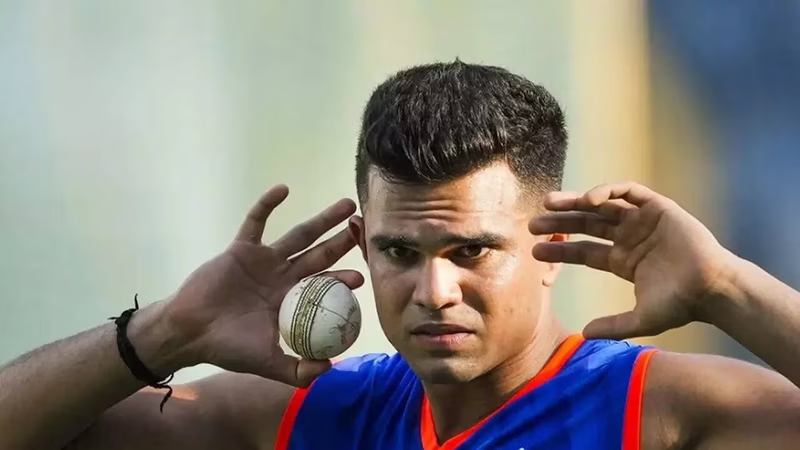
When Arjun Tendulkar was named as an opener for Goa in the 2025–26 Vijay Hazare Trophy, fans and pundits alike raised their eyebrows. Known primarily as a left-arm quick with emerging all-rounder credentials, his promotion to the top of the order was seen as either a bold experiment—or a major misstep. So far, the results speak for themselves: minimal impact, mounting pressure, and now, public criticism from veterans like Yograj Singh, father of Yuvraj Singh.
Table of Contents
- The Opening Bet That Didn’t Pay Off
- Who Is Arjun Tendulkar? Beyond the Surname
- Yograj Singh’s Explosive Claims
- Batting vs Bowling: Where Does Arjun’s True Strength Lie?
- What the Stats Say About His Domestic Career
- Is Arjun Being Mismanaged by Coaches?
- Lessons from Past Young Talents
- Conclusion: Time for a Role Rethink?
- Sources
The Opening Bet That Didn’t Pay Off
In a surprising tactical shift, Goa’s coaching staff decided to deploy Arjun Tendulkar as an opening batsman in the Vijay Hazare Trophy—one of India’s premier domestic one-day tournaments. The move was likely intended to maximize his batting potential and draw on his power-hitting ability in the powerplay overs.
But reality hit hard. Across multiple matches, Arjun struggled to read the new ball, often falling cheaply to quality seamers or misjudging line and length. His strike rate hovered below expectations, and his average remained in single digits—far from what a top-order batter needs to justify their place.
Who Is Arjun Tendulkar? Beyond the Surname
At 25, Arjun Tendulkar has long lived under the colossal shadow of his father, Sachin Tendulkar—the “God of Cricket.” But Arjun has carved his own niche as a genuine pace-bowling all-rounder. Standing over 6’3”, he generates steep bounce and can swing the ball both ways, traits that have earned him IPL contracts with Mumbai Indians and later Gujarat Titans.
His List A and first-class records show more promise with the ball than the bat. While he has played crucial cameos down the order, his core value to any team has traditionally been his bowling—making the decision to open the innings even more puzzling to cricket analysts.
Yograj Singh’s Explosive Claims
Adding fuel to the fire, veteran cricketer and former Indian pacer Yograj Singh has publicly criticized the handling of Arjun’s career. In a recent interview, he alleged that Arjun is being “miscoached” and “pushed into a role that doesn’t suit him.”
“Arjun is naturally a bowler who can bat—a classic all-rounder. But somewhere, the focus has shifted entirely to his batting. That’s not his strength. And worse, opportunities were denied to him earlier when he was ready. Now they’re forcing him to be something he’s not,” Yograj claimed .
While controversial, his remarks tap into a broader concern in Indian cricket: the overemphasis on batting flair, especially for players from high-profile families, at the expense of their natural skill sets.
Batting vs Bowling: Where Does Arjun’s True Strength Lie?
Let’s break it down objectively:
- Bowling: Arjun’s left-arm angle, pace (mid-130s km/h), and ability to extract bounce make him a genuine wicket-taking option in white-ball cricket.
- Batting: He shows power and intent, but lacks the technical refinement of a specialist top-order batter, especially against the new ball in domestic conditions.
- Fielding: Agile for his height, with a strong arm—ideal for a bowling all-rounder in the modern game.
For context, players like Hardik Pandya and Washington Sundar succeeded by first establishing themselves with their primary skill (bowling), then adding batting as a bonus. For Arjun, flipping that script might be doing more harm than good.
What the Stats Say About His Domestic Career
As of January 2026, Arjun Tendulkar’s List A (50-over) stats for Goa and previously for Mumbai reveal a clearer picture:
- Batting average: ~18.5 (as opener in 2025–26 Vijay Hazare Trophy)
- Bowling average: ~27.3 in the same period
- Economy rate: 5.4 in middle overs
- Best figures: 4/32 against Rajasthan
These numbers suggest his impact with the ball remains his most reliable contribution—something that gets diluted when he’s sent out to open.
Is Arjun Being Mismanaged by Coaches?
Coaching decisions in domestic cricket are often influenced by short-term tactics or external narratives. In Arjun’s case, the “Tendulkar legacy” may be creating unrealistic expectations, pressuring teams to showcase him as a batting star—even if it contradicts his development path.
Compare this to how Jasprit Bumrah was initially treated: his unorthodox action was refined, not suppressed, and his role was clearly defined early. Arjun deserves the same clarity.
Lessons from Past Young Talents
History is full of players who thrived when their natural game was nurtured:
- Ravindra Jadeja: Started as a lower-order hitter and part-time spinner—now a world-class all-rounder by staying true to his roots.
- Rishabh Pant: Encouraged to play his natural aggressive game, not molded into a “textbook” keeper-batter.
- Shreyas Iyer: Allowed to develop in the middle order before stepping up as an opener when ready.
For more on talent development in Indian cricket, see our deep dive on [INTERNAL_LINK:how-india-identifies-and-nurtures-domestic-talent].
Conclusion: Time for a Role Rethink?
Arjun Tendulkar possesses undeniable talent—but potential alone isn’t enough. His failed opening experiment in the Vijay Hazare Trophy isn’t just a personal setback; it’s a systemic warning. Coaches, selectors, and even fans must resist the urge to force narratives onto young players. Let Arjun bowl. Let him bat at No. 7 or 8. Let him grow into his game—not someone else’s idea of it. Only then can he step out of his father’s shadow—not by replicating him, but by becoming his own cricketer.