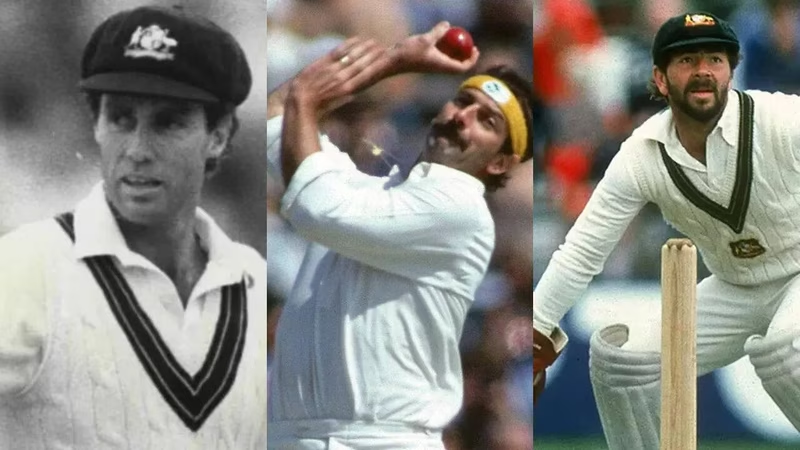
Imagine a single day where three titans of the game walk off the field for the last time—not one by one, but together, in unison, as if fate had scripted their exit like a final act in a grand opera. That’s exactly what happened on January 6, 1984, at the Sydney Cricket Ground (SCG). In a moment that sent shivers down the spine of every cricket lover, Australia’s legendary trio—Greg Chappell, Dennis Lillee, and Rod Marsh—played their final Test match together, closing the book on a golden era that had dominated world cricket for over a decade.
This wasn’t just a retirement. It was a seismic shift in the sport’s landscape. At the time, Chappell was Australia’s all-time leading run-scorer, Lillee the world’s highest wicket-taker, and Marsh the most prolific wicketkeeper in Test history. Their simultaneous departure didn’t just empty the team sheet—it left a void that would take years to fill. Even today, the Chappell Lillee Marsh retirement is remembered not just as an end, but as a benchmark for greatness.
Table of Contents
- The Holy Trinity: Why They Defined an Era
- Chappell Lillee Marsh retirement: The SCG Farewell
- Their Final Stats: A Legacy Cast in Stone
- The Match That Was More Than a Game
- Impact on Australian Cricket: The Aftermath
- How They Are Remembered Today
- Conclusion
- Sources
The Holy Trinity: Why They Defined an Era
Long before the term “Fab Four” or “Big Three” entered cricketing lexicon, Australian fans spoke of the “Holy Trinity”—a nickname coined not for religious reasons, but for the near-mythical synergy between captain Greg Chappell, fast bowler Dennis Lillee, and wicketkeeper Rod Marsh.
What made them special wasn’t just individual brilliance—it was their collective intelligence:
- Chappell: The elegant, cerebral batsman and shrewd captain who led with calm authority.
- Lillee: The fiery, sling-armed pace machine who terrified batsmen with raw speed and swing.
- Marsh: The agile, sharp-tongued keeper whose glovework and stumpings were as precise as his banter.
Together, they formed a unit so cohesive that Marsh and Lillee alone shared 95 Test dismissals—a world record partnership between bowler and keeper that stood for decades .
Chappell Lillee Marsh retirement: The SCG Farewell
The fifth Test against Pakistan in the 1983–84 series was always going to be historic—but no one expected it to be a triple farewell. All three had hinted at retirement, but kept their plans private until the final day.
As the match concluded in a draw (Australia 261 & 179/5, Pakistan 371 & 139/2), the real drama unfolded post-stumps. In a spontaneous and emotional gesture, the SCG crowd rose in a thunderous ovation. The three legends walked arm-in-arm toward the pavilion, waving to fans who knew they were witnessing the end of an era .
It was a rare, unified exit—no drawn-out goodbyes, no farewell tours. Just one last day, one last stand, and a dignified walk into history.
Their Final Stats: A Legacy Cast in Stone
By the end of that SCG Test, their career numbers were nothing short of monumental:
| Player | Tests | Runs / Wickets / Dismissals | Record at Retirement |
|---|---|---|---|
| Greg Chappell | 87 | 7,110 runs (avg 53.86) | Australia’s highest Test run-scorer |
| Dennis Lillee | 70 | 355 wickets (avg 23.92) | World’s leading Test wicket-taker |
| Rod Marsh | 95 | 355 dismissals (343 catches, 12 stumps) | World record for most dismissals by a keeper |
Remarkably, Lillee and Marsh retired with the exact same number—355—a poetic symmetry that felt almost preordained .
The Match That Was More Than a Game
Though the Test ended in a draw, moments from the game are etched in memory:
- Chappell’s final innings: a gritty 56, full of cover drives and pulls—classic Chappell elegance under pressure.
- Lillee’s last wicket: Pakistan’s Qasim Umar, caught by… Rod Marsh. Fittingly, their final act was a dismissal together.
- Marsh’s last stumping: a sharp take off spinner Tom Hogan, proving his reflexes hadn’t dulled.
After the match, Lillee famously said, “We didn’t plan this. But maybe it was meant to be—three mates going out the same way we came in: together.”
Impact on Australian Cricket: The Aftermath
The immediate aftermath was a leadership and performance vacuum. Australia lost the next two series—to the West Indies and then India in 1985–86—as a new generation struggled to fill the void.
But long-term, their legacy became a blueprint:
- Their professionalism raised standards in fitness, preparation, and fielding.
- The Chappell-Lillee-Marsh model inspired future trios like Waugh-Warne-Gilchrist.
- All three later served as selectors, coaches, or commentators, shaping Australia’s cricketing DNA for decades .
[INTERNAL_LINK:australian-cricket-golden-eras] Compare this era with Australia’s 1999–2007 dominance under Steve Waugh and Ricky Ponting.
How They Are Remembered Today
Today, their contributions are enshrined in cricketing immortality:
- All three are in the ICC Hall of Fame.
- Their SCG farewell is regularly featured in “greatest cricket moments” documentaries.
- Young Australian players still study their techniques and leadership styles.
As former captain Ricky Ponting once said, “You measure eras by the giants who define them. Chappell, Lillee, and Marsh didn’t just play cricket—they redefined what it meant to be Australian cricketers.”
Conclusion
The Chappell Lillee Marsh retirement on January 6, 1984, was more than a farewell—it was a cultural moment that transcended sport. It reminded the world that cricket, at its best, is about brotherhood, legacy, and grace in departure. Forty-two years later, their final walk at the SCG remains a poignant symbol of how legends should exit: not with a whisper, but with the roar of a nation’s gratitude.
Sources
- Times of India: OTD: Greg Chappell, Dennis Lillee & Rod Marsh retired together at SCG
- ESPNcricinfo: The Trinity’s Last Stand – SCG 1984
- ICC Hall of Fame: Official Inductee Profiles
- Wisden Almanack 1985: Obituaries of an Era
- [INTERNAL_LINK:rod-marsh-dennis-lillee-partnership] The Greatest Bowler-Keeper Duo in Cricket History