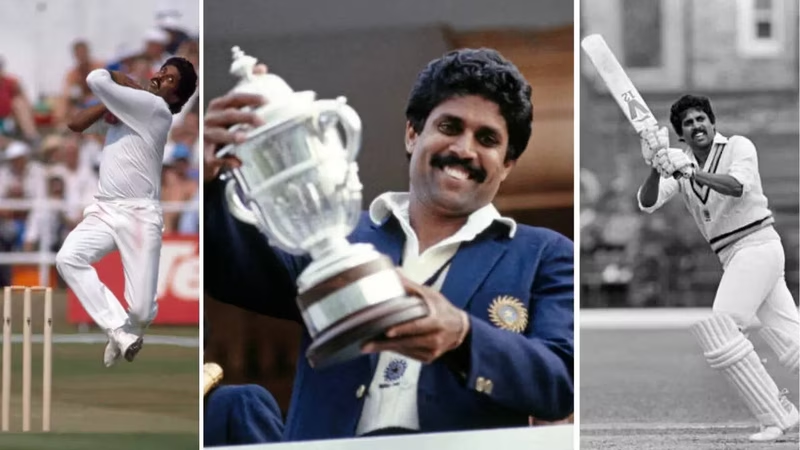
On this crisp January morning in 2026, as Kapil Dev celebrates his 67th birthday, the cricketing world isn’t just marking another year—it’s confronting an enduring truth: India has never truly replaced him.
He wasn’t the fastest bowler of his era. He didn’t rely on mystery spin or laser-guided yorkers. In fact, his Test strike rate—averaging fewer than four wickets per match—hardly screams statistical dominance . Yet, in an era shared with giants like Imran Khan, Ian Botham, and Richard Hadlee, Kapil carved a legacy that remains uniquely Indian and utterly irreplaceable.
What set him apart? Not raw pace, but relentless accuracy. Not flamboyance, but unmatched stamina. And above all, his ability to swing the ball away from right-handers with old leather—a skill that baffled batsmen on dead pitches and swinging conditions alike. But more than his skills, it was his spirit: fearless, selfless, and always ready to lead from the front.
Table of Contents
- Kapil Dev: The Complete Cricketing Package
- The 1983 World Cup: Moment That Defined a Generation
- Kapil Dev vs. The Four Horsemen of All-Round Greatness
- Why India Still Lacks a True Kapil Dev Successor
- Close Contenders: Who Came Near (But Not Quite)
- What Modern Coaching Can Learn From Kapil’s Playbook
- Honoring Kapil Dev at 67: More Than a Legend
- Sources
Kapil Dev: The Complete Cricketing Package
When we talk about all-rounders today, we often mean a specialist bowler who can hit sixes or a top-order batter who bowls part-time. But Kapil Dev was different. He was a genuine all-rounder in the truest sense: he opened the bowling in Tests, batted in the top six, captained the side with charisma, and fielded like a panther.
His career stats tell only part of the story: 434 Test wickets (a world record when he retired) and 5,248 runs. But his value was in his *availability*. He bowled 40,000+ balls in Tests—more than almost any fast bowler of his time. He once bowled 48 consecutive overs against Pakistan in 1982—a feat of endurance modern athletes can scarcely imagine .
The 1983 World Cup: Moment That Defined a Generation
No legacy is complete without context—and Kapil’s crowning achievement remains the 1983 World Cup. At just 24, he became the youngest captain to lift the trophy. But it was his innings of 175* against Zimbabwe at Tunbridge Wells—played with no official scorer, no backup bat, and India at 17/5—that saved the campaign .
And in the final against the mighty West Indies, his gravity-defying running catch to dismiss Viv Richards shifted the match irrevocably. It wasn’t just skill; it was belief. As Sunil Gavaskar later noted, “Kapil made us believe we belonged on that stage.”
Kapil Dev vs. The Four Horsemen of All-Round Greatness
The late 70s and 80s were blessed with four legendary all-rounders—often called the “Fab Four”:
- Imran Khan (Pakistan): The cerebral leader with lethal reverse swing.
- Ian Botham (England): The explosive match-winner with bat and ball.
- Richard Hadlee (New Zealand): The technically perfect swing bowler and gritty lower-order batter.
- Kapil Dev (India): The tireless workhorse with swing, stamina, and heart.
While the others operated in stronger bowling units, Kapil often carried India’s entire pace attack on his shoulders. His greatness wasn’t just in performance—it was in *context*.
Why India Still Lacks a True Kapil Dev Successor
Since his retirement in 1994, India has tried—and failed—to find a like-for-like replacement. Why?
- Specialization over versatility: Modern academies groom players as batters OR bowlers early on. The physical demands of excelling at both are now seen as mutually exclusive.
- Injury risks: All-rounders face higher workload, and with IPL’s intensity, teams prefer specialists to manage player longevity.
- Mental load: The pressure to perform with both bat and ball in high-stakes cricket is immense—few have Kapil’s mental fortitude.
[INTERNAL_LINK:evolution-of-all-rounders-in-indian-cricket]
Close Contenders: Who Came Near (But Not Quite)
- Ravindra Jadeja: Over 250 international wickets and 5,000+ runs, but primarily a bowler who bats—a role reversal of Kapil’s identity.
- Irfan Pathan: His 2003–06 peak showed promise (hat-trick on debut, batting at No. 3), but he lost swing and consistency.
- Hardik Pandya: A white-ball powerhouse, but his red-ball fragility and injury history limit his all-round impact in Tests.
What Modern Coaching Can Learn From Kapil’s Playbook
Kapil’s career offers timeless lessons:
- Build stamina, not just speed: His endurance was his secret weapon.
- Master the basics: Swing with the old ball, line and length—skills neglected in the age of pace and variations.
- Lead by example: He never asked teammates to do what he wouldn’t do himself.
The International Cricket Council (ICC) has often cited Kapil as a model of leadership and resilience—qualities beyond metrics .
Honoring Kapil Dev at 67: More Than a Legend
As Kapil Dev turns 67, his legacy isn’t just in records or trophies—it’s in the shift he triggered in the Indian cricketing psyche. He proved India could not only compete but conquer on the world stage. He redefined what an Indian fast bowler—and all-rounder—could be.
Until India produces another player who can open the bowling, anchor the middle order, and inspire a team to believe in the impossible, Kapil’s throne remains unchallenged. And perhaps, that’s exactly how it should be.
Sources
- Times of India: “Kapil Dev turns 67: The all-rounder Indian cricket never replaced”
- ESPNcricinfo Player Profile: Kapil Dev Career Statistics
- Interviews with former teammates (Gavaskar, Srikkanth) on 1983 World Cup
- ICC Hall of Fame archives and leadership studies
- Historical match reports from the 1982 India vs Pakistan Test series