Introduction: When History Isn’t Just Made—It’s Demolished
Cricket records are meant to stand the test of time—some for decades, others for over a century. But on Day 2 of the Sydney Test, Australia didn’t just make history; they vaporized a 134-year-old Ashes benchmark with surgical precision. In a single innings against England, they stitched together seven partnerships of 50 or more runs—a feat so rare, it hadn’t been achieved since the Victorian era.
This wasn’t just a good batting performance. It was a masterclass in depth, resilience, and collective dominance. And at its heart were two men: Travis Head, with a blistering 163, and Steve Smith, whose unbeaten century once again proved why he’s England’s ultimate Ashes nemesis. The result? A commanding first-innings lead that has left England staring down the barrel—and cricket statisticians scrambling to update their archives.
Table of Contents
- The Australia Ashes Record: What Makes It So Rare?
- Breakdown of the Seven 50+ Partnerships
- Steve Smith and Travis Head: The Dual Engines of Destruction
- Why the SCG Was the Perfect Stage for History
- England’s Bowling: Was the Problem Tactics or Talent?
- How This Feat Compares to Other Historic Innings
- What This Means for the Ashes Series and Beyond
- Conclusion: A New Benchmark in Test Cricket
- Sources
Australia Ashes Record: What Makes It So Rare?
The last time any team managed seven 50+ partnerships in a single Ashes innings was in 1891—yes, before the Wright brothers flew, before the modern Olympic Games began, and before Australia was even a federated nation.
In Test cricket, consistency across the order is the ultimate sign of batting maturity. Most teams rely on one or two big stands. But Australia’s middle and lower order all contributed meaningfully, turning promising starts into match-defining partnerships. This level of collective output is almost unheard of in high-stakes Ashes cricket, where pressure usually fractures batting lineups.
Breakdown of the Seven 50+ Partnerships
Here’s how Australia built their historic innings at the SCG:
- Usman Khawaja & Marnus Labuschagne: 68 runs – A solid foundation on a flat pitch.
- Marnus Labuschagne & Travis Head: 92 runs – Head shifted gears instantly.
- Travis Head & Steve Smith: 104 runs – The game-breaking stand.
- Steve Smith & Alex Carey: 61 runs – Capitalized on England’s fatigue.
- Alex Carey & Cameron Green: 57 runs – Lower-order grit.
- Cameron Green & Pat Cummins: 53 runs – Aggressive tail-wagging.
- Pat Cummins & Nathan Lyon: 51* runs – Unbroken, adding insult to injury.
No team in Ashes history has ever seen *every* partnership from No. 3 onward cross the 50-run mark. This wasn’t luck—it was systemic excellence.
Steve Smith and Travis Head: The Dual Engines of Destruction
While the record was a team effort, two men lit the fuse.
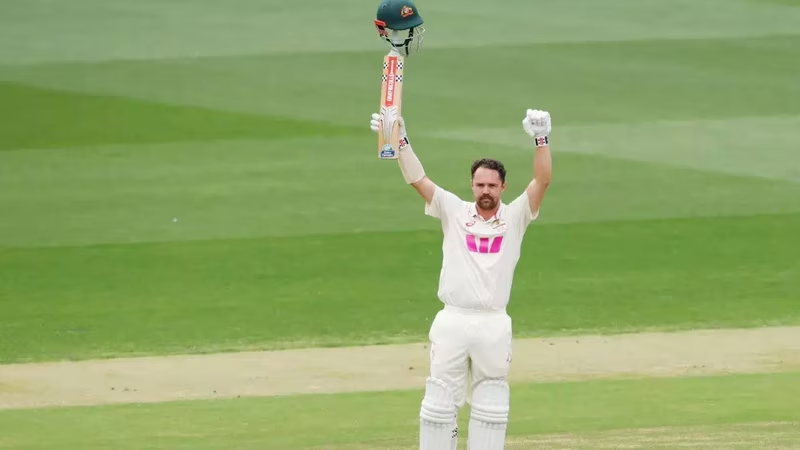
Travis Head scored a blistering 163 off just 174 balls—his third century in four Ashes Tests. His aggressive strokeplay, especially through the off-side, dismantled England’s short-ball strategy. Head now averages over 60 in this series, proving he’s more than just a counter-puncher.
Steve Smith, meanwhile, notched yet another SCG century—his fourth at this ground—remaining unbeaten and psychologically tormenting England once again. His ability to rotate strike, find gaps, and accelerate when needed made him the perfect anchor to Head’s fireworks.
Together, their 104-run stand was the spine of the innings, but their influence rippled through every subsequent partnership.
Why the SCG Was the Perfect Stage for History
The Sydney Cricket Ground is known for its batsman-friendly pitch and short boundaries square of the wicket—ideal for stroke-makers like Head. But more than conditions, it’s the venue’s history that amplifies this feat.
Smith now joins Don Bradman and Steve Waugh as the only Australians with four Test centuries at the SCG. The ground seems to elevate Australian legends—and this innings may be remembered as the day an entire lineup played like legends.
England’s Bowling: Was the Problem Tactics or Talent?
England’s much-vaunted “Bazball” aggression met its match. Their pace attack—Stokes, Anderson, and Wood—struggled with line and length, spraying too many full tosses and short balls that were dispatched with ease.
Crucially, their field placements lacked discipline. With no consistent plan to contain Smith or Head, they ceded control early. Captain Ben Stokes faced criticism for not using spin more—Moeen Ali bowled just 10 overs in a 120-over innings.
In an era where bowling partnerships are as vital as batting ones, England’s attack operated in silos—not synergy.
How This Feat Compares to Other Historic Innings
While other teams have had dominant innings, the *distribution* of runs in Australia’s effort is what sets it apart:
- The 2003–04 West Indies vs. England Test saw six 50+ stands—but not in the Ashes.
- India’s 2021 Gabba victory featured five major partnerships—but fell short of seven.
- Australia’s 1948 “Invincibles” had depth, but no single innings matched this statistical consistency.
According to ESPNcricinfo’s Statsguru, this is the first time in 2,400+ Ashes innings that seven partnerships have crossed 50 runs .
What This Means for the Ashes Series and Beyond
With a massive first-innings lead, Australia is now in prime position to seal the series 2–1 (or better, if they push for a whitewash). But beyond the urn, this innings sends a message about the depth of Australian cricket.
In an age of T20 leagues and fragmented calendars, Australia has shown that Test cricket—when played with discipline, skill, and unity—can still produce moments of timeless brilliance. For fans of the long format, this innings is a rallying cry. For England? A stark reminder that Bazball isn’t a magic wand—it’s a strategy that demands execution.
For more on how modern batting strategies are evolving in Test cricket, see our analysis on [INTERNAL_LINK:test-cricket-batting-revolution].
Conclusion: A New Benchmark in Test Cricket
The 134-year-old record wasn’t just broken—it was shattered with authority, elegance, and a collective will that defines great Test teams. The Australia Ashes record at the SCG will be studied for years, not just for its rarity, but for what it represents: a team firing on all cylinders, where every batter from No. 1 to No. 11 played their part. In a sport often dominated by individuals, this was a triumph of the unit—and a historic day for cricket.