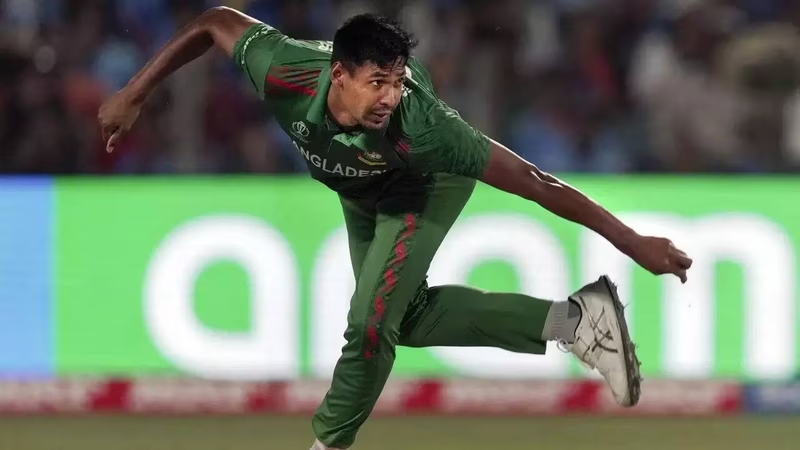
The stage is set for a major crisis just weeks before the start of the ICC Men’s T20 World Cup. In an unprecedented move that threatens the integrity of the tournament, the Bangladesh Cricket Board (BCB) has drawn a hard line in the sand, telling the International Cricket Council (ICC) in no uncertain terms: “We will not play in India.”
This isn’t a vague threat or a negotiating ploy. It’s a full-blown ultimatum driven by deep-seated security concerns, crystallized by the recent and controversial early exit of their star pacer, Mustafizur Rahman, from the Indian Premier League. The BCB is now demanding that its group-stage matches be moved to a neutral venue—specifically Sri Lanka—or be prepared to forfeit them. The cricketing world is now watching, wondering if the ICC can avert a disaster that could reshape the entire tournament.
Table of Contents
- The BCB’s Ultimatum: No Compromise on Safety
- The Mustafizur Rahman Flashpoint
- The ICC’s Delicate Balancing Act
- Why Sri Lanka is the Preferred Alternative
- The Nuclear Option: What a Walkover Would Mean
- A History of Security Disputes in Cricket
- Final Thoughts: A Test of the ICC’s Authority
- Sources
The BCB’s Ultimatum: No Compromise on Safety
BCB Director Asif Akbar has been unequivocal. In his official statement, he declared that Bangladesh’s participation in the T20 World Cup is contingent on the relocation of their matches away from India. “We are ready to face the consequences, including taking walkovers,” Akbar stated, signaling that the board is prepared to sacrifice its tournament chances for the sake of its players’ safety .
This stance is a direct result of the BCB’s assessment that the current security environment in India is not conducive for its national team. The board’s position is that player welfare is non-negotiable and supersedes all other considerations, including sporting competition and financial implications. This hardline approach puts immense pressure on the ICC to find a swift and acceptable solution.
The Mustafizur Rahman Flashpoint
The entire dispute crystallized around the case of Mustafizur Rahman. His sudden and early release from his IPL franchise, officially for “personal reasons,” has been interpreted by Dhaka as a quiet confirmation of underlying security issues that were not being publicly acknowledged .
For the BCB, if a high-profile player in the tightly controlled, high-security bubble of the IPL felt compelled to leave, it raises serious red flags about the safety of an entire national team traveling to play in a high-profile, high-visibility event like the T20 World Cup. Mustafizur’s exit is no longer just a personal matter; it has become the central piece of evidence in Bangladesh’s security dossier against playing in India.
The ICC’s Delicate Balancing Act
The ICC finds itself in an almost impossible position. On one hand, it must uphold its duty of care to all participating teams and ensure their safety. On the other, it is contractually and logistically bound to its primary host, India. The ICC has responded “positively” to the BCB’s concerns, assuring them of its “cooperation and security planning” .
However, “positive” assurances may not be enough for the BCB. The real test will be whether the ICC can provide concrete, verifiable guarantees that satisfy Dhaka’s requirements. The ICC’s ability to manage this crisis will be a major test of its leadership and its capacity to manage the complex political and security dynamics of modern international sport.
Why Sri Lanka is the Preferred Alternative
Bangladesh has explicitly named Sri Lanka as its preferred alternative venue. This choice is strategic for several reasons:
- Geographical and Cultural Proximity: Sri Lanka is a familiar environment for the Bangladeshi team, minimizing travel fatigue and cultural adjustment issues.
- Existing Infrastructure: Sri Lanka has world-class cricket stadiums that have hosted numerous ICC events, including the 2011 World Cup final.
- Neutral Ground: As a fellow South Asian nation but not the primary host, Sri Lanka offers a politically neutral setting.
- Precedent: The 2021 T20 World Cup was successfully shifted to the UAE and Oman, proving that the ICC can relocate matches to a co-host or alternative venue if necessary.
The Nuclear Option: What a Walkover Would Mean
If the ICC fails to act, the BCB has made it clear it will instruct its team to forfeit its matches. The consequences of such a walkover would be severe:
- Sporting Integrity: The tournament’s competitive balance would be destroyed, giving an unfair advantage to Bangladesh’s group opponents.
- Financial Fallout: Broadcasters, sponsors, and ticket holders would face massive losses and potential legal challenges.
- Reputational Damage: The ICC’s credibility as a global governing body would be severely damaged, raising questions about its ability to manage future events in politically sensitive regions.
A History of Security Disputes in Cricket
This is not the first time security concerns have threatened a major cricket tournament. The attack on the Sri Lankan team bus in Lahore in 2009 led to Pakistan’s effective exile from hosting international cricket for a decade. More recently, teams have expressed reservations about touring certain countries due to political instability. These precedents show that while rare, the threat of a team withdrawing for security reasons is a real and potent one that governing bodies must take seriously .
For a deeper look at the politics of cricket hosting, see our analysis on [INTERNAL_LINK:how-politics-affects-icc-tournament-hosting].
Final Thoughts: A Test of the ICC’s Authority
The BCB’s ultimatum over the T20 World Cup is a defining moment for international cricket. It forces a direct confrontation between a nation’s sovereign right to protect its citizens and a global body’s mandate to deliver a seamless sporting event. The ICC now has a narrow window to broker a solution—most likely the relocation of Bangladesh’s matches to Sri Lanka—that satisfies Dhaka’s security demands without completely unraveling its plans for India. The world is watching to see if the ICC can rise to this extraordinary challenge.
Sources
BCB Director Asif Akbar stated Bangladesh “will not play in India” and is “ready to take walkovers” if safety concerns are not met.
The BCB’s concerns were heightened by Mustafizur Rahman’s early exit from the IPL, which they see as evidence of an unsafe environment.
The ICC has responded positively to the BCB, assuring cooperation and a focus on security planning for the T20 World Cup.
Historical precedents, like the 2009 Lahore attack, have shown that security concerns can lead to the relocation of entire international cricket schedules.
Original Reporting: ‘Will not play in India, but ready to …’: BCB director warns ICC.