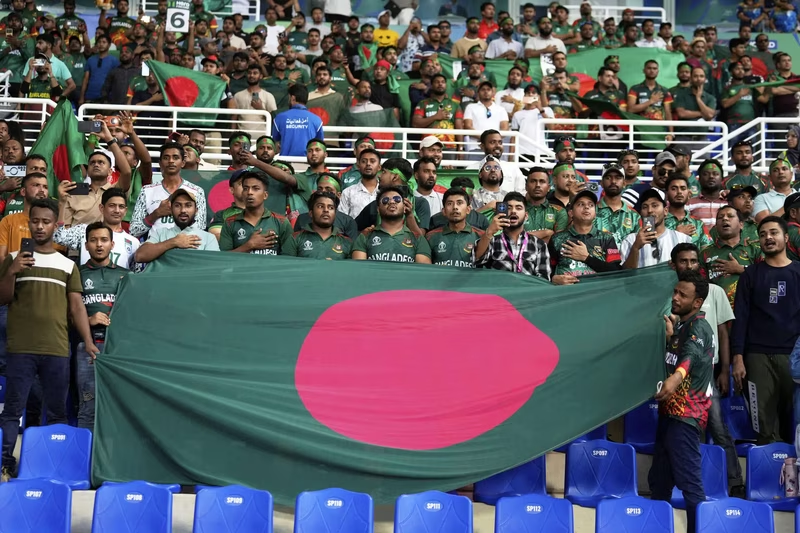
The cricketing world is on the edge of its seat as Bangladesh delivers a stunning ultimatum to the International Cricket Council (ICC): relocate our T20 World Cup matches from India, or we simply won’t play. Citing an existential threat to ‘national dignity’ and serious security concerns, Dhaka has thrown the 2026 tournament into a state of uncertainty, setting its sights on Sri Lanka as the only acceptable alternative.
Table of Contents
- Bangladesh’s Dramatic Statement on National Dignity
- Security Concerns and the Mustafizur Rahman Incident
- Why Sri Lanka is the Chosen Land
- The ICC’s Response and the Road Ahead
- What This Means for the T20 World Cup
- Conclusion
- Sources
Bangladesh’s Dramatic Statement on National Dignity
The Bangladesh government, speaking through its sports adviser and the Bangladesh Cricket Board (BCB), has taken an uncompromising stance. They have made it clear that their participation in the T20 World Cup is not a foregone conclusion. “No World Cup at the cost of national dignity,” has become their rallying cry. The BCB believes the ICC has fundamentally misunderstood the gravity of their situation and has formally requested a venue shift.
This isn’t just about logistics; it’s a matter of principle for a nation that feels its sovereignty and the safety of its citizens have been compromised. The BCB has stated that their team “will not travel to India,” framing the issue as a non-negotiable point of national respect .
Security Concerns and the Mustafizur Rahman Incident
While ‘national dignity’ is the headline-grabbing phrase, the core of the issue stems from a tangible security incident involving star pacer Mustafizur Rahman. Though the BCB has been careful not to over-elaborate in public, reports suggest that an event during a recent IPL stint in India left the player and the board with severe concerns about the well-being of their contingent .
The BCB’s official position emphasizes the “safety and well-being of Bangladeshi players, team officials, [and] Board members” as their primary driver for the request . This has led to a situation where the board is willing to forgo its place on cricket’s biggest T20 stage rather than risk its players’ security, a stance that adds significant weight to their demands.
Why Sri Lanka is the Chosen Land
The BCB hasn’t just said ‘no’ to India; it has a specific ‘yes’ in mind. Their formal request to the ICC is to relocate their matches to Sri Lanka. This isn’t a random choice. Sri Lanka is a co-host for the 2026 T20 World Cup, with a proven track record of hosting major ICC events, including the 2012 T20 World Cup .
The infrastructure is already in place. Key venues like Colombo’s R. Premadasa Stadium, the Pallekele International Stadium in Kandy, and the Sinhalese Sports Club are all confirmed to be part of the tournament . From a logistical and security standpoint, Sri Lanka presents a viable, familiar, and friendly environment for the Bangladeshi team. The sports adviser for the Bangladesh government has been vocal in pushing for this specific alternative .
The ICC’s Response and the Road Ahead
The ICC, for its part, appears to be standing firm. In its official communications, it has stated that it “doesn’t see any security issues in India for Bangladesh” . The global governing body is likely keen to avoid setting a precedent where political or diplomatic tensions can dictate tournament logistics.
However, the situation remains fluid. The BCB has confirmed it is in direct talks with the ICC to “convince them of the gravity of their security concerns” . The path forward hinges on whether the ICC will accept Bangladesh’s evidence and reasoning or if it will hold its ground, potentially forcing Bangladesh to make the ultimate decision of withdrawal. Notably, the BCB has denied reports of any ICC ‘ultimatum,’ suggesting a more complex negotiation is underway .
What This Means for the T20 World Cup
This standoff has massive implications for the tournament scheduled to run from February 7 to March 8, 2026 . If Bangladesh withdraws, it would be a significant blow to the competition’s integrity, especially in Group C where they are slated to play key matches . The ICC would have to scramble to find a replacement or restructure the group stage.
On the other hand, a successful venue shift would be an extraordinary logistical feat but would preserve the tournament’s competitive balance. It would also set a significant, though controversial, precedent for how athlete safety and national sentiment are weighed against commercial and sporting interests in global events. This is a scenario that goes far beyond a simple fixture change; it’s a test of the ICC’s crisis management and its relationship with its member nations.
Conclusion
Bangladesh’s refusal to play the T20 World Cup in India is a seismic event in international cricket. By tying their participation to the non-negotiable principles of national dignity and player security, and by specifically requesting Sri Lanka as a host, Dhaka has forced the ICC into a corner. The coming weeks of negotiations will be critical. Will the ICC bend to accommodate its member board’s profound concerns, or will we see a major team absent from the world’s premier T20 tournament? The entire cricketing world is watching.
Sources
- ESPNcricinfo: Bangladesh firm on T20 World Cup stance
- ICC: Bangladesh to ‘work with ICC’ on T20 World Cup security
- The Guardian: Bangladesh Pushes for Venue Shift After ICC Letter on T20 World Cup
- ESPNcricinfo: ICC T20 World Cup 2026 schedule announced
- ICC: T20 World Cup 2026 to be hosted by India and Sri Lanka