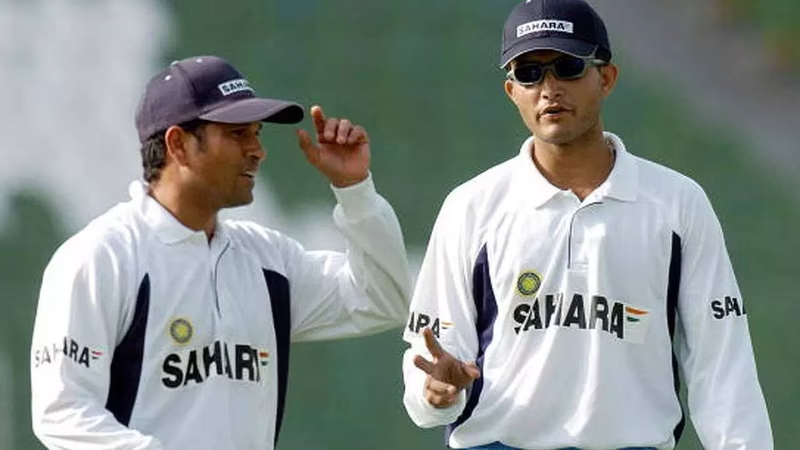
In an era often dominated by fierce on-field rivalry and off-field political tension, a remarkable story of sportsmanship and mentorship has resurfaced, reminding us of cricket’s unique power to bridge divides. Former Bangladesh top-order batter Rajin Saleh has opened up about a pivotal moment in his career, crediting none other than India’s most iconic cricketing figures—Sachin Tendulkar and Sourav Ganguly—for his breakthrough performance during a challenging tour in 2004 .
This anecdote is more than just a nostalgic trip; it’s a powerful counter-narrative to the often-fraught relationship between the two cricketing nations, offering a glimpse into a time when mutual respect transcended competition .
Table of Contents
- A Turning Point in the 2004 India-Bangladesh Series
- Sachin Tendulkar’s “Mental Reset” Advice
- Sourav Ganguly’s Call for Fearless Cricket
- The Impact and Rajin Saleh’s Career-Defining Innings
- A Legacy of Mentorship and Cricket Diplomacy
- Conclusion: A Timeless Lesson in Sportsmanship
- Sources
A Turning Point in the 2004 India-Bangladesh Series
The 2004 tour of India was a baptism by fire for many young Bangladeshi players. The team was struggling to find its footing on the international stage, and the series against a dominant Indian side, fresh off a successful campaign, was a daunting prospect . For Rajin Saleh, a promising talent known for his solid technique, the pressure was immense. After a few low scores, he found himself in a deep batting slump, a familiar and frustrating place for any professional cricketer.
It was during this period of personal and professional difficulty that an unexpected hand of friendship and guidance reached out from the opposing camp.
Sachin Tendulkar’s “Mental Reset” Advice
The “God of Cricket,” Sachin Tendulkar, known for his incredible focus and mental fortitude, shared a piece of wisdom that was both simple and profound. He advised the young Saleh to mentally reset after every single innings .
“He told me to forget the past innings, whether it was good or bad, and start fresh every time I walked out to bat,” Saleh recalled. This philosophy, central to Tendulkar’s own legendary career, is about shedding the emotional baggage of past failures or successes to maintain a clear, present-focused mindset. For a player bogged down by the weight of expectation and a string of failures, this advice was a lifeline .
Sourav Ganguly’s Call for Fearless Cricket
Complementing Tendulkar’s mental strategy, the Indian captain at the time, the aggressive and bold Sourav Ganguly, offered his own brand of mentorship. Ganguly, who had famously warned his own team against taking Bangladesh lightly , urged Saleh to play without fear .
“Dada told me to just go out and express myself,” Saleh remembered. Ganguly’s famous “fearless” approach to the game was a stark contrast to the defensive, survival-mode mindset that can often grip a player from a developing cricketing nation against a top-tier opponent. His advice was to trust his ability and play his natural game, a message that resonated deeply.
The Impact and Rajin Saleh’s Career-Defining Innings
The combined wisdom of these two Indian giants had an immediate and dramatic effect. In the very next match of the ODI series, the third ODI in Dhaka on December 27, 2004, Rajin Saleh played one of the finest innings of his career, scoring a brilliant 82 runs .
This knock was not just a personal triumph; it was a statement of intent for Bangladesh, showcasing their batting potential on a big stage. Saleh has since credited this innings directly to the timely and invaluable advice from Tendulkar and Ganguly, a moment that cemented a lifelong respect for his Indian counterparts.
A Legacy of Mentorship and Cricket Diplomacy
The story of Rajin Saleh’s encounter with Tendulkar and Ganguly is a powerful example of cricket’s role as a diplomatic tool. The India-Bangladesh cricketing relationship, which began in earnest in the early 2000s, has been a crucial part of Bangladesh’s integration into the global cricket community . India has played a significant role in the growth of Bangladesh cricket, from sharing expertise to providing high-level competition .
Furthermore, this incident highlights a lesser-known but important aspect of legends like Sachin Tendulkar: their willingness to mentor and guide players from other nations. Tendulkar’s belief that a good coach or mentor should be “a player’s friend” regardless of nationality is perfectly illustrated in this 2004 encounter. It shows that true greatness extends beyond personal records and includes lifting others up.
This spirit of mentorship is not an isolated incident. Tendulkar has been involved in various initiatives to nurture young talent globally, and this story from two decades ago shows that his generosity of spirit was always a part of his character .
Conclusion: A Timeless Lesson in Sportsmanship
In today’s hyper-competitive and often divisive sporting landscape, Rajin Saleh’s story serves as a beautiful and necessary reminder. It proves that on the cricket field, respect and mutual learning can coexist with fierce competition. The advice from Tendulkar and Ganguly didn’t just help a young player score runs; it built a bridge of goodwill between two nations.
As political and sporting tensions between India and Bangladesh occasionally flare up, this anecdote from 2004 stands as a timeless testament to the unifying power of the game. It’s a story every cricket fan should know—a story where the real victory wasn’t on the scoreboard, but in the spirit of sportsmanship that prevailed.
Sources
- Times of India: Mustafizur Rahman controversy: Amid India-Bangladesh tensions, ex-Bangladesh player recalls help from Sachin Tendulkar, Sourav Ganguly (Exclusive)
- ESPNcricinfo: India in Bangladesh, 2004-05 One-Day Series Highest Individual Scores
- PTI Archives: Ganguly warns team against taking Bangladesh lightly (December 9, 2004)
- The Diplomat: Cricket as a Bridge of Unity: How India and Bangladesh Strengthen Ties (September 28, 2024)
- Hindustan Times: Good coach should be a player’s friend: Tendulkar (November 17, 2013)
- International Cricket Council (ICC)
- [INTERNAL_LINK:india-bangladesh-cricket-rivalry-history]
- [INTERNAL_LINK:sachin-tendulkar-mentorship-legacy]