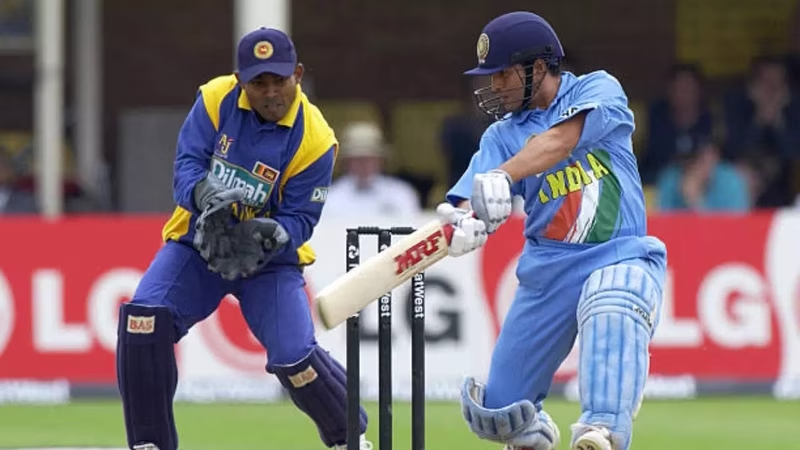
It’s one of the greatest underdog stories in sporting history. In 1996, a team from a nation with no prior major ICC trophy to its name defied all odds to become world champions. But their path to glory wasn’t paved just with skill and grit—it was built on a single, revolutionary, and what many called a reckless ‘punt’. This is the story of how Sri Lanka’s 1996 Cricket World Cup triumph was born from a tactical masterstroke that changed the game forever.
Table of Contents
- The State of ODI Cricket Before 1996
- The Bold ‘Punt’: A New Philosophy is Born
- Execution: The Jayasuriya-Kaluwitharana Revolution
- The Road to the Final: Overcoming Adversity
- The Final and the Legacy of a Gamble
- Conclusion: Why the ‘Punt’ Matters Today
- Sources
The State of ODI Cricket Before 1996
Before the 1996 Cricket World Cup, the opening 15 overs of an ODI innings were a cautious affair. The fielding restrictions were in place, but conventional wisdom dictated a conservative approach. Openers were tasked with seeing off the new ball, preserving wickets, and laying a ‘foundation’ for the middle order to accelerate later. It was a formula followed by every top team, from Australia to the West Indies.
Sri Lanka, however, saw an opportunity where others saw only risk. They recognized that the fielding restrictions were not a defensive shield but an offensive weapon waiting to be unleashed .
The Bold ‘Punt’: A New Philosophy is Born
The mastermind behind this radical shift was captain Arjuna Ranatunga, working closely with coach Dav Whatmore and the team’s think-tank. Their ‘punt’ was simple yet revolutionary: if they won the toss, they would choose to chase. More importantly, they would instruct their openers to attack from the very first over, treating the fielding restrictions as a powerplay to be exploited, not endured .
This decision flew in the face of established cricketing dogma. Many experts and former players openly criticized the strategy, calling it irresponsible and unsustainable . But Ranatunga and his team were convinced. They had practiced this approach relentlessly, turning a high-risk gamble into a well-drilled tactic.
Execution: The Jayasuriya-Kaluwitharana Revolution
The success of this strategy hinged entirely on two men: Sanath Jayasuriya and Romesh Kaluwitharana. They weren’t just openers; they were shock troops. Their mission was to dismantle the opposition’s bowling attack in the first 15 overs, scoring at a rate previously unseen in the game .
Their aggressive style, which “very much resembled the flamboyant Caribbean style,” was perfectly suited to the task . Jayasuriya, with his immense power, and Kaluwitharana, with his fearless strokeplay, formed a partnership that terrified bowlers and redefined the role of an ODI opener. This duo became the living embodiment of Sri Lanka’s tactical ‘punt’, and their performances were the engine of their World Cup campaign.
The Road to the Final: Overcoming Adversity
Sri Lanka’s journey wasn’t without controversy. Their dominance in the group stage, finishing top with a 5-0 record, was aided by the forfeits of both Australia and the West Indies, who refused to play in Colombo due to security concerns . This meant Sri Lanka marched into the knockout stages with momentum and a full head of steam.
In the semi-final against India in Kolkata, their strategy faced its ultimate test. As chaos erupted in the stands with “glass bottles rain[ing] onto the outfield and fires rag[ing] in the stands,” the match was eventually awarded to Sri Lanka by match referee Clive Lloyd . While the circumstances were unfortunate, there was no denying the fear Sri Lanka had already instilled in their opponents through their explosive brand of cricket.
The Final and the Legacy of a Gamble
The final against Australia in Lahore was the perfect showcase for their philosophy. Chasing a target of 242, the Sri Lankan openers once again provided a flying start. The middle order, led by Aravinda de Silva’s magnificent century, finished the job with ease, winning by 7 wickets and losing only 3 .
Their victory was more than just a trophy; it was a validation of their entire approach. Sri Lanka had proven that their ‘punt’ was not a fluke but a blueprint for modern ODI success. They were “pioneers of a new approach to ODI cricket, emphasizing aggressive batting from the very start of the innings” . Every team that has since adopted an aggressive powerplay strategy owes a debt to that 1996 Sri Lankan side.
Conclusion: Why the ‘Punt’ Matters Today
Thirty years on, the legacy of that single, daring decision during the buildup to the 1996 Cricket World Cup is undeniable. It transformed ODI cricket from a patient, attritional battle into the dynamic, high-octane spectacle we know today. What was once dismissed as a reckless gamble is now standard operating procedure for every top team. Sri Lanka’s triumph stands as a timeless reminder that in sport, as in life, the biggest rewards often come from having the courage to make the boldest ‘punt’. For a deeper dive into legendary captaincy, check out our analysis on [INTERNAL_LINK:greatest-cricket-captains].
Sources
- Times of India: Thirty years ago, a punt helped the country to World Cup triumph
- Thuppahi’s Blog: Arjuna Ranatunga’s Wide-ranging Review of the World Cup Win [[1], [9]]
- ESPNcricinfo: Lessons from 1996 World Cup: The Perfect Competitive Storm
- ICC Official Records: 1996 Cricket World Cup Final Scorecard
- Wisden Almanack: The Lankan lions roar – 1996
- [INTERNAL_LINK:history-of-odi-cricket]