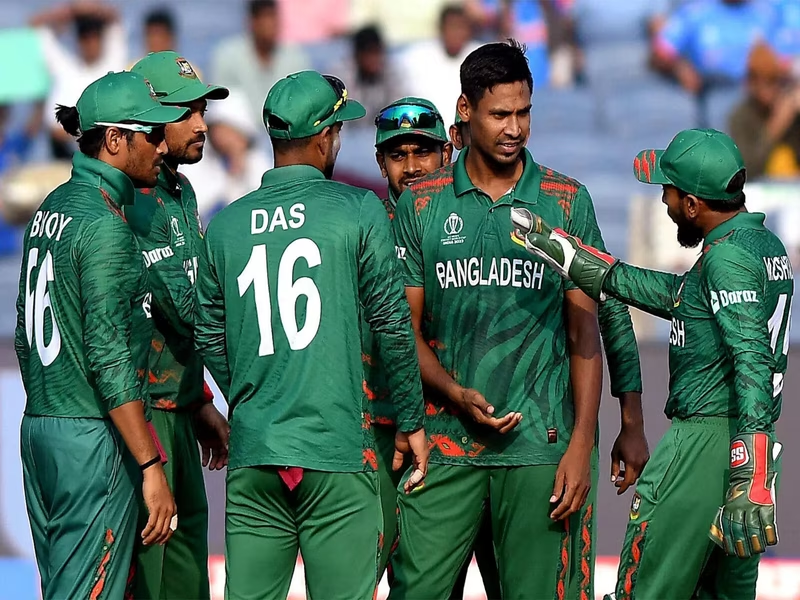
The world of cricket is rarely just about the game on the field. Sometimes, geopolitics, public sentiment, and corporate decisions collide with devastating force. This is the harsh reality facing Bangladesh cricket right now, as it navigates its most severe Bangladesh cricket crisis in recent memory—a perfect storm ignited by a single controversial decision in the IPL.
What began as the release of star pacer Mustafizur Rahman from his Kolkata Knight Riders contract has spiraled into a full-blown diplomatic and financial emergency for the sport in Bangladesh . The fallout is two-pronged: a mass exodus of crucial Indian sponsorship and an unprecedented challenge to their very participation in the upcoming ICC Men’s T20 World Cup 2026.
Table of Contents
- The Mustafizur Spark: How an IPL Decision Lit the Fuse
- Sponsorship Exodus Hits Bangladeshi Players Hard
- BCB’s Bold Move: Requesting a World Cup Venue Change
- ICC’s Response and the Road Ahead for Bangladesh Cricket
- Conclusion: A Sport Caught in the Crossfire
- Sources
The Mustafizur Spark: How an IPL Decision Lit the Fuse
The entire crisis traces back to the 2026 Indian Premier League auction. Mustafizur Rahman, a fan favorite and a proven match-winner, was signed by the Delhi Capitals. However, within hours, he was released by the franchise after being “advised” to do so by the Board of Control for Cricket in India (BCCI) . While the official reasons were murky, widespread reports pointed to intense political and public pressure in India, creating a massive backlash in Bangladesh .
In Dhaka, this was perceived not as a simple sporting decision, but as a national insult. The Bangladesh government swiftly retaliated by banning all IPL broadcasts and promotions within the country . This tit-for-tat move escalated tensions to a level that now threatens the core of Bangladesh’s international cricketing future.
Sponsorship Exodus Hits Bangladeshi Players Hard
The immediate and tangible impact of this diplomatic chill is being felt in the bank accounts of Bangladesh’s top cricketers. Indian sports equipment giant Sanspareils Greenlands (SG), a long-time sponsor, has reportedly severed its ties with several key players, including star batter Litton Das . Other prominent names like Mominul Haque and Yasir Ali are also said to be affected by this sudden withdrawal of a critical income stream .
This sponsorship pullback is a significant blow. For many players, these deals represent a substantial portion of their earnings outside their central contracts with the Bangladesh Cricket Board (BCB). The loss of this financial security creates immense personal and professional uncertainty at a time when they should be focusing solely on their game.
BCB’s Bold Move: Requesting a World Cup Venue Change
Facing intense domestic pressure and citing serious security concerns for its players and staff, the BCB took a drastic step. It formally requested the International Cricket Council (ICC) to relocate all of Bangladesh’s group stage matches for the T20 World Cup 2026 from India to the tournament’s co-host, Sri Lanka .
The BCB’s stance is firm, framing the issue as a matter of national dignity. A senior official stated the team would not travel to India to avoid “national humiliation” in the wake of the Mustafizur incident . All of Bangladesh’s scheduled fixtures were initially set to be played on Indian soil, making this request a direct challenge to the tournament’s logistical framework .
ICC’s Response and the Road Ahead for Bangladesh Cricket
The ICC, tasked with maintaining the integrity and smooth operation of its flagship event, has so far rejected the BCB’s request to shift the matches . The governing body is reportedly working with the BCB to address their security concerns while maintaining the original schedule .
This leaves Bangladesh in an impossible position. A boycott of their World Cup matches would result in automatic forfeiture, a disastrous outcome for their ranking and reputation. On the other hand, sending their team to India under the current cloud of controversy could be politically untenable at home. The situation remains fluid, but the shadow of the Bangladesh cricket crisis looms large over the entire tournament. Experts from global risk consultancies like [Eurasia Group](https://www.eurasiagroup.net/) have noted that such sporting disputes can have long-lasting effects on bilateral economic and cultural ties.
Conclusion: A Sport Caught in the Crossfire
The current Bangladesh cricket crisis is a stark reminder that modern sport exists within a complex web of politics, commerce, and national identity. What started as a personnel decision in a private T20 league has now jeopardized player livelihoods, strained international relations, and cast doubt on a major global sporting event. The path forward is fraught with difficulty, and a resolution will require significant diplomatic finesse from all parties involved—far beyond the boundary ropes.
Sources
- The Times of India: Sponsors pull back, futures clouded: Bangladesh cricketers caught in India standoff
- ESPNCricinfo: Mustafizur Rahman released by Delhi Capitals after BCCI ‘advice’
- ICC Official Statement on T20 World Cup 2026 Security Protocols
- Our Coverage: The Most Controversial Moments of IPL 2026