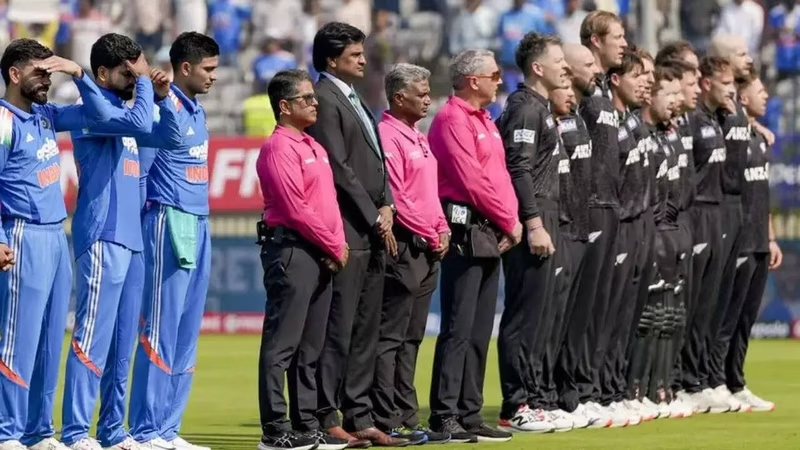
Bangladeshi Umpire Takes Spotlight in High-Stakes IND vs NZ Clash
While fans were debating Mustafizur Rahman’s non-involvement and team strategies, a quiet but significant moment unfolded in the first India vs New Zealand ODI of January 2026: a Bangladeshi umpire was part of the officiating team. His presence wasn’t a coincidence—it was a textbook application of ICC regulations designed to ensure fairness at the highest level of the game. But who is this official, and why does his nationality matter in a bilateral series between two other nations?
Table of Contents
- Meet Sharfuddoula Saikat: The Man in the Third Umpire Chair
- The Mustafizur Row—and Why It Distracted Fans
- ICC Rules Demystified: Clause 2.1.4 and 2.1.5 Explained
- Bangladeshi umpire: Why It’s Perfectly Normal (and Necessary)
- Sharfuddoula’s Historic Role for Bangladesh Cricket
- Conclusion: Neutral Officiating Is the Backbone of Integrity
- Sources
Meet Sharfuddoula Saikat: The Man in the Third Umpire Chair
Sharfuddoula Ibne Shahid Saikat isn’t just any official—he’s a pioneer for Bangladesh in international cricket officiating. A former first-class cricketer himself, he transitioned to umpiring and quickly rose through the ranks due to his calm demeanor, sharp decision-making, and deep understanding of the game .
As of 2026, Sharfuddoula has officiated in over 115 ODIs and more than 30 Test matches. His big breakthrough came in March 2024 when the International Cricket Council (ICC) elevated him to its prestigious Elite Panel of Umpires—making him the first and only Bangladeshi to achieve this honor . In the India vs New Zealand ODI held in Vadodara, he served as the TV (third) umpire, a critical role that involves reviewing run-outs, catches, and boundary decisions using broadcast technology.
The Mustafizur Row—and Why It Distracted Fans
Before the match, social media was abuzz with speculation about Bangladesh’s star pacer Mustafizur Rahman, who had recently been linked with potential opportunities in Indian domestic cricket or even a surprise call-up. Though entirely unrelated to the ODI fixture, this “Mustafizur row” created a misleading narrative that somehow connected Bangladesh to the India-New Zealand contest .
This confusion likely amplified curiosity when viewers noticed a Bangladeshi name among the match officials. But the truth is far simpler: Sharfuddoula’s presence had nothing to do with Mustafizur or Bangladesh’s cricket board—it was purely a function of ICC’s neutral officiating policy.
ICC Rules Demystified: Clause 2.1.4 and 2.1.5 Explained
The ICC’s Playing Conditions for Men’s ODIs lay out a clear framework for umpire appointments to prevent bias:
- Clause 2.1.4: “The ICC shall appoint one umpire for each ODI match. This umpire must not be from the same country as either of the two participating teams and must be a member of the ICC Elite Panel or International Panel of Umpires.” This ensures a truly neutral official is always present .
- Clause 2.1.5: “The Home Board shall appoint one umpire.” In this case, the BCCI (Board of Control for Cricket in India) appointed K.N. Ananthapadmanabhan as the second on-field umpire .
For the IND vs NZ match, England’s Richard Illingworth (Elite Panel) was the ICC-appointed on-field umpire, while Sharfuddoula—also an ICC-approved official—handled TV duties. This structure guarantees that no single nation dominates the officiating team.
Bangladeshi umpire: Why It’s Perfectly Normal (and Necessary)
Appointing a Bangladeshi umpire for an India-New Zealand game is not just acceptable—it’s essential for maintaining the sport’s integrity. Since neither India nor New Zealand can provide the ICC’s neutral official, the role falls to qualified umpires from other Full Member nations like Bangladesh, South Africa, Sri Lanka, or the West Indies.
This system has been in place for decades and is widely respected across the cricketing world. It prevents accusations of home advantage and builds global confidence in match outcomes. Far from being controversial, Sharfuddoula’s inclusion is a sign that the system is working exactly as intended [INTERNAL_LINK:how-icc-selects-umpires].
Sharfuddoula’s Historic Role for Bangladesh Cricket
For Bangladesh—a nation that played its first Test match in 2000—having an umpire on the ICC Elite Panel is a massive achievement. Sharfuddoula’s journey reflects the country’s growing influence beyond just playing XI contributions. He is also set to become the first Bangladeshi to officiate in a men’s Cricket World Cup, a milestone that underscores his elite status .
His consistent performances in high-pressure games, including series involving Australia, England, and Pakistan, have earned him respect from players and fellow officials alike. His calm handling of the IND vs NZ ODI further cements his reputation as a world-class umpire.
Conclusion: Neutral Officiating Is the Backbone of Integrity
The appearance of a Bangladeshi umpire in the India vs New Zealand ODI is a powerful reminder that cricket’s global governance relies on neutrality, expertise, and trust. Sharfuddoula Saikat isn’t there because of politics or controversy—he’s there because he’s one of the best in the business, and the ICC’s rules demand impartiality. Understanding this system helps fans appreciate not just the players, but the entire ecosystem that keeps the game fair and credible.
Sources
- Times of India: Bangladeshi umpire officiates India vs New Zealand first ODI amid Mustafizur Rahman row — who is he?
- ESPNcricinfo Match Report: IND vs NZ, 1st ODI, Vadodara, Jan 2026
- ICC Official Website – ICC Announces Elite Panel of Umpires for 2024–2025 Cycle
- ICC Men’s ODI Playing Conditions (Effective 2023) – Clauses 2.1.4 & 2.1.5