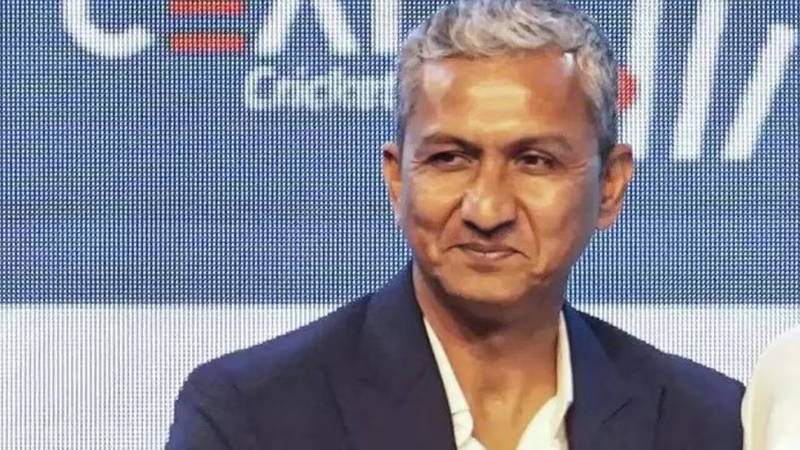
Cricket matches between India and New Zealand are always high-stakes affairs, but the first ODI of the series on January 10, 2026, will be remembered for something entirely off the pitch. During a live broadcast, former Indian cricketer and commentator Sanjay Bangar referred to Hindi as the “national language of India”—a statement that instantly went viral for all the wrong reasons .
The remark, made while discussing field placements with KL Rahul and Washington Sundar, triggered an immediate and fierce backlash across social media. Within minutes, viewers—especially from non-Hindi-speaking states—pointed out a fundamental truth: India does not have a national language. The controversy overshadowed New Zealand’s solid 300/8 total, powered by Daryl Mitchell’s 84, and reignited a decades-old debate about linguistic identity and federalism in India .
Table of Contents
- What Did Sanjay Bangar Actually Say?
- Why Calling Hindi the ‘National Language’ Is Factually Incorrect
- What the Indian Constitution Really Says
- The Social Media Firestorm and Regional Reactions
- Broader Implications: Language, Identity, and National Unity
- Conclusion: A Reminder of India’s Linguistic Pluralism
- Sources
What Did Sanjay Bangar Actually Say?
During a tactical discussion in the 35th over of New Zealand’s innings, Bangar remarked: “In our national language of India, which is Hindi…” before continuing his analysis . The comment appeared casual, likely unintentional—but in a country where language is deeply tied to cultural identity, such slips carry heavy weight.
While Bangar has not issued a formal apology as of this writing, the clip spread like wildfire, with users from Tamil Nadu, West Bengal, Karnataka, and other regions expressing frustration over what they see as the persistent erasure of their linguistic heritage in national discourse .
Why Calling Hindi the ‘National Language’ Is Factually Incorrect
This is not a matter of opinion—it’s a matter of constitutional fact. Despite common misconceptions, India has no national language. The idea that Hindi holds this status is a widespread myth, often repeated in schools, media, and even official settings—but it is simply untrue .
What India does have is an official language of the Union, and that is where Hindi (alongside English) comes in—but even that designation is limited and contested.
What the Indian Constitution Really Says
Article 343(1) of the Constitution of India clearly states: “The official language of the Union shall be Hindi in Devanagari script.” However, it immediately adds a crucial caveat: English would continue to be used for all official purposes for at least 15 years from the commencement of the Constitution—that is, until 1965 .
Due to strong opposition from non-Hindi states, the Official Languages Act of 1963 was passed, allowing English to remain in use indefinitely alongside Hindi for central government communication . This effectively created a bilingual system at the federal level.
Moreover, the Eighth Schedule of the Constitution originally recognized 14 languages. Today, it includes 22 officially recognized languages—from Assamese and Bengali to Tamil, Telugu, Marathi, and Urdu—each with equal constitutional dignity . None is designated as “national.”
As the Press Information Bureau (PIB), Government of India, explicitly clarifies: “There is no national language of India” .
The Social Media Firestorm and Regional Reactions
The backlash was swift and unrelenting:
- Tamil Twitter users shared memes highlighting Tamil’s 2,000-year literary history, questioning why their language—older than Hindi in its classical form—is often sidelined .
- Bengali netizens pointed to Rabindranath Tagore and the rich cultural legacy of their language, arguing that linguistic hierarchy undermines India’s federal spirit.
- Kannada and Malayalam speakers echoed similar sentiments, noting that such comments reinforce a “North Indian hegemony” in national narratives .
Even neutral observers criticized the remark as careless, especially coming from a public figure on a national broadcast. In a country where language movements have led to state reorganizations (like the creation of Andhra Pradesh in 1953), such statements are never just “slips of the tongue.”
Broader Implications: Language, Identity, and National Unity
This incident isn’t really about Sanjay Bangar. It’s about a recurring pattern in Indian public life where Hindi is casually elevated above other languages, often under the guise of “national unity.” But true unity doesn’t come from linguistic homogenization—it comes from respecting diversity.
[INTERNAL_LINK:india-official-languages-explained] explores how multilingualism is not a barrier to governance but a strength of Indian democracy.
For broadcasters, educators, and public figures, this moment serves as a critical reminder: accuracy matters. In a nation of 1.4 billion people speaking hundreds of languages, precision in language about language is not pedantry—it’s respect.
Conclusion: A Reminder of India’s Linguistic Pluralism
Sanjay Bangar’s comment may have been a fleeting moment in a cricket match, but its resonance speaks volumes about India’s unresolved tensions around language and identity. The phrase “national language of India” is a myth—one that continues to alienate millions of citizens whose mother tongues are just as Indian as Hindi. As the country marches toward greater inclusivity, it must start by acknowledging a simple truth enshrined in its own founding document: India’s strength lies in its plurality, not in a single imposed tongue. Let this controversy be a lesson—not in outrage, but in awareness.
Sources
- Times of India. (2026). Sanjay Bangar calls Hindi ‘national language of India’ on air, faces heavy backlash during 1st ODI. https://timesofindia.indiatimes.com/…/126465020.cms.
- Constitution of India, Article 343. https://www.india.gov.in/my-government/constitution-india.
- Press Information Bureau (PIB), Government of India. (2023). FAQs on Official Language. https://pib.gov.in/PressReleasePage.aspx?PRID=1924218.
- Official Languages Act, 1963. Ministry of Home Affairs, Government of India.