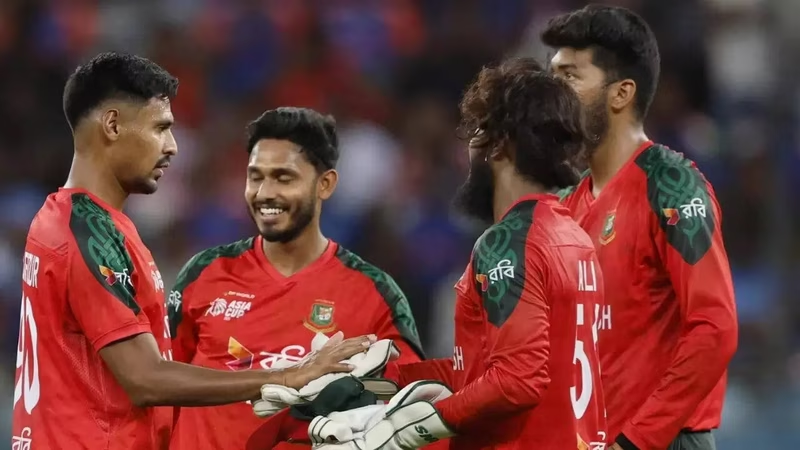
The world of cricket is no stranger to drama, but the latest clash between Bangladesh and the International Cricket Council (ICC) over the upcoming T20 World Cup 2026 in India has taken things to a whole new level. At the heart of this controversy lies a stunning accusation from a top Bangladeshi official—and an even more stunning rebuttal from the sport’s global governing body.
In a move that sent shockwaves through the cricketing community, Bangladesh’s sports advisor publicly claimed that the ICC itself had flagged serious Bangladesh ICC security concerns regarding the team’s participation in India. The response? The ICC didn’t just disagree; they called it “a complete lie.”
Table of Contents
- The Bangladesh Claim: What Was Said?
- The ICC Response: “A Complete Lie”
- The Mustafizur Rahman Factor
- Why Does This Matter for the T20 World Cup 2026?
- Conclusion: Navigating a Cricketing Crisis
- Sources
The Bangladesh Claim: What Was Said?
The controversy began when Bangladesh’s sports advisor made a series of explosive statements. He asserted that the ICC’s own security assessment had identified specific threats to the Bangladeshi team if they were to travel to India for their scheduled group-stage matches .
According to the advisor, these Bangladesh ICC security concerns were so severe that they touched on two highly sensitive areas:
- Player Selection: The claim suggested that the inclusion of certain players, most notably star pacer Mustafizur Rahman, could pose a unique security risk.
- National Identity: It was further alleged that even wearing the Bangladeshi national jersey in India could be a potential flashpoint.
Based on these alleged findings from the ICC, the Bangladesh Cricket Board (BCB) had formally requested that all of their matches be relocated from India to a neutral venue, specifically Sri Lanka . This request was not a casual suggestion but a firm stance rooted in what they believed was an official ICC security advisory .
The ICC Response: “A Complete Lie”
The ICC’s reaction was swift, direct, and uncompromising. In an official statement, the global body categorically denied the Bangladeshi government’s claims. A spokesperson for the ICC stated that the assertion that their security team had flagged player selection or national attire as specific threats was nothing short of “a complete lie” .
The ICC clarified that while they are in constant communication with all member nations regarding safety and logistics, there has been no formal communication from their security department that validates the specific points raised by Bangladesh’s sports advisor . They emphasized that their primary focus is on ensuring a safe and successful tournament for all teams and fans.
This stark contradiction—a high-level government claim versus a flat-out denial from the sport’s highest authority—has created a significant credibility gap that needs urgent resolution before the tournament kicks off.
The Mustafizur Rahman Factor
Star bowler Mustafizur Rahman’s name has become central to this dispute. As one of Bangladesh’s most recognizable and successful cricketers, his presence is crucial for the team’s chances at the ICC Men’s T20 World Cup. However, his past involvement with the Indian Premier League (IPL), including a recent release from the Kolkata Knight Riders , has seemingly placed him at the epicenter of the political tension.
The Bangladeshi advisor’s claim that Mustafizur’s selection itself is a security risk, allegedly per an ICC warning, is the most contentious point. The ICC has directly refuted this, stating they have issued no such warning about any individual player . Despite the controversy, the BCB has gone ahead and named Mustafizur in their official 15-member squad for the tournament, with Litton Das as captain . This move signals their intent to compete, but the venue issue remains unresolved.
Why Does This Matter for the T20 World Cup 2026?
This isn’t just a war of words; it has real, tangible consequences for one of the biggest events in the cricketing calendar.
- Tournament Integrity: If a full-strength Test-playing nation refuses to participate in its host country, it casts a long shadow over the event’s legitimacy and spirit.
- Logistical Nightmare: Last-minute venue changes for multiple matches would be a logistical and financial nightmare for the ICC, broadcasters, and local organizers.
- Geopolitical Tensions: The dispute has moved beyond the boundary ropes and into the realm of geopolitics, potentially straining relations between the two neighboring cricket-loving nations.
For fans eagerly awaiting the T20 World Cup 2026, this saga is a source of deep concern. Will we see a full-strength Bangladesh team take on their rivals in India, or will this dispute lead to a historic and unfortunate boycott? The ICC has maintained its position that the tournament will proceed as planned in India, with no venue shifts approved .
Conclusion: Navigating a Cricketing Crisis
The chasm between Bangladesh’s claims of validated Bangladesh ICC security concerns and the ICC’s firm denial of ever issuing such a validation is the defining crisis of the pre-T20 World Cup 2026 period. One party is accusing the other of either gross negligence or a cover-up, while the other is accusing its member of spreading falsehoods for political reasons.
For the sake of the game, its fans, and the players caught in the middle, a private, high-level dialogue is urgently needed to bridge this gap. The world hopes for a resolution that ensures a safe, fair, and fiercely contested tournament where the only battles are fought on the cricket field, not in press conferences and official statements. Until then, the cloud of uncertainty hangs heavy over what should be a celebration of the sport.
Sources
- Times of India: Bangladesh claims ICC flagged security risks in India; body calls it ‘a lie’
- ICC Official Website: ICC Statement on T20 World Cup Security [INTERNAL_LINK:icc-official-statements]
- [EXTERNAL_LINK:https://www.bbc.com/sport/cricket] BBC Sport: Coverage on T20 World Cup 2026 Preparations