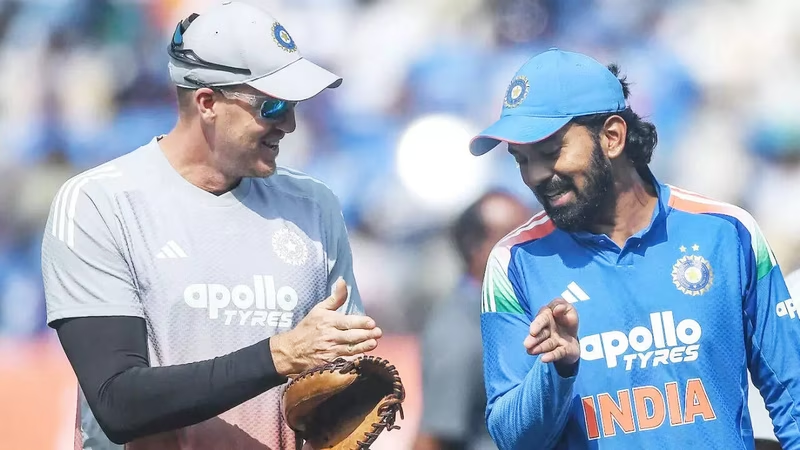
In the high-stakes world of international cricket, victories are often celebrated for their explosive boundaries and wicket-taking deliveries. But sometimes, the real battle happens in the quiet moments between the overs, in the unspoken communication between two batters at the crease. The recent ODI between India and New Zealand was one such contest, where the headline-grabbing win masked a hidden crisis: Washington Sundar injury that threatened to derail the entire chase.
Table of Contents
- The Hidden Crisis During India’s Chase
- KL Rahul’s Masterclass in Pressure Management
- Washington Sundar’s Injury History and Concerns
- Strategic Shifts for Future Matches
- Conclusion: The Quiet Heroism of Test Cricket
- Sources
The Hidden Crisis During India’s Chase
The scoreboard told a story of a controlled chase, but the reality on the pitch was far more precarious. KL Rahul, in a candid revelation, opened up about the immense challenge he faced when his batting partner, Washington Sundar, was visibly struggling. Sundar had picked up a side strain while bowling in the first innings, an injury severe enough that he had to leave the field temporarily .
When Sundar came out to bat, it was clear he couldn’t run between the wickets effectively. For Rahul, this meant his usual aggressive game plan had to be thrown out the window. Every single he took had to be calculated, every potential two-run opportunity became a risk assessment. The primary objective shifted from scoring quickly to simply rotating the strike and, crucially, avoiding dot balls that could increase the pressure exponentially.
KL Rahul’s Masterclass in Pressure Management
This situation demanded a unique blend of aggression and extreme caution—a paradox that KL Rahul navigated with remarkable composure. He knew that pushing Sundar for even a quick single could have resulted in a run-out, ending their partnership and potentially the match. Instead, Rahul took on the burden of scoring almost all the runs himself, a task made even harder by the need to keep the scoreboard ticking over.
His strategy was textbook under pressure:
- Focus on Boundaries: When possible, Rahul looked for opportunities to clear the ropes to minimize the need for running.
- Strike Rotation: He used clever placement and deft touches to ensure he was back on strike as often as possible, shielding Sundar from the bulk of the strike.
- Mental Fortitude: Perhaps most importantly, he maintained a calm demeanor, preventing the tension from affecting his own performance or unsettling his injured partner.
This wasn’t just about batting; it was a masterclass in on-field leadership and crisis management, showcasing why Rahul remains a vital cog in India’s middle order.
Washington Sundar’s Injury History and Concerns
The Washington Sundar injury is not an isolated incident. The talented all-rounder has had a frustrating history with fitness setbacks, including a torn ligament in 2021 and shoulder surgery in 2023 . This latest side strain is a significant concern for the Indian team management, especially with major tournaments like the T20 World Cup 2026 on the horizon .
Team captain Shubman Gill confirmed after the match that Sundar would undergo a scan to assess the full extent of the damage . Early reports suggest he is likely to miss the remainder of the ODI series against New Zealand , a blow to India’s balance given his valuable contributions with both bat and ball. His ability to bowl tight lines and contribute crucial lower-order runs makes him a unique asset, and his absence forces the selectors to look for alternatives.
Strategic Shifts for Future Matches
With Sundar sidelined, India’s strategy for the upcoming matches in the series, including the crucial 3rd ODI scheduled for January 18, 2026, at the Holkar Cricket Stadium in Indore , will need a significant rethink.
The team now faces a critical decision:
- Batting Depth: Who will fill the No. 7 or 8 spot to provide the same stability Sundar offered? A pure batter might weaken the bowling attack, while another bowler might not offer the same resilience with the bat.
- Bowling Attack: Can the existing spinners, like Kuldeep Yadav or Ravindra Jadeja, shoulder a heavier load? Or will the team lean more heavily on its pace battery?
- Contingency Planning: This incident highlights the need for better on-field contingency plans for managing injured batters during a chase, a scenario that could recur.
For fans playing [INTERNAL_LINK:fantasy_cricket], this development is a stark reminder of the volatility of player availability and the importance of having a flexible squad.
Conclusion: The Quiet Heroism of Test Cricket
While the roar of the crowd celebrates the winning runs, the true essence of the game often lies in these unseen battles. KL Rahul’s ability to adapt his game, manage his partner’s limitations, and still guide his team home is a testament to his skill and temperament. The Washington Sundar injury was a major plot twist in what seemed like a straightforward chase, revealing the layers of complexity that make cricket so compelling. As India looks ahead, managing Sundar’s recovery and adapting their strategy will be as important as any tactical move on the field.
Sources
- Times of India: “Hidden drama in India’s chase: KL Rahul opens up on Sundar’s injury”
- “Washington Sundar ruled out of India vs New Zealand”
- “Washington Sundar set to be ruled out of IND vs NZ 2026”
- “IND vs NZ, 1st ODI: Why did Washington Sundar not bat at No”
- “Washington’s injury update: Will he play the next ODI?”
- “Washington Sundar ruled out of cricket ahead of T20 World”
- “IND vs NZ: After Rishabh Pant, Washington Sundar’s side”
- “Washington Sundar likely to miss remaining matches”
- “The Inspiring Story of Indian Cricketer Washington Sundar”
- ESPNcricinfo: “IND vs NZ Scorecard, 3rd ODI at Indore, January 18”