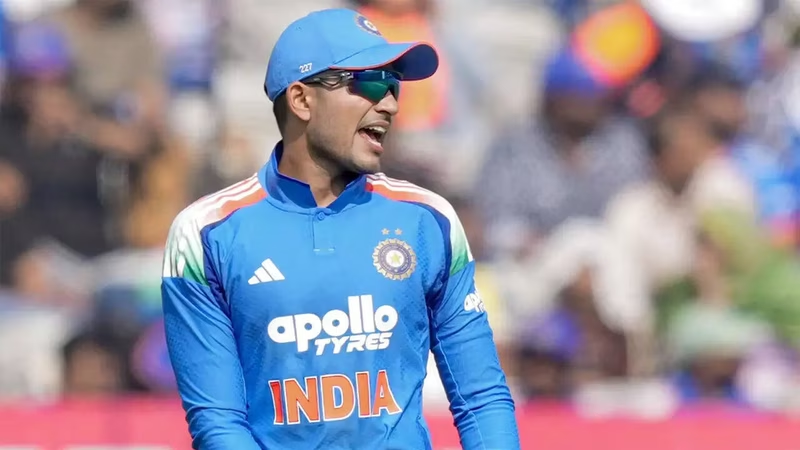
Move over, quiet strategists—cricket’s new-age captaincy might just be loud, bold, and brilliantly instinctive. At least, that’s the impression left by Shubman Gill in India’s nail-biting four-wicket win over New Zealand in the first ODI at Vadodara on January 11, 2026. And according to pacer Harshit Rana, it’s no accident. “Shubman is a free and aggressive captain,” Rana said in a post-match interview. “He empowers us to express ourselves while making crystal-clear decisions under pressure.”
With Virat Kohli stepping back from white-ball leadership and Rohit Sharma managing workload, Gill’s emergence as a potential long-term leader isn’t just timely—it’s transformative. But what exactly does “aggressive captaincy” look like in modern cricket? And why is it resonating so deeply within the Indian dressing room?
Table of Contents
- What Harshit Rana Revealed About Shubman Gill’s Captaincy
- The Vadodara Win: A Blueprint of Gill’s Leadership Style
- How Gill’s Aggressive Captaincy Differs from Past Indian Skippers
- Why Empowerment Is the New Backbone of Team India
- Gill’s Dual Role as Batsman and Leader in High-Stakes Games
- What This Means for India’s Future in White-Ball Cricket
- Conclusion: A New Generation of Leadership Has Arrived
- Sources
What Harshit Rana Revealed About Shubman Gill’s Captaincy
In his candid remarks, Rana didn’t just call Gill “aggressive”—he unpacked what that means in practice. “He doesn’t overcomplicate things,” Rana explained. “If he wants you to bowl yorkers, he says it. If he trusts you in the death overs, he gives you the ball without hesitation. That kind of clarity builds confidence instantly” .
This approach reflects a shift from micromanagement to trust-based leadership. Unlike captains who rely heavily on data analysts mid-innings, Gill appears to blend instinct with input—a style reminiscent of MS Dhoni but executed with youthful energy.
The Vadodara Win: A Blueprint of Gill’s Leadership Style
The match itself was a masterclass in balanced aggression:
- Batting: After early wobbles, Gill walked in at No. 3 and scored a composed 56 off 72 balls, rotating strike and accelerating when needed.
- Bowling changes: He brought Kuldeep Yadav back for a crucial 40th over that broke Kane Williamson’s momentum.
- Field placements: Unconventional but effective—slips for spinners, aggressive leg-side traps for middle-order hitters.
- Death bowling: Trusted debutant Akash Deep with the 48th over, which yielded just 5 runs and a key wicket.
Most telling? When India needed 18 off 12 balls, Gill didn’t panic. He rotated strike to keep Washington Sundar on strike—a calculated risk that paid off as Sundar hit the winning boundary.
How Gill’s Aggressive Captaincy Differs from Past Indian Skippers
Compare Gill’s style to recent leaders:
| Captain | Style | Decision Speed |
|---|---|---|
| Rohit Sharma | Strategic, experience-driven | Moderate—often consults seniors |
| Virat Kohli | Intense, emotionally charged | Fast—but sometimes reactive |
| Shubman Gill | Instinctive, empowering | Fast + proactive |
Gill’s aggression isn’t about shouting or sledging—it’s about decisive action and backing young talent. As noted by ESPNcricinfo analysts, this “quiet assertiveness” could be ideal for India’s transition phase .
Why Empowerment Is the New Backbone of Team India
Rana’s praise highlights a cultural shift. Under Gill, players like Akash Deep, Rana himself, and Washington Sundar aren’t just fillers—they’re trusted executors. This empowerment fosters ownership, reduces performance anxiety, and accelerates player development.
“When your captain believes in you, you bowl like you’ve got nothing to lose,” Rana added—a sentiment echoed by many in the squad.
Gill’s Dual Role as Batsman and Leader in High-Stakes Games
Gill’s 56 wasn’t flashy, but it was perfectly calibrated for the chase. He absorbed pressure during the middle overs, shielded lower-order batters, and accelerated only when the equation allowed. This situational awareness—balancing personal responsibility with team needs—is the hallmark of elite captain-batsmen.
[INTERNAL_LINK:india-young-leaders-in-cricket] explores how Gill, Pant, and others are redefining leadership beyond age and seniority.
What This Means for India’s Future in White-Ball Cricket
With the 2027 ODI World Cup and 2026 T20 World Cup on the horizon, India needs a leader who can blend innovation with composure. Gill’s performance suggests he’s ready. His ability to stay calm during the late collapse (after Kohli’s dismissal) and still guide the team home speaks volumes about his temperament.
Conclusion: A New Generation of Leadership Has Arrived
Harshit Rana’s endorsement of Shubman Gill captaincy isn’t just praise—it’s validation of a new philosophy in Indian cricket. Aggression, in this context, isn’t recklessness. It’s clarity. It’s trust. It’s the courage to back your gut and your teammates in equal measure. As India looks toward a future beyond its golden generation, Gill’s leadership might just be the spark that ignites the next era of dominance.
Sources
- Times of India: Shubman Gill is an aggressive captain: Harshit Rana
- ESPNcricinfo: IND vs NZ, 1st ODI Match Analysis