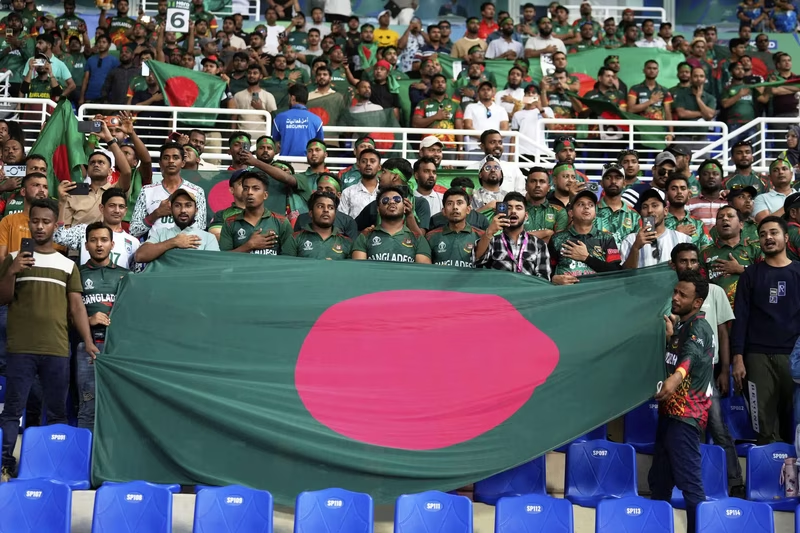
The countdown to the 2026 T20 World Cup was supposed to be a time of excitement and anticipation. Instead, it’s been overshadowed by a high-stakes diplomatic and sporting row. In a stunning development, Bangladesh’s Sports Advisor, Asif Mahmud, declared that his nation’s cricket team would refuse to play in India for the upcoming T20 World Cup, citing serious security concerns . The claim sent shockwaves through the cricketing world—until the International Cricket Council (ICC) issued a powerful and unambiguous rebuttal, calling the assertions into question and reaffirming its confidence in the host nation .
Table of Contents
- The Explosive Claim: Bangladesh’s Boycott Threat
- The ICC’s Firm Rebuttal: Setting the Record Straight
- Understanding the Political and Cricketing Context
- What the ICC Risk Assessment Really Means
- Potential Consequences for Bangladesh and the Tournament
- Conclusion: A Test of Trust and Diplomacy
- Sources
The Explosive Claim: Bangladesh’s Boycott Threat
Speaking to reporters, Bangladesh’s Sports Advisor Asif Mahmud made a series of startling statements. He claimed that an “ICC assessment report” had highlighted significant security risks for visiting teams in India, particularly in the context of the country’s general elections scheduled for 2024 . Based on this alleged report, Mahmud asserted that Bangladesh would not send its team to India and would instead push for the tournament to be relocated elsewhere—anywhere but India .
This announcement was not just a logistical concern; it was a direct challenge to the ICC’s authority and a potential geopolitical flashpoint. For a full-member nation to publicly declare its intent to boycott a flagship ICC event is an extremely rare and serious move.
The ICC’s Firm Rebuttal: Setting the Record Straight
The ICC wasted no time in issuing a formal and unequivocal response. In a clear and direct statement, the global cricket body stated that its independent risk and security assessments had “not identified any specific or credible threats to any participating team or officials” related to the T20 World Cup .
Critically, the ICC clarified two key points that directly contradicted Bangladesh’s claims:
- No Recommendation for Squad Changes: The ICC explicitly stated that its security protocols have not advised any national board to alter their squad selection or travel plans due to security concerns in India.
- No Link to Election Timing: The council also denied that its planning had any connection to a potential postponement of India’s general elections, a claim that had been floated in some media reports following Mahmud’s comments .
The ICC’s message was clear: the tournament is on, the venues are safe, and all teams, including Bangladesh, are expected to participate as scheduled.
Understanding the Political and Cricketing Context
To fully grasp this controversy, one must look beyond the press releases. The relationship between the cricket boards of India and Bangladesh has often been complex, marked by both intense on-field rivalry and off-field political sensitivities .
Furthermore, hosting a mega-event like the T20 World Cup is a matter of immense national pride for India. Any suggestion that the country cannot provide a secure environment for international teams is seen as a direct affront. On the other side, domestic political pressures within Bangladesh may have influenced the advisor’s strong public stance, using cricket as a platform to address broader national narratives .
[INTERNAL_LINK:india-bangladesh-cricket-rivalry-history] This incident is the latest chapter in a long and often tense sporting history between the two neighbors.
What the ICC Risk Assessment Really Means
The ICC, like all major international sports federations, conducts rigorous, ongoing security evaluations for its events. These assessments are performed by specialized, independent firms with expertise in global risk management . They consider a wide range of factors, from local crime rates and political stability to health infrastructure and emergency response capabilities.
The fact that the ICC has publicly stated its confidence in India’s ability to host the event safely carries significant weight. It’s not a casual opinion; it’s the conclusion of a professional, data-driven process. For Bangladesh to publicly dispute this finding without presenting its own concrete evidence puts them in a difficult position within the global cricket community.
Potential Consequences for Bangladesh and the Tournament
If Bangladesh were to follow through on its threat, the repercussions would be severe:
- Sporting Sanctions: The ICC could impose heavy fines, deduct ranking points, or even suspend Bangladesh’s membership, which would bar them from all international cricket.
- Financial Losses: The BCB (Bangladesh Cricket Board) would lose out on crucial ICC funding and revenue from the tournament.
- Diplomatic Fallout: It would strain relations not just with India, but with other ICC member nations who view such a boycott as destabilizing to the sport.
- Fan Disappointment: Millions of passionate Bangladeshi fans would be deprived of seeing their heroes compete on the world stage.
For the tournament itself, the absence of a full-member nation would be a massive blow to its credibility and commercial appeal.
Conclusion: A Test of Trust and Diplomacy
The “Anywhere but India” saga is more than just a pre-tournament spat. It’s a critical test of the trust between a host nation, its guests, and the sport’s governing body. While security is a paramount concern that should never be taken lightly, the ICC’s firm stance suggests that the current situation in India does not warrant the drastic action proposed by Bangladesh’s advisor. The coming weeks will be crucial. Will cooler heads prevail, allowing the focus to return to the cricket? Or will this controversy escalate, casting a long shadow over the 2026 T20 World Cup? The entire cricketing world is watching.