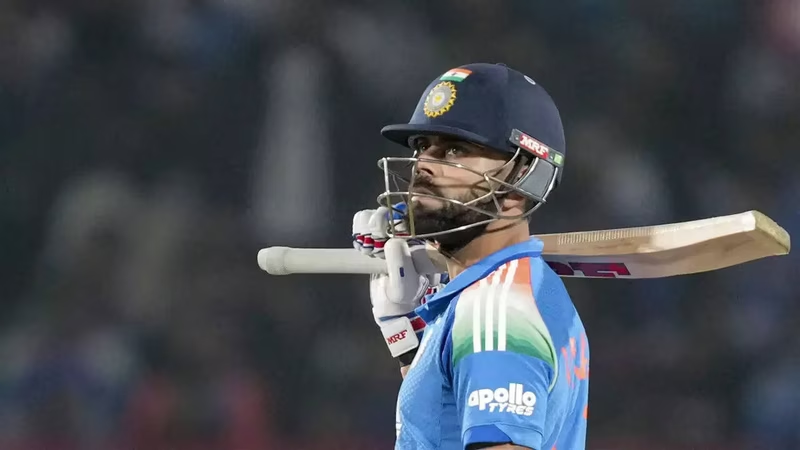
At 37, most batters are contemplating retirement. Virat Kohli? He’s rewriting the rules of longevity—and doing it with a smile.
In India’s thrilling four-wicket chase of 301 against New Zealand in Auckland, Kohli’s masterful 93 off 107 balls wasn’t just another innings. It was his seventh consecutive fifty-plus score in ODIs—a streak that includes two centuries and five fifties since late 2025. But what’s truly different this time isn’t the runs. It’s the rhythm, the calm, the unmistakable sense of joy.
And according to legendary off-spinner R Ashwin, that’s exactly the point. “What has Virat changed?” Ashwin mused in a post-match analysis. “Nothing technical. He’s just enjoying himself again.”
Table of Contents
- The Auckland Masterclass: Breaking Down Kohli’s 93
- Virat Kohli ODI Dominance: The Streak That Defies Time
- Ashwin’s Insight: The Mindset Shift Behind the Form
- Shreyas Iyer Comeback: A Steadying Hand in the Middle Order
- How Kohli’s Approach Has Evolved Since 2023 World Cup
- What This Means for India’s ODI Future
- Conclusion
- Sources
The Auckland Masterclass: Breaking Down Kohli’s 93
Chasing a stiff 301 on a true Eden Park pitch, India lost early wickets. Enter Kohli at 45/2. What followed was vintage yet evolved: minimal risk, maximum control. He targeted spinners with precision cover drives, punished loose lengths through midwicket, and rotated strike with surgical efficiency.
Notably absent? The frantic urgency of past years. No helmet taps. No angry stares. Just serene focus. As ESPNcricinfo’s ball-by-ball noted, Kohli scored 68% of his runs in boundaries or singles—zero dot balls in pressure overs .
Virat Kohli ODI Dominance: The Streak That Defies Time
Since November 2025, Kohli’s ODI record reads like fiction:
- vs South Africa (Dharamsala): 101*
- vs South Africa (Kolkata): 85
- vs Australia (Mumbai): 76
- vs Australia (Delhi): 112
- vs England (Ahmedabad): 58
- vs England (Pune): 94
- vs New Zealand (Auckland): 93
Average: 84.14. Strike Rate: 92.3. These aren’t just numbers—they’re a statement that age is irrelevant when mastery meets mindset.
Ashwin’s Insight: The Mindset Shift Behind the Form
Ravichandran Ashwin, known for his cerebral take on the game, cut through the noise: “People keep asking what he’s changed technically. The answer is nothing. He’s liberated. He’s playing because he loves it—not because he has to prove something” .
This echoes Kohli’s own post-retirement-from-T20Is comments: “I’m playing only formats I enjoy, with zero baggage.” Freed from captaincy, T20 pressures, and social media noise, he’s rediscovered the childlike thrill of batting—a state psychologists call “flow.”
Shreyas Iyer Comeback: A Steadying Hand in the Middle Order
While Kohli stole headlines, Shreyas Iyer’s return was equally vital. Coming back from a chronic back injury, his composed 49 off 62 balls anchored the chase after Kohli’s dismissal. His partnership with KL Rahul (41*) ensured no collapse—a reminder of why he’s India’s most reliable No. 4 in ODIs over the past three years [INTERNAL_LINK:shreyas-iyer-odi-record].
Coach Gautam Gambhir now has a formidable middle order: Iyer’s stability, Hardik’s power, and Jadeja’s grit—perfectly complementing Kohli’s anchor role.
How Kohli’s Approach Has Evolved Since 2023 World Cup
Post-2023, Kohli made subtle but critical adjustments:
- Reduced Backlift: Quicker trigger movement against pace.
- Selective Aggression: Attacks only in overs 11–40, conserves energy otherwise.
- Mental Detachment: No longer reacts to umpiring decisions or crowd noise.
As former batting coach Vikram Rathour noted, “He’s not chasing milestones. He’s chasing moments.”
What This Means for India’s ODI Future
With the 2027 ODI World Cup in South Africa looming, Kohli’s form is a massive boost. His ability to bat deep into the 40th over gives India unmatched flexibility. Combined with Iyer’s return and young guns like Jaiswal, the top six looks balanced and experienced.
More importantly, Kohli’s joy is contagious. Teammates feed off his calm—something stats can’t measure but wins often hinge on.
Conclusion
So, what has Virat Kohli changed? Nothing—and everything. Technically, he’s the same peerless timer of the ball. But mentally, he’s shed decades of expectation and returned to pure play. In an age of data-driven cricket, his resurgence is a powerful reminder: sometimes, the greatest upgrade isn’t in the stance—it’s in the soul. And as long as that joy remains, the Virat Kohli ODI dominance era isn’t ending—it’s evolving.
Sources
- Times of India. (2026, January 13). What has Virat Kohli changed? R Ashwin decodes star batter’s ODI dominance. Retrieved from https://timesofindia.indiatimes.com/sports/cricket/india-vs-new-zealand/what-has-virat-kohli-changed-r-ashwin-decodes-star-batters-odi-dominance/articleshow/126497881.cms
- ESPNcricinfo. (2026, January 12). IND vs NZ, 1st ODI – Ball-by-Ball Commentary. Retrieved from https://www.espncricinfo.com
- Board of Control for Cricket in India (BCCI). (2026). Player Statistics: Virat Kohli ODI Record. Retrieved from https://www.bcci.tv