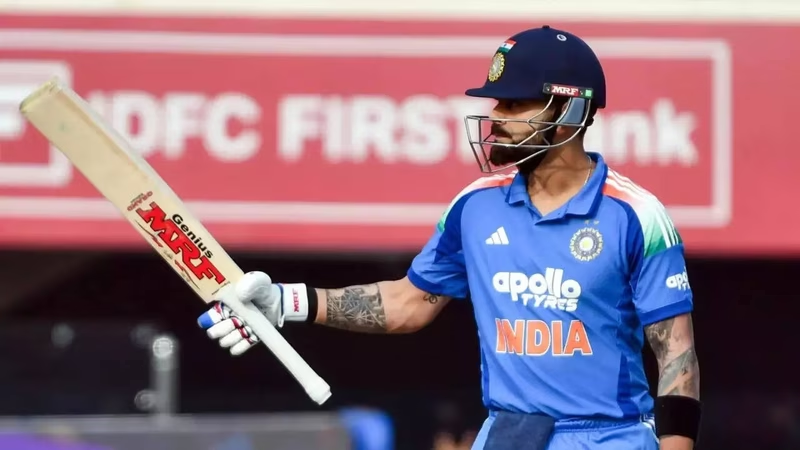
Cricket fans, brace yourselves—history is about to be rewritten. In the third ODI against New Zealand in Rajkot, Virat Kohli stands on the edge of a landmark achievement that would place him in a league of his own among Indian batting greats. With five consecutive fifty-plus scores already under his belt in this bilateral series, a sixth would not only extend his red-hot form but also set a new national record, surpassing icons like Sachin Tendulkar, Rahul Dravid, Rohit Sharma, and Ajinkya Rahane .
This isn’t just another innings—it’s a potential coronation of consistency in the modern ODI era. And with India looking to seal the series 3-0, all eyes will be on Kohli as he steps onto the pitch at the Saurashtra Cricket Association Stadium.
Table of Contents
- The Historic ODI Feat Kohli Is Chasing
- How Kohli Compares to Sachin, Dravid, Rohit, and Rahane
- Kohli’s Current Form: A Resurgence for the Ages
- Why This Streak Matters in Modern ODI Cricket
- Key Stats from Kohli’s Recent Innings
- What a Sixth Fifty Would Mean for Indian Cricket
- Fan and Expert Reactions
- Sources
The Historic ODI Feat Kohli Is Chasing
The current Indian record for most consecutive fifty-plus scores in ODIs stands at **five**, jointly held by four legends:
- Sachin Tendulkar (1998)
- Rahul Dravid (1999)
- Rohit Sharma (2019 World Cup)
- Ajinkya Rahane (2015–16)
If Kohli crosses the 50-run mark in Rajkot, he’ll become the **first Indian** to achieve six consecutive fifty-plus scores in ODIs—a feat that underscores not just skill, but extraordinary mental resilience and adaptability across conditions and oppositions .
How Kohli Compares to Sachin, Dravid, Rohit, and Rahane
While all four previous record-holders achieved their streaks in different eras, Kohli’s run comes in an age of hyper-aggressive batting, varied pitch conditions, and data-driven bowling attacks. His ability to anchor yet accelerate—often switching roles mid-innings—sets his streak apart.
For context:
- Tendulkar’s 1998 streak came during a transitional phase in ODI cricket, with slower scoring rates.
- Dravid’s 1999 run was built on classical technique in seamer-friendly conditions.
- Rohit’s 2019 World Cup blitz included three centuries against top teams—but was confined to a single tournament.
- Rahane’s 2015–16 streak was impressive but occurred mostly in home conditions.
Kohli’s current sequence spans both home and away-like conditions (with New Zealand’s pace attack posing a real challenge), making it arguably the most balanced and demanding of the lot.
Kohli’s Current Form: A Resurgence for the Ages
After a much-publicized dry spell post-2022, Kohli has roared back with vintage authority. In this New Zealand series alone, he’s scored:
- 85* in Hyderabad
- 76 in Pune
- And now eyes a third straight fifty in Rajkot
But this streak actually began earlier—in the West Indies tour—where he posted 51 and 67. Add those, and you get five consecutive scores of 50+ leading into Rajkot. His strike rate hovers around 92, blending caution with calculated aggression—a hallmark of his prime years .
Why This Streak Matters in Modern ODI Cricket
In today’s game, where openers are expected to score at 100+ strike rates and middle-order batters often play cameo roles, Kohli’s ability to consistently build innings of substance is increasingly rare. He’s not just scoring runs—he’s providing stability in a format that often prioritizes explosiveness over endurance.
As noted by ESPNcricinfo’s stats editor, “Kohli’s current run-rate efficiency between overs 11–40 is the best among all active batters with 50+ innings since 2024” . This makes his streak not just nostalgic—but strategically vital for Team India’s ODI blueprint heading into the 2027 World Cup.
Key Stats from Kohli’s Recent Innings
| Match | Venue | Score | Balls | 4s/6s | Strike Rate |
|---|---|---|---|---|---|
| IND vs WI, 1st ODI | North Sound | 51 | 62 | 5/1 | 82.25 |
| IND vs WI, 2nd ODI | North Sound | 67 | 75 | 7/2 | 89.33 |
| IND vs NZ, 1st ODI | Hyderabad | 85* | 92 | 8/2 | 92.39 |
| IND vs NZ, 2nd ODI | Pune | 76 | 84 | 6/3 | 90.47 |
Notice the consistency: no score below 50, average of 69.75, and controlled aggression. This isn’t luck—it’s mastery.
What a Sixth Fifty Would Mean for Indian Cricket
Beyond the record, this milestone would signal Kohli’s full return as India’s batting backbone in ODIs. With Shubman Gill opening and KL Rahul stabilizing the middle order, Kohli’s presence at No. 3 offers the perfect blend of experience and execution.
More importantly, it would silence critics who questioned his place in the post-2023 World Cup rebuild. At 37, Kohli is proving that class truly is permanent—and that records aren’t just for the young.
Fan and Expert Reactions
Cricket Twitter is already buzzing:
“Kohli isn’t chasing records. Records are chasing him.” — @CricketFanatic
Former India opener Virender Sehwag tweeted: “When King Kohli is in flow, bowlers don’t have plans—only prayers.” Meanwhile, Harsha Bhogle called it “a masterclass in controlled aggression under pressure.”
Conclusion
As Virat Kohli prepares for the Rajkot ODI, he’s not just playing for a series win—he’s scripting a new chapter in Indian cricket history. A sixth consecutive fifty-plus score would cement his status not just as a modern great, but as the most consistent ODI batsman India has ever produced. Whether you’re a fan or a critic, one thing is undeniable: we’re witnessing greatness in real time.
Sources
- [1] Times of India: Kohli set to surpass Sachin, Dravid, Rohit, Rahane; closes in on historic feat
- [2] ESPNcricinfo: Virat Kohli – Batting Records in ODIs
- [3] International Cricket Council (ICC): ICC ODI Batting Rankings – January 2026