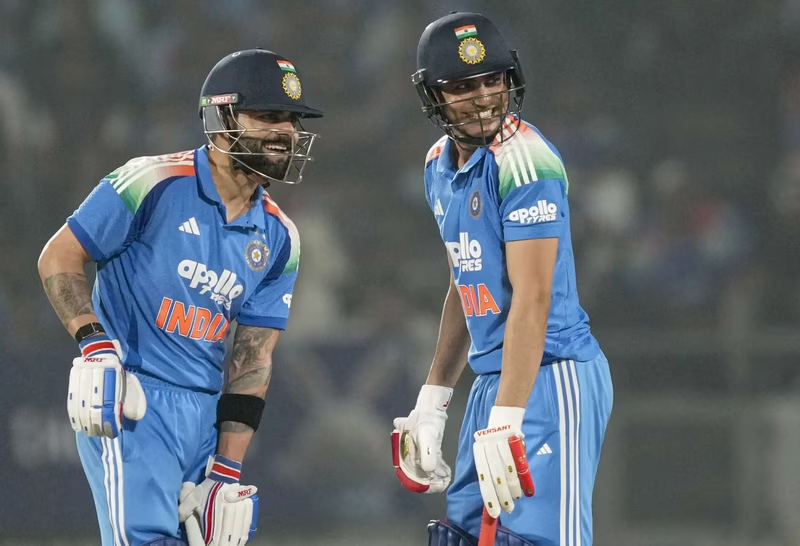
Raw talent is everywhere. But greatness? That’s rare.
In a powerful reflection following India’s recent ODI win over New Zealand, former head coach Ravi Shastri didn’t praise boundaries or wickets. Instead, he zoomed in on something far less visible but infinitely more impactful: Virat Kohli’s work ethic.
“Talent alone won’t cut it,” Shastri declared. “What separates Kohli from the rest is his discipline off the field—the hours he puts in when no one’s watching.”
This isn’t just nostalgic praise. It’s a direct message to India’s emerging stars, especially young captain Shubman Gill, who now leads a team brimming with flair but in need of Kohli-level consistency and commitment.
Table of Contents
- The Virat Kohli Work Ethic According to Ravi Shastri
- Why Discipline Beats Talent in Modern Cricket
- Kohli’s Routine: The Hidden Engine of His Success
- Shubman Gill and the Next Generation of Indian Crickers
- India vs New Zealand ODI: A Showcase of Commitment
- Conclusion: The Legacy of Kohli’s Habits
- Sources
The Virat Kohli Work Ethic According to Ravi Shastri
During his tenure as India’s head coach (2017–2021), Ravi Shastri witnessed firsthand how Kohli transformed from a gifted batsman into a global icon of sporting excellence. And according to Shastri, the secret wasn’t in his cover drive—it was in his calendar.
“He’s second to none,” Shastri said, emphasizing that Kohli’s real edge lies in his “relentless pursuit of improvement” . While others rested after matches, Kohli was in the gym. While others skipped recovery sessions, he was icing his knees and reviewing footage.
This Virat Kohli work ethic wasn’t performative. It was foundational. And Shastri believes it’s the exact blueprint India’s new crop must adopt if they want sustained success—not just flashes of brilliance.
Why Discipline Beats Talent in Modern Cricket
Today’s game moves at lightning speed. T20 leagues, back-to-back tours, bio-bubbles—it’s a grind. Natural ability gets you noticed, but only discipline keeps you at the top.
Consider this:
- Talent fades without maintenance. Fitness, technique, and mental resilience require daily investment.
- Pressure exposes preparation. In high-stakes games like India vs New Zealand, it’s not who’s flashy—it’s who’s ready.
- Leadership starts with example. As captain, Kohli didn’t just demand effort—he embodied it.
As ESPNcricinfo notes, Kohli’s training regimen includes two-a-day sessions, strict diet control, and personalized biomechanical analysis . This isn’t optional for him—it’s non-negotiable.
Kohli’s Routine: The Hidden Engine of His Success
While fans see centuries, insiders see sacrifice. A typical off-season day for Kohli includes:
- 5:30 AM: Wake-up, hydration, mobility drills.
- 6:30 AM: High-intensity functional training (HIIT) or strength session.
- 9:00 AM: Batting practice with throwdowns and video feedback.
- 2:00 PM: Recovery: cryotherapy, massage, physio.
- Evening: Film study—his own innings and opposition bowlers.
This structure isn’t rigid for rigidity’s sake. It’s designed to maximize longevity in a sport that chews up and spits out even the most talented players by age 32. At 37 in 2026, Kohli remains a pillar of India’s middle order—a testament to his habits, not just his hand-eye coordination.
Shubman Gill and the Next Generation of Indian Cricketers
With Kohli gradually transitioning out of leadership and possibly the game itself, the baton passes to players like Shubman Gill. The 26-year-old captain has the strokes, the calm demeanor, and the backing of the board.
But does he have the same obsessive commitment?
Shastri’s comments are clearly a nudge—and a challenge. “The next generation must understand: you can’t just show up and expect to win,” he implied . Gill, who scored a composed 89 in the recent ODI against New Zealand, is already showing signs of maturity. Yet, Shastri’s message is clear: emulate Kohli’s process, not just his results.
For more on India’s leadership transition, check out our deep dive on [INTERNAL_LINK:future-of-indian-cricket-captaincy].
India vs New Zealand ODI: A Showcase of Commitment
The 2026 ODI in Pune wasn’t just a win—it was a statement. Chasing 267, India lost early wickets but stayed composed. Gill anchored, Hardik Pandya finished cleanly, and the bowlers executed plans with precision.
That composure under pressure? That’s cultivated in training, not born in crisis. And it echoes the culture Kohli and Shastri built together—a culture where preparation meets opportunity.
Conclusion: The Legacy of Kohli’s Habits
Ravi Shastri’s praise for Virat Kohli’s work ethic isn’t just about one man. It’s a manifesto for Indian cricket’s future. In an era of instant fame and short attention spans, Kohli’s greatest gift may not be his runs—but his routine. By naming discipline as the ultimate differentiator, Shastri has handed the next generation a roadmap: talent opens the door, but only relentless work keeps you in the room.
Sources
- Times of India: ‘Second to none’: Shastri names one habit that separates Kohli from the rest
- ESPNcricinfo: Inside Virat Kohli’s Elite Training Regimen
- BCCI Official: India defeats New Zealand by 6 wickets in 1st ODI