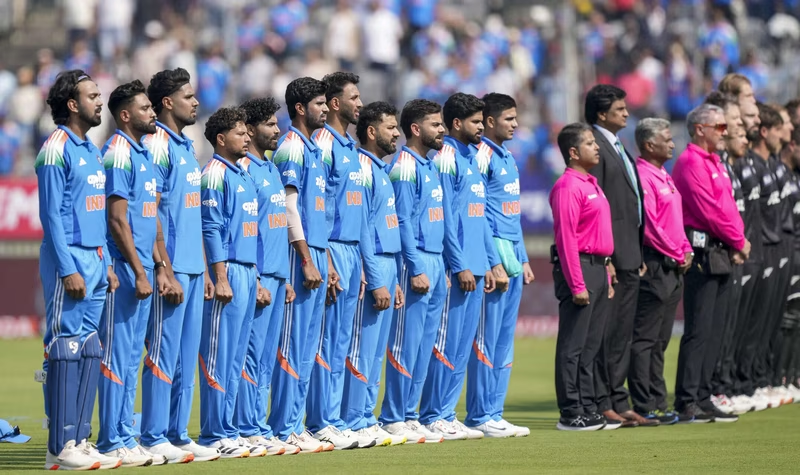
In a fascinating twist that highlights the complex intersection of sports, politics, and international governance, a Bangladesh umpire officiates IND-NZ ODI matches on Indian soil this week. This comes at a time when the Bangladesh Cricket Board (BCB) has taken a firm public stance against sending its national team to India for the upcoming T20 World Cup 2026, citing serious security concerns . The situation presents a stark paradox: while the team stays home, one of its most respected officials is right in the middle of the action.
Table of Contents
- The Umpire in the Eye of the Storm
- BCB Stands Firm on T20 World Cup Boycott
- How the ICC Keeps Cricket Neutral
- A History of Political Tensions in Cricket
- What This Means for the Future of International Cricket
- Conclusion: Separating the Game from the Geopolitics
- Sources
The Umpire in the Eye of the Storm
The man at the center of this diplomatic conundrum is Sharfuddoula Saikat, a highly experienced official who was elevated to the ICC Elite Panel of Umpires in March 2024 . His resume is impressive: he has officiated in 32 Test matches, 119 ODIs, and 75 T20 Internationals. He is also the head of the BCB’s umpiring committee, making his presence in India all the more noteworthy .
Saikat’s role in the ongoing India vs New Zealand ODI series, including the first match in Vadodara, has drawn some criticism back home, given the BCB’s official position . However, his participation is not a personal choice but a direct result of the ICC’s strict and independent appointment process for match officials.
BCB Stands Firm on T20 World Cup Boycott
The backdrop to this unusual scenario is the BCB’s unequivocal refusal to participate in the T20 World Cup 2026 if it is held in India. The board has publicly stated its concerns about the “safety and well-being” of its players and staff, requesting that their matches be moved to a different host nation or co-host country [[3], [6]].
This stance has created a significant headache for the ICC, which is now engaged in urgent talks with the BCB to find a resolution before the tournament begins . The BCB has remained firm, stating they will not travel “under current conditions,” a position that has cast a shadow over the global event .
How the ICC Keeps Cricket Neutral
The key to understanding why Saikat is in India while the Bangladesh team is not lies in the ICC’s operational structure. The international governing body maintains a clear separation between its member boards’ bilateral political issues and the administration of its own events and appointments.
The Independent Appointment System
The ICC has a dedicated panel of elite and international umpires whom it appoints directly for all major international fixtures, including bilateral series like IND-NZ. These appointments are made based on merit, experience, and workload management, not the current diplomatic climate between the host and the umpire’s home country .
Umpires as ICC Officials, Not National Representatives
Once on the ICC panel, an umpire like Saikat is considered an official of the ICC itself, not a representative of the BCB during an international match. This principle ensures the integrity and neutrality of the game, preventing any single nation’s political stance from influencing on-field decisions. It’s a system designed to keep the sport above the fray of geopolitics—a principle that is being severely tested in this instance .
A History of Political Tensions in Cricket
This is far from the first time cricket has been caught in the crossfire of international relations. From the apartheid-era bans on South Africa to the long-standing tensions between India and Pakistan that have severely limited bilateral series, the sport has a complex history with politics. The current standoff between India and Bangladesh adds another chapter to this ongoing narrative, demonstrating that even in the modern era, cricket cannot always remain an island of pure sport.
What This Means for the Future of International Cricket
The situation raises critical questions for the future. If a full member nation can refuse to participate in a World Cup hosted by another member, what does that mean for the viability of global tournaments? Will we see more “neutral venues” become the norm, even for events officially hosted by a single country? For fans of the game, the hope is that solutions can be found that prioritize both player safety and the spirit of international competition. In the meantime, the sight of a Bangladesh umpire officiates IND-NZ ODI serves as a powerful, if awkward, symbol of the ICC’s attempt to maintain order amidst chaos [INTERNAL_LINK:t20-world-cup-2026-schedule].
Conclusion: Separating the Game from the Geopolitics
Sharfuddoula Saikat’s presence on the field is a testament to the professionalism of match officials and the ICC’s robust, if sometimes strained, systems. It underscores a fundamental truth: while boards may engage in political posturing, the game itself must go on, governed by a set of neutral rules and impartial arbiters. Whether this principle can hold in the face of the BCB’s T20 World Cup boycott remains to be seen, but for now, the whistle blows, and the game continues.
Sources
- Times of India: BCB stays away, umpire stays on
- ESPNcricinfo: Bangladesh refuse to travel to India for T20 World Cup
- ICC Official Website: ICC announces Elite Panel of Umpires for 2024-25
- Cricbuzz: Bangladesh umpire Sharfuddoula officiates during IND vs NZ 1st ODI