Table of Contents
- The Great ODI Debate Reignited
- Virat Kohli vs Rohit Sharma ODI: The Numbers Game
- Mohammad Kaif’s Revelation: The Mindset Factor
- Converting Starts Into Centuries: Kohli’s Superpower
- Rohit Sharma’s Brilliance—and Its Limits
- Kohli’s Historic Fifty-Plus Streak: A New Indian Record in Sight?
- Conclusion: Why Mindset Trumps Mere Talent
- Sources
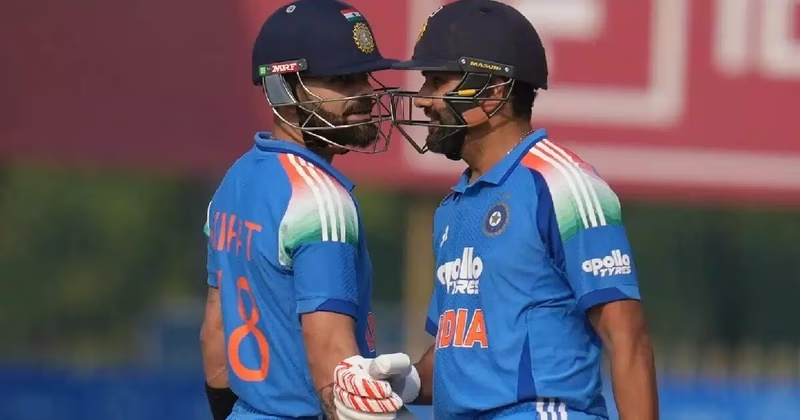
The rivalry between Virat Kohli and Rohit Sharma isn’t one of animosity—it’s one of contrast. Both are modern greats, World Cup veterans, and pillars of India’s batting for over a decade. Yet, when it comes to One Day Internationals (ODIs), one name consistently edges ahead: Virat Kohli. Now, former India middle-order stalwart Mohammad Kaif has explained why—pinpointing not technique or flair, but something far more intangible: mindset. In a recent analysis, Kaif argued that Kohli’s relentless self-awareness and refusal to settle for “good enough” is what separates him in the Virat Kohli vs Rohit Sharma ODI narrative .
The Great ODI Debate Reignited
With India currently locked in a bilateral series against New Zealand, both Kohli and Sharma have been in the spotlight. While Rohit remains the captain and opener, it’s Kohli who continues to deliver under pressure—most recently with another composed half-century . These performances aren’t isolated; they’re part of a pattern that’s defined his career. And now, as he inches closer to a new Indian record with his ongoing fifty-plus streak, the conversation about who truly dominates the ODI format has resurfaced—with Kaif offering a compelling answer.
Virat Kohli vs Rohit Sharma ODI: The Numbers Game
Let’s start with the stats—because they tell a story even before mindset enters the frame:
- Virat Kohli: 14,000+ ODI runs at an average of 57.00+, with 50 centuries—the most in ODI history.
- Rohit Sharma: 10,700+ ODI runs at an average of 49.00, with 31 centuries—including three double-hundreds.
While Rohit holds the record for the highest individual ODI score (264), Kohli’s consistency is unmatched. He averages over 50 in every major cricketing nation, including Australia, England, and South Africa—conditions where many openers, including Sharma, have struggled . This isn’t just about runs; it’s about reliability across contexts.
Mohammad Kaif’s Revelation: The Mindset Factor
In his breakdown, Kaif didn’t focus on cover drives or pull shots. Instead, he zoomed in on what happens *after* a player reaches 30 or 40 runs. “Virat doesn’t see a fifty as a milestone—he sees it as a starting point,” Kaif explained . This philosophy is key. Where others might relax after a good start, Kohli tightens his focus. He knows that in ODIs, 50s win you applause—but 100s win matches.
Kaif emphasized Kohli’s “self-awareness.” Even after scoring 80 or 90, Kohli critiques his innings, asking: *Could I have rotated strike better? Did I miss a scoring opportunity?* This level of introspection, Kaif argues, is rare—even among elite players.
Converting Starts Into Centuries: Kohli’s Superpower
One of the most telling stats in ODI cricket is the conversion rate—how often a player turns a 50 into a 100. Here, Kohli’s numbers are staggering:
- Kohli converts roughly 50% of his fifties into centuries.
- Rohit Sharma’s conversion rate hovers around 30%.
This gap isn’t about skill—it’s about temperament. Kohli thrives in the “danger zone” between 70 and 90, where pressure mounts and field placements tighten. He doesn’t chase boundaries; he works singles, rotates strike, and waits for the right ball. It’s a masterclass in controlled aggression.
Rohit Sharma’s Brillitude—and Its Limits
None of this diminishes Rohit’s genius. His ability to dominate the powerplay, clear the ropes with ease, and play match-defining knocks (like his 209 vs Australia in 2013) is legendary. But as Kaif subtly noted, Rohit’s game is more feast-or-famine. When he’s on, he’s unstoppable. But when he’s off, he can fall cheaply—a vulnerability less common in Kohli’s game .
Moreover, Rohit’s role as an opener exposes him to the new ball and high-risk situations early on. Kohli, batting at No. 3 or 4, often walks in with a settled platform—yet still delivers under scoreboard pressure, like his 93* in the first ODI vs New Zealand .
Kohli’s Historic Fifty-Plus Streak: A New Indian Record in Sight?
Kohli is currently on a remarkable run of consecutive fifty-plus scores in ODIs. If he extends this streak, he could surpass Rahul Dravid’s Indian record for most successive 50+ scores in the format . This isn’t just about personal glory—it’s proof of his sustained excellence. In an era of T20 distractions and shortened attention spans, Kohli’s focus on the 50-over game remains unwavering.
For fantasy cricket managers and fans alike, this consistency makes him a non-negotiable pick. To understand how current form impacts team selection, check out our guide on [INTERNAL_LINK:how-to-pick-players-for-fantasy-cricket].
Conclusion: Why Mindset Trumps Mere Talent
The Virat Kohli vs Rohit Sharma ODI comparison isn’t about declaring one better than the other—it’s about understanding what drives greatness. As Mohammad Kaif so insightfully pointed out, talent gets you to the crease, but mindset keeps you there. Kohli’s obsession with maximizing every innings, his refusal to be satisfied, and his emotional control under pressure are what keep him ahead in the stats, the records, and the eyes of experts. In the end, cricket isn’t just played with the bat—it’s won in the mind. For deeper insights into player psychology, refer to resources from the International Cricket Council.
Sources
- Times of India – Why Virat Kohli has always stayed ahead of Rohit in ODIs — ex-India batter explains
- ESPNcricinfo – India vs New Zealand 1st ODI Scorecard, 2026
- ICC Player Rankings – ODI Batting Records
- Analysis of Rohit Sharma’s ODI batting patterns
- Live Cricket Updates – Kohli’s 93* vs New Zealand
- BCCI Archives – Rahul Dravid’s ODI records