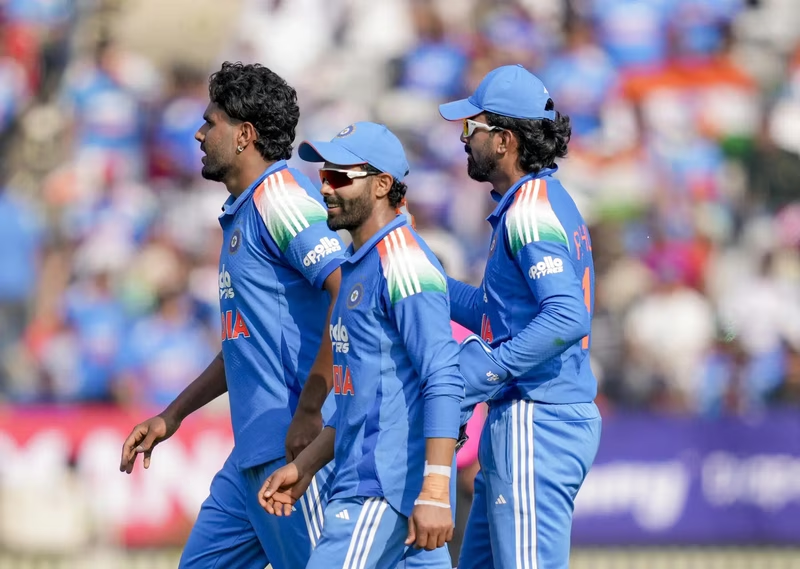
Cricket isn’t just about runs and wickets—it’s about balance. And right now, according to legendary opener and former chief selector Kris Srikkanth, India’s ODI side is dangerously unbalanced. Following their seven-wicket defeat to New Zealand in Rajkot, Srikkanth didn’t hold back: “The team is suffering,” he declared, pinpointing the glaring absence of a reliable sixth bowler as a critical weakness .
This isn’t just casual criticism. It’s a direct challenge to the team management’s recent decisions—specifically, the continued exclusion of all-rounder Axar Patel despite mounting evidence that his skill set could solve India’s middle-overs malaise.
Table of Contents
- Srikkanth’s Scathing Assessment
- The Sixth Bowler Dilemma in Modern ODI Cricket
- Jadeja’s Struggles and the Cost of Over-Reliance
- Why Axar Patel Is the Missing Piece
- Historical Precedent: India’s Past Success with Balanced XIs
- Conclusion
- Sources
Srikkanth’s Scathing Assessment
In a candid post-match analysis, Srikkanth zeroed in on the team’s composition. “We don’t have a proper sixth bowler. That’s why the team is suffering,” he stated bluntly . His frustration stems from seeing India’s pace trio—Mohammed Siraj, Mukesh Kumar, and Washington Sundar—forced to cover excessive overs during the crucial middle phase (overs 11–40), while spin options remain limited.
With Ravindra Jadeja, traditionally the go-to sixth option, delivering inconsistent performances with the ball, the void has grown wider. In the Rajkot ODI, Jadeja went wicketless in his 10 overs, conceding 58 runs—a far cry from the control he once offered .
The Sixth Bowler Dilemma in Modern ODI Cricket
The concept of a sixth bowler has evolved dramatically in the modern ODI era. Gone are the days when five specialist bowlers sufficed. Today’s high-scoring contests demand a sixth credible option who can:
- Bowl at least 6–8 economical overs under pressure.
- Provide variety (spin vs. pace, wrist vs. finger spin).
- Contribute with the bat in the lower-middle order.
As noted by the ICC’s playing conditions and strategic analyses, teams that master this balance—like Australia and South Africa—consistently outperform opponents in tight chases or defenses . India’s current setup lacks this flexibility, leaving them vulnerable when primary bowlers are targeted.
Jadeja’s Struggles and the Cost of Over-Reliance
Ravindra Jadeja remains one of India’s most decorated all-rounders, but his recent ODI form tells a different story. Since returning from injury in late 2025, his economy rate has ballooned to over 5.8, and his strike rate has dipped significantly .
More concerning is his inability to break partnerships—a role he once excelled at. Against New Zealand’s Daryl Mitchell and Glenn Phillips, Jadeja was milked for singles and boundaries alike, offering no real threat. This over-reliance on a single all-rounder has become a strategic liability.
Why Axar Patel Is the Missing Piece
Enter Axar Patel. The left-arm spinner from Gujarat has been in stellar domestic and IPL form, consistently delivering with both bat and ball. In the 2025 IPL season, he averaged 28 with the bat and took 18 wickets at an economy of 7.2—proving his T20 credentials translate to longer formats .
His inclusion would provide:
- A genuine sixth bowler who can operate in powerplays and middle overs.
- Left-arm spin variation to complement Kuldeep Yadav’s wrist spin.
- Handy batting depth at No. 7 or 8, capable of accelerating or stabilizing.
Yet, despite being in the squad, he hasn’t featured in the playing XI for the New Zealand series—a decision Srikkanth calls “inexplicable.”
Historical Precedent: India’s Past Success with Balanced XIs
India’s 2011 World Cup-winning side famously used a balanced XI featuring three seamers, two specialist spinners (Harbhajan Singh and Yuvraj Singh), and part-time options like Sachin Tendulkar and Virender Sehwag. That flexibility was key in varied conditions .
Similarly, during the 2023 World Cup, the inclusion of Shardul Thakur as a bowling all-rounder added crucial depth. The lesson is clear: rigid templates fail; adaptable squads win.
For more on India’s evolving ODI strategy, check out our deep dive on [INTERNAL_LINK:india-odi-team-evolution-post-2023].
Conclusion
Kris Srikkanth’s critique isn’t just noise—it’s a wake-up call. The lack of a dependable sixth bowler is exposing India in high-stakes matches, and the solution may be sitting right in the dressing room. Axar Patel’s omission isn’t just a selection oversight; it’s a tactical blind spot that could cost India dearly in upcoming ICC events. As the series against New Zealand heads to its decider, the selectors must ask: are they picking a team to win today—or to win when it truly matters?
Sources
- Times of India. “‘The team is suffering’: Kris Srikkanth highlights lack of sixth bowler.” https://timesofindia.indiatimes.com/…
- ESPNcricinfo. “Ravindra Jadeja ODI Bowling Stats – 2025 Season.” https://www.espncricinfo.com/…
- IPL Official Website. “Axar Patel Player Profile & 2025 Season Stats.” https://www.iplt20.com/…
- ICC. “Men’s Cricket World Cup 2011 – Team India Playing XI Analysis.” https://www.icc-cricket.com/…