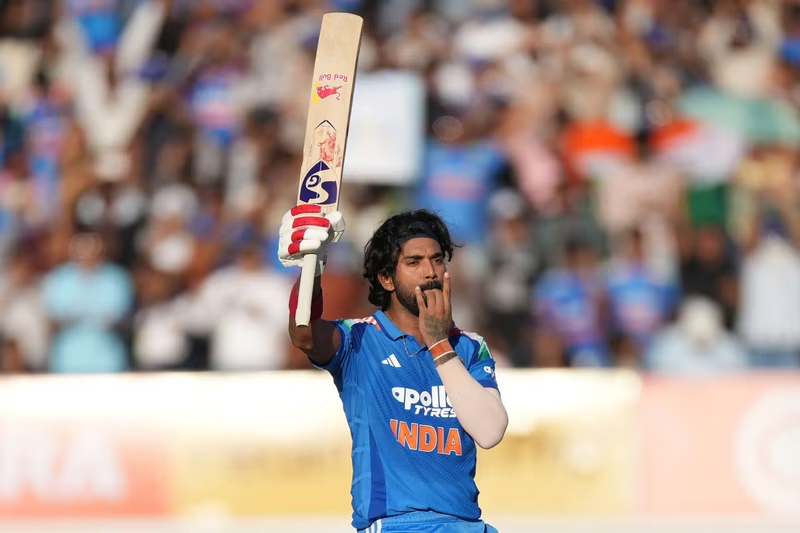
For years, KL Rahul has been pigeonholed as India’s go-to finisher—the calm hand who walks in at No. 6 or 7 to mop up the tail end of an innings. But his recent, majestic unbeaten 112 against New Zealand wasn’t just another knock. It was a statement. A declaration that he’s ready—and more than capable—of shouldering responsibility much earlier in the innings, right in the heart of the middle overs.
Batting at No. 5 in challenging conditions, Rahul didn’t just score runs; he orchestrated them. With textbook cover drives, precise placements, and a temperament that screamed maturity, he reminded everyone why he’s one of India’s most technically sound batters. This wasn’t the frantic, boundary-hunting finisher we’ve seen before. This was a classic ODI craftsman at work—patient, calculated, and utterly dominant .
Table of Contents
- Why the KL Rahul Finisher Role Is Outdated
- Breaking Down Rahul’s Unbeaten 112 Against New Zealand
- The Evolution of Rahul’s Batting Temperament
- How a Middle-Overs Role Benefits Team India
- Historical Context: Rahul’s ODI Century Drought and Comeback
- Conclusion: Time to Redefine KL Rahul’s Place in the Lineup
- Sources
Why the KL Rahul Finisher Role Is Outdated
The label of “KL Rahul finisher role” has stuck—but it no longer fits. While he’s proven effective in high-pressure chases (remember his 109* vs Sri Lanka in 2023?), his skill set is far too rich for such a narrow function. Rahul possesses the rare blend of classical technique and modern adaptability that makes him ideal for the crucial No. 4 or No. 5 slot—the very positions where ODIs are often won or lost.
Modern ODI cricket demands stability between overs 10–40. You need batters who can rotate strike, absorb pressure, and build partnerships—not just clear the ropes in the final five overs. Rahul’s latest innings was a textbook example of that middle-overs mastery.
Breaking Down Rahul’s Unbeaten 112 Against New Zealand
His century came off 115 balls, laced with 10 boundaries and 2 sixes—a perfect balance of grace and aggression. What stood out wasn’t just the scoring rate (nearly 97), but how he paced his innings:
- Overs 15–30: Focused on rotating strike and preserving wickets during the post-powerplay slowdown.
- Overs 30–45: Accelerated intelligently against spinners, using sweeps and deft touches.
- Death Overs (46–50): Shifted gears seamlessly, finding boundaries without taking undue risks.
This phased approach is the hallmark of a true middle-order anchor—not a finisher who relies on chaos.
The Evolution of Rahul’s Batting Temperament
Rahul’s journey hasn’t been linear. From explosive T20 openers to wicketkeeping duties across formats, he’s worn many hats—sometimes to his detriment. Critics have pointed to inconsistency, especially in Test cricket. But in ODIs, a new clarity has emerged.
Since being dropped after the 2023 World Cup, Rahul has worked relentlessly on mental resilience. His return to form in domestic cricket and the IPL laid the groundwork, but this innings in New Zealand feels like a culmination—a batter who finally knows his identity and sticks to it .
How a Middle-Overs Role Benefits Team India
Placing Rahul at No. 5 offers India several strategic advantages:
- Stability After Early Wickets: If openers fall quickly, Rahul’s solid technique prevents collapse.
- Bridging the Gap to Hard-Hitters: He can partner with Shreyas Iyer or Suryakumar Yadav, allowing them to play freely.
- Versatility Against Spin: Rahul’s footwork and sweep shot make him ideal for subcontinental conditions.
- Leadership & Experience: As a former vice-captain, his presence calms the middle order under pressure.
In contrast, relegating him to No. 7 wastes his ability to build innings—a luxury India can’t afford in tight contests.
Historical Context: Rahul’s ODI Century Drought and Comeback
This was Rahul’s first ODI hundred since his 109* against Sri Lanka in the 2023 World Cup—a gap of over two years. During that period, he faced intense scrutiny, with many questioning his place in the side. Yet, his dedication never wavered. He used his time away from the national team to refine his game, focusing on shot selection and mental discipline .
This comeback century isn’t just about personal redemption; it’s a testament to his professionalism. In an era where players chase instant gratification, Rahul’s patience and perseverance stand out.
Conclusion: Time to Redefine KL Rahul’s Place in the Lineup
KL Rahul’s unbeaten 112 has shattered the myth that he’s merely a finisher. It’s time for the Indian selectors and coaching staff to recognize his true value: as a composed, technically gifted middle-order pillar who can control the narrative of an ODI innings from the 15th over onward. Locking him into the No. 5 spot isn’t just good for Rahul—it’s essential for India’s success in the 2027 World Cup cycle. The finisher tag? It’s time to retire it.
Sources
- The Times of India: More than a finisher: KL Rahul’s unbeaten 112 strengthens case for bigger middle-overs role
- International Cricket Council (ICC): Official ICC Player Rankings and Stats
- ESPNcricinfo: KL Rahul Profile and Career Statistics