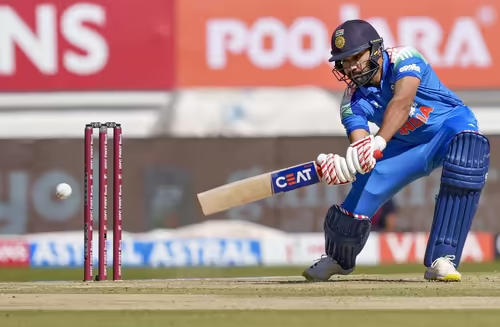
Cricket fans are used to seeing Rohit Sharma dominate bowling attacks with his elegant cover drives and towering sixes. So when the Indian captain posts modest scores in back-to-back ODIs while his longtime teammate Virat Kohli blazes away with consecutive fifties, questions inevitably arise. Is age catching up? Has his touch deserted him? Or is there more to the story?
Thankfully, we don’t have to speculate. India’s assistant coach, Ryan ten Doeschate, has stepped in with a refreshingly candid and grounded explanation for Rohit Sharma’s quiet ODI run during the ongoing series against New Zealand. And it’s a reminder that cricket is as much about context as it is about raw numbers.
Table of Contents
- The Stark Contrast in Form: Rohit vs Virat
- Rohit Sharma’s Quiet ODI Run: The Coach’s Explanation
- The Role of Pitch Conditions and Match Rust
- Beyond the Scorecard: Rohit’s Team-First Ethos
- Historical Context: A Captain With a Proven Record
- What Lies Ahead for Team India?
- Conclusion: Patience Over Panic
- Sources
The Stark Contrast in Form: Rohit vs Virat
In the first two ODIs of the India vs New Zealand series, the narrative has been dominated by Virat Kohli’s resurgence. Scoring 75 and 62*, Kohli has looked in complete control, silencing any lingering doubts about his ODI prowess . His timing, placement, and hunger for runs have been a masterclass in top-order batting.
Meanwhile, Rohit Sharma, the man at the other end of the spectrum, has managed just 18 and 24. For a player of his stature and a captain leading from the front, these are uncharacteristically low returns. Social media was quick to pounce, with critics questioning his place in the side—a reaction that often overlooks the bigger picture.
Rohit Sharma’s Quiet ODI Run: The Coach’s Explanation
Enter Ryan ten Doeschate. In a post-match press conference, the former Netherlands all-rounder and now key member of India’s coaching staff offered a calm, rational perspective. He attributed Sharma’s struggles not to a technical flaw or a loss of confidence, but to two critical external factors: challenging pitch conditions and a severe lack of recent match practice .
“He’s just a bit short on cricket,” ten Doeschate explained plainly. This simple statement carries significant weight. Unlike Kohli, who has been active in domestic cricket and the preceding T20 series, Rohit has had limited time in the middle. Cricket is a rhythm game, and even the greatest players need overs under their belt to find their timing and feel.
The Role of Pitch Conditions and Match Rust
The pitches in this series have been far from the flat, batting paradises of old. They’ve offered movement off the seam and variable bounce, making stroke-play difficult for even the most experienced batsmen. In such conditions, a batter who hasn’t faced high-quality pace in competitive matches is at a distinct disadvantage.
Consider this: before this ODI series, Rohit’s last competitive outing was in the T20 World Cup final in June 2024. That’s a gap of over 18 months in the 50-over format. In contrast, Virat Kohli played a full Ranji Trophy season and was in the thick of the action during the T20 leg of the tour. The difference in match sharpness is stark.
Beyond the Scorecard: Rohit’s Team-First Ethos
Ten Doeschate also highlighted a crucial, often overlooked aspect of Rohit’s leadership: his selfless, team-first approach. “He’s always looking at what’s best for the team,” the coach noted . This isn’t just lip service. As captain, Rohit has consistently prioritized the collective over his personal milestones. He’s willing to take risks, rotate the strike, and play second fiddle if it means setting up a platform for others—a trait that doesn’t always show up in individual scorecards but is vital for team success.
Historical Context: A Captain With a Proven Record
It’s easy to forget, in the heat of a slow start, that Rohit Sharma is one of the most successful ODI batsmen of all time. He holds the record for the most double centuries in the format (three) and boasts a career average well above 48 . His record as ODI captain is also formidable, having led India to numerous series victories and a spot in the 2023 World Cup final.
Judging a player of his calibre on two low scores in tricky conditions is not just unfair—it’s short-sighted. History shows that once Rohit finds his rhythm, he can single-handedly change the course of a game. Fans would do well to remember his explosive 119 against Australia in the 2023 World Cup semi-final—a knock that came after a period of relative quiet.
What Lies Ahead for Team India?
With the series decider on the horizon, all eyes will be on the Indian top order. Can Rohit Sharma silence his critics with a vintage innings? Or will the team continue to rely on Kohli’s purple patch? The beauty of cricket is its unpredictability. What’s certain is that the coaching staff, led by Rahul Dravid and supported by ten Doeschate, has full faith in their captain’s ability to deliver when it matters most [[INTERNAL_LINK:india-vs-new-zealand]].
Conclusion: Patience Over Panic
The discourse around Rohit Sharma’s quiet ODI run is a classic case of fans mistaking a temporary dip for a permanent decline. Ryan ten Doeschate’s explanation—rooted in logic, experience, and respect for the player—provides the necessary context. It’s a reminder that behind every statistic is a human being navigating complex variables like pitch, form, and fitness. For now, the call is for patience, not panic. After all, great players have a way of reminding us why they’re great.
Sources
- Times of India: ‘Short on cricket’: India coach explains Rohit’s quiet run amid Virat surge
- ESPNcricinfo Stats: Rohit Sharma Career Statistics