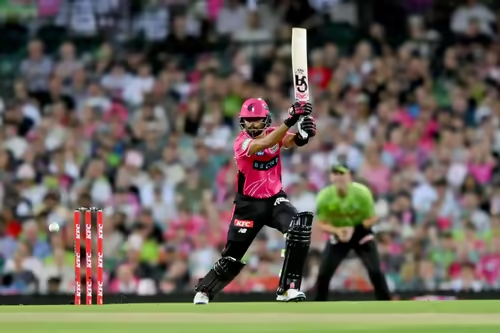
The glitz and pace of the BBL usually spotlight explosive six-hitters and lightning-fast run chases. But this season, two of Pakistan’s most celebrated stars found themselves in an uncomfortable spotlight for all the wrong reasons.
Babar Azam and Mohammad Rizwan—icons of modern Pakistani cricket—ended their BBL 2026 stints not with fanfare, but with frustration, low strike rates, and a historic first: Rizwan became the first overseas player in BBL history to be officially retired out. Meanwhile, Babar’s simmering tension with Steve Smith during a mid-pitch exchange went viral, symbolizing a campaign that never quite clicked .
Table of Contents
- The Numbers Don’t Lie: BBL’s Slowest Batters
- Babar Azam’s Frustrating BBL Campaign
- Rizwan Makes BBL History—for the Wrong Reason
- Why Tempo Matters in the BBL
- Fan and Expert Reactions
- What This Means for Pakistan’s T20 Future
- Conclusion: A Wake-Up Call for Stars
- Sources
The Numbers Don’t Lie: BBL’s Slowest Batters
Official BBL stats from the 2026 season placed both Pakistani stars at the top of an unflattering leaderboard: the slowest batters among regular overseas participants.
- Babar Azam: Strike rate of **107.48** across 8 innings (avg: 24.33)
- Mohammad Rizwan: Strike rate of **102.74** in 6 innings (avg: 19.80)
For context, the league average strike rate in BBL 2026 hovered around **142**. Even domestic middle-order anchors like Beau Webster (135+) and Aaron Hardie (128+) outpaced them. In a format where every ball counts, scoring below 110 is often seen as detrimental to team momentum—especially for top-order batters expected to set or chase aggressively .
Babar Azam’s Frustrating BBL Campaign
Signed as a marquee player for the Melbourne Stars, expectations were sky-high for Babar. Yet, he struggled to adapt to the BBL’s unique conditions: short boundaries, aggressive bowling changes, and dew-heavy evening pitches.
The nadir came during a match against Sydney Sixers, where a verbal exchange with Steve Smith—reportedly over running between wickets—ended with Babar shaking his head in visible frustration before being dismissed for just 18 off 22 balls . The moment sparked memes and debates: was Babar too rigid for T20 chaos?
His technique, so elegant in Tests and ODIs, looked hesitant against slower balls and wide yorkers—staples of Australian T20 bowling. He rarely cleared the ropes (just 3 sixes all season), relying instead on textbook cover drives that yielded singles, not boundaries.
Rizwan Makes BBL History—for the Wrong Reason
If Babar’s struggles were disappointing, Rizwan’s were historic—in the worst way possible. Playing for the Hobart Hurricanes, he was officially retired out during a must-win game against Perth Scorchers—a first for any overseas player in BBL history .
The move wasn’t tactical. It was desperate. After crawling to 14 off 19 balls while his partner raced to 40 off 20, the coaching staff signaled for him to leave the crease to inject fresh firepower. The message was brutal but clear: your presence is slowing us down.
Rizwan, known for his grit in international cricket, appeared shell-shocked. Post-match, he admitted, “I’m still learning the rhythm of this league,” but fans weren’t convinced. Social media dubbed it “the slowest retirement in BBL history.”
Why Tempo Matters in the BBL
Unlike bilateral T20Is, the BBL thrives on entertainment, speed, and unpredictability. Franchises invest heavily in overseas stars not just for runs—but for impact.
Consider recent success stories:
- Glenn Maxwell (SR: 158+): Chaos creator, boundary machine
- Nicholas Pooran (SR: 165+): Wicketkeeper who turns games in 10 balls
- David Warner (SR: 145+): Aggressive from ball one
In this ecosystem, a strike rate under 110 isn’t just poor—it’s counterproductive. Teams need accelerators, not anchors, especially in powerplays and death overs. Babar and Rizwan, despite their elite credentials, played like they were in a World Cup semifinal, not a Friday night BBL thriller.
Fan and Expert Reactions
Australian commentators didn’t hold back. Former Aussie pacer Brett Lee called it “a masterclass in how not to play T20 cricket.” Meanwhile, ex-Pakistan captain Ramiz Raja defended them, saying, “They’re class players adjusting to unfamiliar roles.”
Fans were split. Pakistani supporters blamed pitch conditions and lack of support. Australian fans questioned why franchises picked “Test-match batters” for a fireworks league. Fantasy cricket managers, meanwhile, quietly dropped both from their squads mid-season.
What This Means for Pakistan’s T20 Future
This BBL outing raises urgent questions ahead of the 2026 T20 World Cup. Can Pakistan’s core batting unit adapt to modern T20 demands? Or are they stuck in a bygone era of accumulation over acceleration?
With younger, more explosive talents like Tayyab Tahir and Irfan Khan Niazi emerging, selectors may face tough calls. Babar and Rizwan remain vital—but their roles might need redefining: perhaps as stabilizers at No. 3 or 4, not openers expected to dominate from ball one.
Conclusion: A Wake-Up Call for Stars
The BBL 2026 won’t define Babar Azam or Mohammad Rizwan’s legacies—but it should serve as a stark wake-up call. In today’s T20 world, elegance alone isn’t enough. You need explosiveness, adaptability, and the courage to fail fast.
For two of Pakistan’s finest, the lesson is clear: the game is evolving. And if even the BBL—a league known for its inclusivity—finds your tempo too slow, it’s time to rethink the approach.
Sources
- Times of India: Embarrassment for Pakistan! Babar, Rizwan top unwanted list in BBL
- Cricket Australia: BBL 2026 Official Stats
- ESPNcricinfo: BBL 2026 – Babar & Rizwan Struggle to Adapt
- [INTERNAL_LINK:bbl-player-performance-analysis]
- [INTERNAL_LINK:pakistan-t20-world-cup-prospects]