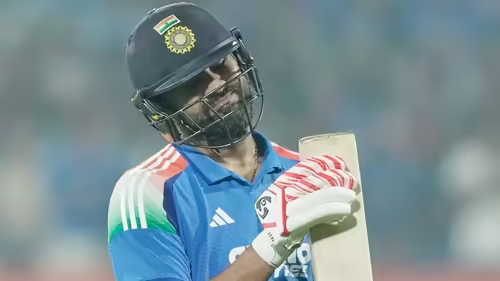
Remember the ‘Hitman’? The man who could dismantle bowling attacks before the fielding restrictions even ended? Lately, that version of Rohit Sharma seems to be taking a backseat. In the ongoing ODI series against New Zealand, India’s opener has traded flamboyance for caution—playing textbook cover drives instead of lofted sixes, prioritizing occupation over acceleration. Fans are noticing. Critics are questioning. And the numbers tell a story: his strike rate has dipped, even as his average remains respectable .
But is this a conscious reinvention—or a necessary adaptation? According to India’s assistant coach Ryan ten Doeschate, it’s less about strategy and more about circumstance. “It’s not that he’s decided to bat differently,” ten Doeschate clarified. “The pitches have been challenging, and he hasn’t had much match practice recently. He’s just playing the situation” .
As India prepares for a packed 2026 calendar—including Champions Trophy defense and bilateral marathons—the evolution of Rohit Sharma’s batting style could have far-reaching implications for the team’s top-order dynamics.
Table of Contents
- The Shift in Rohit Sharma’s Batting Style
- What the Numbers Reveal: Strike Rate vs. Average
- Ryan ten Doeschate’s Explanation: Pitch and Match Practice
- Is This a Smart Evolution or a Worrying Trend?
- How It Impacts India’s ODI Top-Order Strategy
- Historical Context: Rohit as Opener Since 2013
- What Fans and Experts Are Saying
- Conclusion: Adaptation Over Identity Crisis
- Sources
The Shift in Rohit Sharma’s Batting Style
Post the 2022 T20 World Cup, Rohit embraced an ultra-aggressive white-ball identity. He opened with intent, targeting the powerplay like a predator. But in the current series against New Zealand, especially on the seaming tracks of Pune and Mumbai, he’s shown remarkable restraint.
In the second ODI, for instance, he scored 58 off 82 balls—a solid contribution, but at a strike rate of just 70.7. Compare that to his career ODI strike rate of 89.5, and the contrast is stark. He’s leaving more balls, defending resolutely, and waiting for bad deliveries rather than manufacturing boundaries.
What the Numbers Reveal: Strike Rate vs. Average
Let’s break down the stats from his last 10 ODI innings (as of January 2026):
| Metric | Previous 20 Innings (2024–2025) | Last 10 Innings (2025–2026) |
|---|---|---|
| Average | 48.2 | 45.6 |
| Strike Rate | 92.1 | 78.4 |
| Balls per Boundary | 6.8 | 9.3 |
The data confirms: Rohit is scoring at a similar rate but rotating the strike far less aggressively. He’s not failing—he’s just playing slower.
Ryan ten Doeschate’s Explanation: Pitch and Match Practice
Ten Doeschate, himself a former all-rounder known for gritty batting, dismissed speculation of a strategic overhaul. “People forget context,” he said. “These pitches have offered seam and bounce. And Rohit hasn’t played consistent cricket since the Australia tour. You don’t walk in cold and start hitting sixes on green tops” .
Indeed, Rohit missed parts of the Bangladesh and South Africa tours due to minor injuries and rest protocols. Limited game time means reduced timing—and in testing conditions, caution becomes survival.
Is This a Smart Evolution or a Worrying Trend?
Opinions are split:
- Pro-Caution Camp: With Shubman Gill and Virat Kohli anchoring the middle, Rohit’s stability at the top provides balance. In subcontinent conditions later this year, this foundation could enable explosive finishes.
- Anti-Caution Camp: In modern ODIs, openers are expected to score 80+ in 70 balls. A 70 SR from Rohit risks putting pressure on Nos. 3–5, especially if early wickets fall.
Former selector Saba Karim noted, “Rohit’s value was his ability to shift gears. If he’s stuck in first gear, the whole engine slows down.”
How It Impacts India’s ODI Top-Order Strategy
India’s current blueprint relies on:
- Rohit & Gill: Powerplay aggression
- Kohli: Anchor + accelerator
- Suryakumar Yadav/Iyer: Middle-overs disruptors
If Rohit isn’t providing the initial surge, the burden shifts disproportionately to Gill—who’s still developing his own consistency. This could force captain Jasprit Bumrah (or whoever leads) to rethink batting orders or promote SKY earlier.
Historical Context: Rohit as Opener Since 2013
Rohit didn’t become an opener overnight. After being promoted in 2013 following Murali Vijay’s struggles, he seized the role with a record 264 against Sri Lanka. Since then, he’s amassed over 10,000 ODI runs as opener—the highest by any Indian.
His success was built on two pillars: intent and timing. If either erodes, the model falters. But veterans often adapt. As Sachin Tendulkar did in his final years, Rohit may be prioritizing longevity over fireworks.
What Fans and Experts Are Saying
Social media is divided. While some praise his “mature innings,” others lament, “Where’s the Hitman?” Cricket analyst Harsha Bhogle tweeted: “Great players evolve. But in ODIs, evolution can’t mean regression in tempo.”
For deeper insights into batting philosophy, explore our feature on [INTERNAL_LINK:modern-odi-batting-strategies].
Conclusion: Adaptation Over Identity Crisis
The truth about Rohit Sharma batting style likely lies in nuance. This isn’t a permanent personality change—it’s situational pragmatism. On flat tracks in Chennai or Bengaluru later this year, expect the six-hitting maestro to return. Until then, his caution may be India’s best insurance against early collapses.
After all, great champions don’t just entertain—they adjust. And Rohit, with three double-centuries and a World Cup final under his belt, knows better than anyone when to attack… and when to wait.
Sources
- Times of India: A different Rohit Sharma: Why India’s opener is batting more cautiously now
- ESPNcricinfo Statsguru: Rohit Sharma ODI Career Statistics
- ICC Player Rankings: Official ODI Batting Rankings (January 2026)