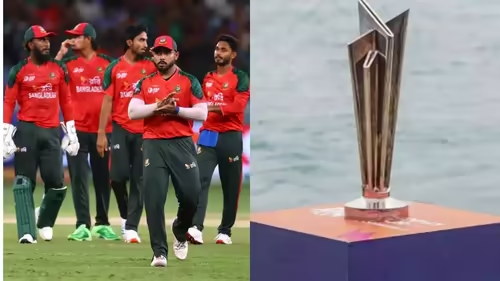
The 2026 ICC Men’s T20 World Cup is facing its first major crisis before a single ball is bowled. With Bangladesh’s participation clouded by political instability and venue security concerns, whispers of a last-minute T20 World Cup replacement have grown louder—pointing squarely at Scotland, the highest-ranked team outside the tournament. But despite the swirling rumors, Scottish cricket officials have issued a clear statement: they haven’t been contacted by the International Cricket Council (ICC), and out of respect for Bangladesh, they’re not seeking the spot .
This delicate situation has thrown the global cricket community into a state of anxious anticipation. On one hand, the integrity of the tournament demands certainty; on the other, replacing a Full Member nation like Bangladesh would be unprecedented and politically fraught. As the clock ticks toward the June 2026 start date, all eyes are on the ICC’s next move.
Table of Contents
- Why Is Bangladesh’s Participation in Doubt?
- Scotland as the Logical T20 World Cup Replacement
- Official Stances: ICC, Bangladesh, and Scotland
- Precedents and Implications for Global Cricket
- What Happens Next: Key Dates and Scenarios
- Conclusion: A Test of ICC Leadership
- Sources
Why Is Bangladesh’s Participation in Doubt?
Bangladesh was originally scheduled to co-host several matches in the 2026 T20 World Cup, part of the ICC’s strategy to expand the game’s footprint across Asia. However, following months of civil unrest, political volatility, and security warnings from multiple foreign governments, concerns have escalated about the safety of players, officials, and fans .
While the Bangladesh Cricket Board (BCB) insists the country is “fully prepared” to host, independent security assessments commissioned by participating nations have reportedly flagged high-risk scenarios. The ICC, bound by its duty of care, is now exploring contingency plans—including relocating Bangladesh’s matches or, in the most extreme scenario, removing the team from the tournament entirely .
Scotland as the Logical T20 World Cup Replacement
If the ICC does decide to replace Bangladesh, Scotland is the undisputed frontrunner. Currently ranked 11th in the ICC T20I rankings, they are the highest-placed team not already qualified for the 20-team tournament . They narrowly missed direct qualification but dominated the Europe Sub-Regional Qualifier in 2025, showcasing a balanced squad led by experienced campaigners like Richie Berrington and Michael Leask.
Crucially, Scotland has a proven track record in global events. They famously defeated England in the 2018 World Cup and have consistently punched above their weight in T20 tournaments. Their inclusion would not only maintain competitive integrity but also reward consistent performance in the qualification pathway.
Official Stances: ICC, Bangladesh, and Scotland
Despite rampant speculation, all three parties have maintained cautious public positions:
- ICC: Has not confirmed any discussions about replacing Bangladesh. A spokesperson stated, “All Full Members remain participants unless a formal decision is made by the ICC Board.”
- Bangladesh Cricket Board (BCB): Vehemently denies any threat to their participation, calling reports “baseless rumors” and reaffirming their readiness to host .
- Cricket Scotland: CEO Alan Leighton clarified, “We have not been approached by the ICC. We respect Bangladesh as a cricketing nation and would never lobby for their removal. But if asked, we’d be ready to represent Associate nations with pride” .
This diplomatic silence from the ICC suggests internal deliberations are ongoing, likely involving legal, financial, and geopolitical risk assessments.
Precedents and Implications for Global Cricket
Replacing a Full Member in a World Cup would be historic—and controversial. The closest precedent was in 2003, when Zimbabwe’s participation was nearly revoked due to political turmoil, but they ultimately played. Removing Bangladesh could set a new standard for accountability, signaling that hosting rights come with non-negotiable security obligations.
However, it could also deepen the divide between Full and Associate Members. Critics argue that such a move might undermine the ICC’s own “One Family” ethos, especially if the decision appears politically motivated rather than purely safety-driven. Conversely, supporters believe it would uphold player welfare as the top priority—a principle increasingly central to modern sport governance .
What Happens Next: Key Dates and Scenarios
The ICC faces a tight window to resolve this. Key upcoming milestones include:
- February 2026: Final venue confirmation deadline for all host countries.
- March 2026: Player registration and travel logistics must be finalized.
- April 2026: Official team announcements and warm-up schedules released.
Three likely scenarios now emerge:
- Status Quo: Bangladesh hosts as planned, with enhanced security.
- Relocation Only: Bangladesh plays, but their matches are moved to UAE or Sri Lanka.
- Full Replacement: Bangladesh is withdrawn, and Scotland is invited as the next eligible team.
Conclusion: A Test of ICC Leadership
The looming question of a T20 World Cup replacement is more than a logistical puzzle—it’s a defining moment for the ICC’s credibility. Balancing diplomacy, safety, fairness, and sporting merit requires exceptional leadership. While Scotland waits patiently in the wings, the real story is whether the global governing body can act decisively to protect the spirit of the game without sacrificing its principles. For fans, one thing is certain: the drama off the field may rival the action on it. Stay updated with our comprehensive guide on [INTERNAL_LINK:t20-world-cup-2026-schedule-teams-venues].
Sources
- “Scotland to replace Bangladesh for T20 WC? Fresh updates emerge,” Times of India.
- “Security concerns grow over Bangladesh’s T20 World Cup role,” ESPNcricinfo.
- “ICC weighs contingency plans for Bangladesh-hosted matches,” Cricbuzz.
- “ICC Men’s T20I Team Rankings – January 2026,” International Cricket Council.
- “BCB dismisses T20 WC replacement rumors,” Dhaka Tribune.
- “Cricket Scotland: Ready but respectful,” BBC Sport.
- “Player Welfare in International Cricket: A Policy Review,” International Centre for Sports Security (ICSS).