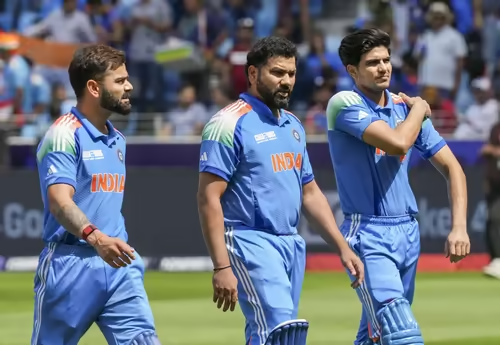
Change is coming to Indian cricket’s financial backbone—and it’s about to hit some of the game’s biggest names.
The Board of Control for Cricket in India (BCCI) is finalizing a major BCCI central contract overhaul that could see icons like Virat Kohli and Rohit Sharma dropped from the top-tier A+ category they’ve long occupied. Under the proposed new structure, the A+ grade may be eliminated entirely, replaced by a streamlined three-tier system that ties compensation directly to format participation, availability, and workload .
This isn’t just bureaucratic reshuffling—it’s a strategic pivot toward rewarding present-day contributors over legacy status. And it signals a clear message: the era of automatic top-tier retainers for part-time players is ending.
Table of Contents
- What Is the BCCI Central Contract Overhaul?
- Why Virat and Rohit May Lose A+ Status
- The New Three-Tier System Explained
- Who Benefits From the Changes?
- Player Reactions and Precedents
- Conclusion: A Fairer but Controversial Shift
- Sources
What Is the BCCI Central Contract Overhaul?
Since 2004, the BCCI has awarded annual central contracts to its top national players, categorizing them into Grades A+, A, B, and C—with corresponding retainers ranging from ₹7 crore (A+) to ₹1 crore (C) . The system was designed to ensure financial stability and commitment to national duty.
But with India’s cricket calendar now packed across all three formats—and with senior stars increasingly opting out of T20Is or Tests—the old model no longer reflects on-ground realities. Hence, the proposed overhaul aims to align pay with actual contribution.
Why Virat and Rohit May Lose A+ Status
Both Kohli and Sharma have significantly reduced their international workload in recent years:
- Rohit Sharma retired from T20Is after the 2024 World Cup and now plays only ODIs and occasional Tests.
- Virat Kohli has skipped multiple bilateral T20I series and limited his Test appearances to marquee fixtures like Border-Gavaskar or World Test Championship matches.
Under the new criteria—which reportedly weigh “number of matches played across formats” and “availability for selection”—their selective participation makes them ineligible for the highest bracket. As one BCCI insider told TOI, “If you’re not available for 80% of the season, you can’t expect an A+ retainer” .
The New Three-Tier System Explained
The proposed structure simplifies grading into just three categories:
- Tier 1: For players active in all three formats or two formats with high match count (e.g., Jasprit Bumrah, Shubman Gill).
- Tier 2: For specialists or part-timers (e.g., Ravindra Jadeja in Tests + ODIs, or Mohammed Siraj in red-ball cricket).
- Tier 3: For emerging or fringe players with limited caps but strong domestic performances.
Retainers will be recalibrated accordingly, with Tier 1 likely capped at ₹5–6 crore—down from the current ₹7 crore—but with enhanced match fees and performance bonuses to compensate active players fairly.
Who Benefits From the Changes?
The real winners will be India’s next generation:
- Yashasvi Jaiswal and Dhruv Jurel—regulars across formats—could jump straight to Tier 1.
- Rinku Singh and Arshdeep Singh, key to India’s T20I future, gain financial security despite lacking A+ legacy.
- Domestic stalwarts like Ruturaj Gaikwad may finally get recognized beyond sporadic call-ups.
This shift mirrors global trends. Cricket Australia, for instance, uses a “contribution index” that adjusts contracts quarterly based on selection and performance .
Player Reactions and Precedents
While neither Kohli nor Sharma has publicly commented, sources close to the players suggest they understand the rationale. After all, both continue to earn massively through IPL contracts (Kohli: ₹15 crore with RCB; Sharma: ₹16 crore with MI) and endorsements.
Historically, the BCCI has adjusted contracts based on form—MS Dhoni was moved to Grade B in 2019 before his World Cup swansong. But this overhaul is more systemic, embedding meritocracy into the core framework.
Conclusion: A Fairer but Controversial Shift
The BCCI central contract overhaul marks a necessary evolution—one that prioritizes current contribution over past glory. While demoting legends like Kohli and Sharma may stir emotional debate, it ensures that today’s workhorses aren’t financially overshadowed by part-time icons. In the long run, this could strengthen India’s bench depth and incentivize consistent availability. For more on how contracts shape team dynamics, explore our analysis on [INTERNAL_LINK:how-central-contracts-influence-indian-cricket].
Sources
- Times of India. “No more A+ category? BCCI plans central contract overhaul as Kohli, Rohit likely to drop A tier.” https://timesofindia.indiatimes.com/…
- BCCI Annual Player Contracts Archive (2023–24).
- Cricket Australia. “National Player Contract Structure & Guidelines.” https://www.cricket.com.au
- ESPNCricinfo. “How Boards Around the World Structure Player Retainers.”