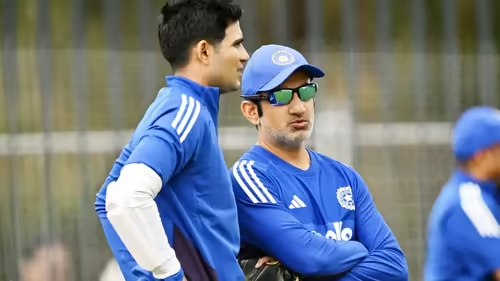
When a respected voice like Ajinkya Rahane speaks, the cricketing world listens. And his latest comments about India’s ODI woes have struck a raw nerve. In a refreshingly honest assessment, the former Test vice-captain didn’t mince words: the team’s recent failures—especially the shocking series loss to a second-string New Zealand side—are not just bad luck. They’re symptoms of deeper systemic issues under head coach Gautam Gambhir’s leadership.
“Tough questions will be asked,” Rahane said, highlighting two critical problems: relentless team changes and a lack of clarity in player roles . His message is clear: without stability and trust, even the most talented squad can’t perform consistently. And with the 2027 ODI World Cup just around the corner, time is running out to fix what’s broken.
Table of Contents
- What Rahane Said About India’s ODI Woes
- The Cost of Excessive Team Changes
- Why Player Security Matters for World Cup Success
- Gautam Gambhir’s Leadership Under Scrutiny
- The Path Forward to the 2027 World Cup
- Conclusion: Stability Over Experimentation
- Sources
What Rahane Said About India’s ODI Woes
Rahane’s critique centers on two interconnected flaws in India’s current ODI setup:
- Constant Roster Shuffling: “Too many changes after every series. Players don’t get a fair run to prove themselves or build combinations,” he noted.
- Absence of Role Clarity: Batters and bowlers are often unsure of their responsibilities within the team structure, leading to reactive rather than proactive cricket.
He emphasized that while experimentation is necessary, it must happen within a framework—not as random tinkering. “You can’t keep changing the foundation while expecting the house to stand,” he remarked, urging management to use the upcoming break in the schedule to “reset and back the right combination” .
The Cost of Excessive Team Changes
Since Gambhir took over, India’s ODI XI has seen unprecedented turnover. In the last five series alone, over 18 players have been rotated through the middle order—a position that demands consistency and confidence.
The result? A fragile batting lineup that collapses under pressure. Against New Zealand, India lost 4–5 wickets in the middle overs across all three matches, precisely where experience and settled roles are crucial. When a player knows they might be dropped after one failure, they play fearfully—not freely.
Compare this to Australia’s approach ahead of their 2023 World Cup win: they locked in a core group 18 months in advance, giving them time to gel. India, by contrast, seems stuck in perpetual trial mode.
Why Player Security Matters for World Cup Success
Rahane, known for his calm temperament and team-first attitude, stressed that “player security” isn’t about entitlement—it’s about psychological safety. “When a player knows the management believes in him, he takes ownership. He fights harder,” he explained.
This is especially vital for young talents like Yashasvi Jaiswal or Rinku Singh, who need room to fail and learn. Dropping them after one low score sends the wrong message: that short-term results trump long-term development.
For the 2027 World Cup, India needs a core of 12–14 players who understand their roles inside out. That only happens when they’re given consistent opportunities—not sporadic cameos.
Gautam Gambhir’s Leadership Under Scrutiny
Gautam Gambhir, a World Cup-winning opener himself, was appointed with high hopes. His aggressive philosophy worked wonders in the Champions Trophy. But ODI cricket demands more than just intent—it requires structure, patience, and man-management.
Critics argue that Gambhir’s “win-at-all-costs” mentality is clashing with the need for nurturing talent. His public criticism of players’ “softness” may motivate some, but it can demoralize others. Rahane’s call for “honest conversations” suggests a gap between the dressing room and the coaching staff—a dangerous disconnect in elite sport.
The challenge for Gambhir isn’t just tactics; it’s trust-building. Can he evolve from a motivator into a mentor?
The Path Forward to the 2027 World Cup
Rahane sees the next 12 months as a golden opportunity. With no major ODI tournaments until late 2026, the BCCI can use bilateral series to:
- Identify a fixed top six and stick with it for at least 10–12 matches.
- Appoint a dedicated middle-overs spin bowler (e.g., Washington Sundar or Kuldeep Yadav) and build a strategy around them.
- Hold internal camps focused on role-specific training—death hitting, powerplay bowling, field placements.
- Encourage open feedback sessions between players, coaches, and selectors.
As Rahane put it: “The break is a gift. Use it to build, not just to react.”
Conclusion: Stability Over Experimentation
Ajinkya Rahane’s intervention is a wake-up call. India’s ODI woes aren’t about talent—they’re about trust, clarity, and continuity. The Champions Trophy win proved India can be world-beaters. But trophies aren’t won in isolated bursts; they’re built through sustained excellence.
If the management heeds Rahane’s advice and prioritizes player security over constant churn, the 2027 World Cup could be India’s moment of redemption. If not, the cycle of inconsistency will continue. For more on India’s road to 2027, check out our [INTERNAL_LINK:india-2027-world-cup-preview] series.
Sources
- Times of India: ‘Tough questions…’: Rahane reveals reasons behind India’s ODI woes under Gambhir
- ESPNcricinfo: India’s ODI Team Instability: A Statistical Breakdown
- ICC Official Website: ICC Men’s Cricket Future Tours Programme
- The Hindu: Rahane urges clarity in team selection ahead of 2027 WC