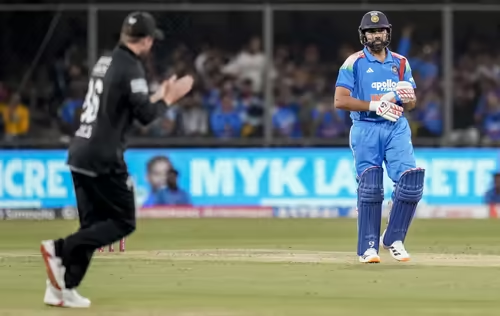
The roar of the crowd in Indore was replaced by a deafening silence as Rohit Sharma trudged back to the pavilion for just 11 runs in the decisive third ODI against New Zealand. It wasn’t just another dismissal; it was the final, feeble note in a series-long symphony of struggle for India’s white-ball captain. This performance, or lack thereof, has ignited a fierce debate: does the man who once lit up the 2023 World Cup still have the fire in his belly for the 2027 edition?
Table of Contents
- The Numbers Don’t Lie: A Series to Forget
- Simon Doull’s “Hunger” Question
- The 2027 World Cup Conundrum
- Virat Kohli’s Contrast and the Team Impact
- Conclusion: What’s Next for the Hitman?
- Sources
The Numbers Don’t Lie: A Series to Forget for Rohit Sharma
For a player of Rohit Sharma’s caliber, a bad game is an anomaly. A bad series, however, is a red flag. Across the three ODIs, his scores read a meager 24, 23, and 11, totaling just 58 runs at a paltry average of 19.33 . This was a stark contrast to his historical dominance against New Zealand, where he boasts over 1,000 runs at a solid average . On home soil, his record is even more impressive, with an average of 44.28 . This series was a complete departure from that legacy.
The most concerning aspect wasn’t just the low scores, but the manner of his dismissals—often looking tentative and out of sync. For a player whose game is built on confidence and timing, this loss of fluency is a worrying sign. His struggles were a key factor in India’s historic 2-1 series loss, their first-ever ODI series defeat to New Zealand on home soil .
Simon Doull’s “Hunger” Question
The on-field failures were quickly followed by off-field scrutiny. Former New Zealand pacer and respected commentator Simon Doull didn’t mince his words. He directly questioned Rohit Sharma’s motivation, stating, “I just wonder, that 27 World Cup in South Africa, is that too far away? Does he have that real hunger?” .
Doull’s analysis went deeper, suggesting that Rohit has always thrived when he had a clear, immediate goal in sight—like the T20 or 50-over World Cups . Now, with no major ICC event looming on the immediate horizon, the question is whether the long wait until 2027 can sustain his competitive drive. “No matter who you are,” Doull implied, the absence of a near-term target can be a powerful demotivator .
The Fragmented ODI Calendar Factor
Doull also pointed to the increasingly sparse ODI schedule as a contributing factor . With bilateral series becoming rarer and the focus shifting to T20 leagues and Test cricket, opportunities for players like Rohit to find rhythm in the 50-over format are limited. This lack of consistent game time can make it incredibly difficult to maintain peak form, especially for a veteran player whose reflexes and timing require constant sharpening.
The 2027 World Cup Conundrum
The 2027 ODI World Cup in South Africa is the official endgame for Rohit’s white-ball career. But at 38 years old by then, the path is fraught with challenges. The gap between now and then is vast, filled with countless variables—form slumps, injuries, and the emergence of younger talent. Can a player maintain the intense physical and mental discipline required for such a long haul without the regular adrenaline of high-stakes matches?
This conundrum places the BCCI and the team management in a tricky spot. Do they continue to back their experienced leader through this fallow period, banking on his ability to peak at the right time? Or do they begin a gradual transition, giving more game time to the next generation to build their own momentum towards 2027? It’s a delicate balancing act between loyalty and pragmatism.
Virat Kohli’s Contrast and the Team Impact
The narrative of Rohit’s struggles was thrown into sharp relief by his longtime teammate, Virat Kohli. While the captain faltered, Kohli stood tall, amassing a series-topping 240 runs at a magnificent average of 80.00, including a brilliant 124 in the final match . Kohli’s performance was a masterclass in consistency and application, highlighting what was missing from the top of the order.
This stark contrast within the same dressing room underscores the team’s over-reliance on its senior stars. When one pillar crumbles, the entire structure feels the strain. India’s batting lineup, which looked so formidable on paper, appeared fragile and unbalanced without a solid start from its openers. The series loss was a collective failure, but Rohit’s personal drought was its most glaring symptom. For more on how India’s batting order is evolving, check out our [INTERNAL_LINK:india-batting-order-analysis] section.
Conclusion: What’s Next for the Hitman?
The questions surrounding Rohit Sharma are no longer just about a temporary dip in form. They cut to the core of his future ambition and his role in the Indian setup. Simon Doull’s comments about his “real hunger” have resonated because they articulate a fear many fans share. The road to the 2027 World Cup is long, and the recent series against New Zealand has shown that the journey will be anything but smooth. The onus is now on Rohit to answer these doubts not with words, but with runs, proving that the fire of the Hitman still burns bright.
Sources
- Times of India: ‘No matter who you are’: Rohit’s ‘real hunger’ questioned after poor series
- ESPNcricinfo: New Zealand tour of India, 2026 Statistics [[3], [21]]
- Cricket.com: Rohit Sharma vs New Zealand ODI Records & Stats [[4], [8]]
- Sportskeeda: Simon Doull Questions Rohit Sharma’s Hunger For 2027 World Cup [[18], [15]]
- NDTV Sports: IND vs NZ ODIs recap: A rare Kiwi heartbreak for the Men in Blue [[24], [27]]