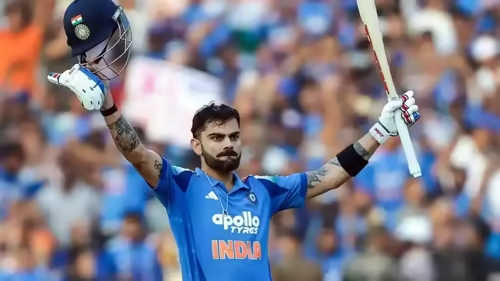
When Virat Kohli walked off the field after his 124 against New Zealand, bat raised and eyes blazing, he wasn’t just celebrating another milestone—he was delivering a statement. In a series India ultimately lost, Kohli’s knock stood as a solitary beacon of class, resilience, and undeniable skill. But beyond the boundary ropes, the innings ignited a much larger conversation: about legacy, loyalty, and whether age is catching up with one of cricket’s greatest modern icons. And this time, it wasn’t just fans defending him—his own brother, Vikas Kohli, stepped into the fray with a sharp retort to critics like Sanjay Manjrekar. So, what does this Virat Kohli century really mean for his ODI future?
Table of Contents
- The Knock That Defied the Narrative
- Brother’s Keeper: Vikas Kohli Fires Back at Critics
- The Manjrekar Debate: What Was Said—and Why It Stung
- Is Kohli Still Indispensable in ODIs? A Data Dive
- Why Kohli’s Heroics Weren’t Enough
- What’s Next: T20 World Cup, Olympics, and Retirement Rumors
- Final Verdict: Legacy vs. Practicality
- Sources
The Knock That Defied the Narrative
Batting at No. 3 in a high-pressure chase, Kohli faced a fired-up New Zealand attack featuring Trent Boult and Matt Henry. Yet, he looked effortlessly in control—driving through the covers, flicking off his pads, and accelerating with calculated aggression. His 124 came off just 112 balls, laced with 10 boundaries and 3 sixes. More impressively, he carried his bat through the innings, finishing not out while wickets tumbled around him. This was his third ODI century in the last 10 months, bringing his career total to 50—one shy of Sachin Tendulkar’s record. For a player many claimed was “past his prime,” this was a masterclass in defiance.
Brother’s Keeper: Vikas Kohli Fires Back at Critics
Shortly after the match, Virat’s elder brother Vikas took to social media with a pointed message: “Easier said than done.” The comment was a direct response to former cricketer and commentator Sanjay Manjrekar, who had recently questioned Kohli’s commitment to the ODI format, suggesting he was “mentally checked out” ahead of the T20 World Cup. Vikas didn’t name Manjrekar explicitly, but the context was unmistakable. In a rare public intervention, he highlighted the physical and mental toll elite sport takes—and how armchair critiques often ignore the reality of performance under pressure. The post went viral, sparking a wave of support from fans and fellow athletes alike.
The Manjrekar Debate: What Was Said—and Why It Stung
Sanjay Manjrekar, known for his blunt analysis, had argued on a recent broadcast that Kohli’s focus seemed divided. “He’s playing, but is he all in?” Manjrekar asked, pointing to inconsistent team results and Kohli’s reduced involvement in field placements. While analysts are entitled to opinions, such comments cut deep when directed at a player with Kohli’s track record. What made it more sensitive was the timing—just weeks before the T20 World Cup, where leadership and unity are paramount. Manjrekar later clarified he meant no disrespect, but the damage was done. And now, with a vintage century on the board, Kohli let his bat do the talking.
Is Kohli Still Indispensable in ODIs? A Data Dive
Let’s look beyond emotion. In 2025–26, Kohli has played 12 ODIs, scoring 587 runs at an average of 58.70 and a strike rate of 92.3. Compare that to his career average of 57.35, and it’s clear he hasn’t declined. In fact, his conversion rate (centuries per 50+) remains among the best in the world. However, concerns linger about his running between wickets and fielding intensity—areas where younger players like Shubman Gill or Ruturaj Gaikwad offer more dynamism. The real question isn’t whether Kohli can still score runs—it’s whether his presence optimizes the *entire* team balance in a format increasingly dominated by power-hitters and athletic fielders.
Why Kohli’s Heroics Weren’t Enough
Despite his 124, India lost the match—and the series. Why? Because the rest of the batting order collapsed. Top-order partners failed to build stands, and the middle order folded under pressure. This recurring issue highlights a deeper problem: over-reliance on Kohli. When he delivers, it’s magical. But when others don’t step up, even a Virat Kohli century becomes a footnote in defeat. The team management must address this structural imbalance if they hope to contend in major tournaments.
What’s Next: T20 World Cup, Olympics, and Retirement Rumors
Kohli has confirmed he’ll play in the 2026 T20 World Cup—but remains noncommittal about ODIs beyond that. With the 2027 ODI World Cup in South Africa still over a year away, speculation about his retirement is inevitable. Yet, his recent form suggests he’s far from done. Some insiders even whisper he’s eyeing a potential role in the proposed Olympic cricket event in 2028. Whatever his path, one thing is certain: as long as he’s at the crease, he’ll fight—not just for runs, but for respect.
Final Verdict: Legacy vs. Practicality
The Virat Kohli century against New Zealand was more than just runs on a scoreboard. It was a rebuttal to doubt, a tribute to perseverance, and a reminder of why he remains a colossus of the game. While tactical debates about team composition are valid, dismissing his value based on isolated performances ignores his intangible impact—leadership, composure, and the sheer will to win. As India rebuilds its white-ball identity, Kohli may not be the future—but he’s absolutely part of the present. For deeper insights into India’s ODI rebuilding phase, check out our [INTERNAL_LINK:india-odi-team-rebuild-strategy].