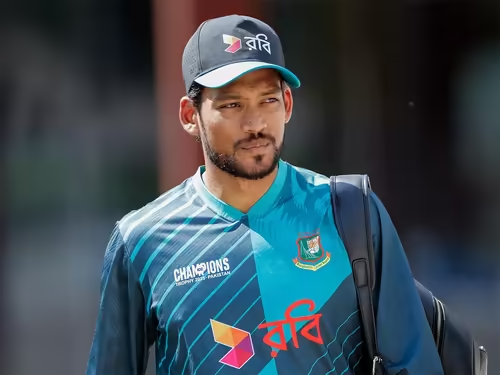
“We want to play.” These four simple words, uttered by Bangladesh’s star batter and Test captain Najmul Hossain Shanto, carry the weight of an entire nation’s cricketing hopes . While the world focuses on the political and administrative chess game between the Bangladesh Cricket Board (BCB) and the International Cricket Council (ICC), it’s the players who are caught in the crossfire, their dreams of competing on the global stage at the T20 World Cup shrouded in uncertainty.
Table of Contents
- The Players’ Plea: From the Heart
- The BCB Stance: Security Concerns and a Firm ‘No’
- The ICC Dilemma: A Global Tournament at Stake
- Possible Scenarios: What Happens Next?
- Conclusion: A Tale of Two Agendas
- Sources
The Players’ Plea: From the Heart
For the athletes who have trained their entire lives for this moment, the ongoing dispute is more than just a news headline—it’s a personal crisis. Shanto has been candid about the mental toll this uncertainty is taking on the squad. “It’s affecting us but we’re acting as if it’s ok,” he admitted, revealing the emotional strain behind their professional facade .
The players see the T20 World Cup as a golden opportunity to prove themselves on the international stage. Their recent performances have shown promise, and they are eager to translate that potential into results. Being denied the chance to compete, not because of their skill but due to external factors, is a bitter pill to swallow. Their collective message is clear: they are ready, willing, and desperate to represent their country .
The BCB Stance: Security Concerns and a Firm ‘No’
In stark contrast to the players’ eagerness, the BCB has maintained an unwavering position. The board has officially refused to send the national team to India for the tournament, citing “serious security concerns” as the primary reason . This stance was formally communicated to the ICC, with the BCB requesting that all of Bangladesh’s matches be moved to the co-host, Sri Lanka .
The BCB’s resolve appears unshakeable. They have rejected what they call “unreasonable ICC conditions” for participation and have stated they will not bow to pressure from the global governing body . This firmness suggests that the issue goes beyond mere logistics and may be deeply intertwined with broader political and diplomatic sensitivities between the two nations.
The ICC Dilemma: A Global Tournament at Stake
The ICC finds itself in an incredibly difficult position. On one hand, it must uphold the integrity of its flagship event, which is scheduled to be held across multiple venues in India and Sri Lanka . Allowing a team to unilaterally demand a venue change sets a dangerous precedent for future tournaments.
On the other hand, the absence of a full-member nation like Bangladesh would be a massive blow to the tournament’s credibility and commercial success. Reports indicate that the ICC has already rejected the BCB’s request to shift the matches to Sri Lanka . The situation has even drawn support from an unexpected quarter, with the Pakistan Cricket Board (PCB) writing to the ICC in support of Bangladesh’s stance and even offering to host their matches in Pakistan .
Possible Scenarios: What Happens Next?
With the ICC Board set to meet for a final decision, the cricketing world is holding its breath. Several outcomes are possible:
- Bangladesh Backs Down: The BCB could reverse its decision and agree to play in India, allowing the players to fulfill their dream. However, given their public statements, this seems unlikely .
- ICC Concedes: The ICC could make an exception and move Bangladesh’s matches to Sri Lanka or another neutral venue. This would preserve the team’s participation but damage the ICC’s authority .
- Bangladesh Withdraws: If no compromise is reached, Bangladesh may be forced to withdraw from the tournament entirely. This would be a devastating outcome for the players and fans alike, and could lead to financial penalties for the BCB .
- A Last-Minute Compromise: A creative solution, perhaps involving heightened security guarantees or a specific set of neutral venues, could be brokered at the eleventh hour.
For a deeper look at the historical context of India-Bangladesh cricketing relations, see our analysis on [INTERNAL_LINK:india-bangladesh-cricket-rivalry-history].
Conclusion: A Tale of Two Agendas
The current standoff over the T20 World Cup is a poignant story of conflicting priorities. The players’ agenda is pure and simple: to play cricket for their country. The BCB’s agenda, however, is entangled in complex layers of security, politics, and national interest. As the ICC prepares to make its final call, the fate of Bangladesh’s World Cup campaign—and the dreams of its cricketers—hangs in the balance. One can only hope that a solution is found that respects both the players’ passion and the legitimate concerns of the board.
Sources
- Times of India: ‘We want to play’: B’desh batter voices players’ plea as standoff deepens
- Live updates on BCB’s refusal and ICC conditions: , ,
- Najmul Hossain Shanto’s statements on player sentiment: , , ,
- ICC’s venue announcement and potential decisions: , ,
- PCB’s support for Bangladesh’s stance: ,