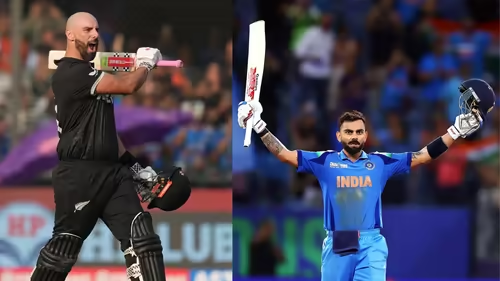
Cricket fans, brace yourselves—there’s a new king in ODI cricket. In a development that’s sent shockwaves through the cricketing world, New Zealand’s Daryl Mitchell has officially claimed the No.1 ODI batting ranking, ending Virat Kohli’s long-standing reign near the top. This isn’t just a routine shuffle in the ICC charts; it’s a symbolic passing of the torch, powered by sheer performance under pressure during the recent India tour. And while Kohli steps down, Rohit Sharma’s slide to fourth place adds another layer to India’s evolving white-ball narrative. Let’s unpack how Mitchell pulled off this quiet revolution—and what it signals for the future of international batting.
Table of Contents
- How Daryl Mitchell Seized the No.1 ODI Batting Ranking
- Why Kohli and Rohit Slipped Down the Rankings
- Understanding the ICC ODI Ranking System
- Historical Context: Past No.1 ODI Batters
- What This Means for New Zealand and India
- Conclusion: A New Era of ODI Batting?
- Sources
How Daryl Mitchell Seized the No.1 ODI Batting Ranking
Daryl Mitchell didn’t just climb the rankings—he stormed them. During New Zealand’s ODI series against India in January 2026, the all-rounder smashed consecutive centuries: 112* in the first match and 103 in the second . These weren’t just runs; they were match-defining innings on challenging subcontinental pitches, often under scoreboard pressure. His ability to anchor the innings while accelerating when needed showcased a maturity rarely seen in modern ODI batting.
With these performances, Mitchell accumulated 845 rating points—the highest in the format—surpassing Virat Kohli’s 837 . What makes this feat even more remarkable is that Mitchell achieved it without the global spotlight that usually follows Indian or Australian stars. He’s the quiet assassin of world cricket, and now, he’s officially the best.
Why Kohli and Rohit Slipped Down the Rankings
Virat Kohli, who had been hovering near the top for over a decade, hasn’t played an ODI since the 2023 World Cup final—a gap that’s now catching up with his ranking. While his legacy remains untouchable, the ICC system rewards current form and recency. Without recent matches, his points naturally decayed.
Rohit Sharma’s fall to fourth place is equally telling. The Indian captain managed only 38 and 22 in the first two ODIs against New Zealand . Consistency has been a growing concern for Sharma in bilateral series, despite his tournament brilliance. The drop reflects not just poor scores, but a broader trend: India’s top order is under scrutiny as the team transitions toward the next World Cup cycle.
Understanding the ICC ODI Ranking System
For fans wondering how one player can overtake legends so quickly, here’s how the ICC system works:
- Points are awarded based on runs scored, quality of opposition, and match result.
- Recent performances carry more weight than older ones (a rolling 3–4 year window).
- A player’s rating = total points ÷ number of matches (with a minimum threshold).
This means a red-hot streak—like Mitchell’s—can rapidly boost a player’s average, while inactivity or low scores drag others down. It’s a meritocratic but unforgiving model. For a deeper dive, explore [INTERNAL_LINK:how-icc-rankings-work].
Historical Context: Past No.1 ODI Batters
Mitchell joins an elite club. Since the ICC introduced official ODI rankings in the early 2000s, only a handful have held the top spot:
- Sachin Tendulkar
- Ricky Ponting
- AB de Villiers
- Virat Kohli (multiple stints)
- Babar Azam
Kohli last held the No.1 position in 2023. Before him, Babar Azam’s reign symbolized Pakistan’s batting renaissance. Now, Mitchell’s ascent marks New Zealand’s growing influence in white-ball cricket—a nation once seen as perennial underdogs, now producing world-class technicians.
What This Means for New Zealand and India
For New Zealand, Mitchell’s rise is validation of their patient, skill-first development philosophy. Alongside Glenn Phillips (now ranked 20th) and Devon Conway, they’ve built a deep, adaptable batting lineup perfect for multi-format success.
For India, it’s a wake-up call. With Kohli aging and Rohit inconsistent, the team must accelerate its batting rebuild. Youngsters like Shubman Gill and Yashasvi Jaiswal need more responsibility. As the 2027 ODI World Cup approaches, relying on past glory won’t cut it. The rankings don’t lie—and right now, they’re flashing a warning signal.
Conclusion: A New Era of ODI Batting?
Daryl Mitchell’s claim to the No.1 ODI batting ranking is more than a personal triumph—it’s a sign of shifting tides in world cricket. The era of Indian batting dominance is being challenged by a new generation of global stars who blend grit, innovation, and consistency. While Kohli and Rohit remain icons, the rankings reflect a simple truth: in sport, the present always overtakes the past. Whether Mitchell can hold onto the top spot—or if India’s young guns will respond—will be one of the most compelling storylines of 2026.
Sources
- Times of India: Mitchell dethrones Kohli to claim No.1 ODI ranking
- ICC Official Rankings: ICC Men’s ODI Batting Rankings
- ESPNcricinfo Statsguru: Historical ODI Performance Data