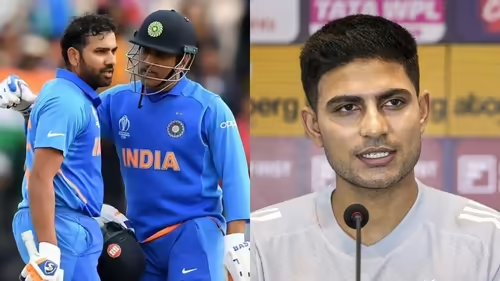
Shubman Gill’s Captaincy Under Fire: Ashwin Questions Leadership After India’s ODI Series Loss to New Zealand
India’s unexpected 2-1 defeat to New Zealand in the recent ODI series has done more than just dent the team’s record—it’s ignited a fierce debate about the future of its leadership. At the center of the storm is young skipper Shubman Gill, whose tactical choices during the high-stakes contest have drawn pointed criticism from none other than legendary off-spinner and former national player, R Ashwin.
On his widely followed YouTube channel, Ashwin didn’t mince words: “Why do we praise Rohit Sharma and MS Dhoni?” he asked, directly contrasting their decisive, pressure-applying captaincy with what he described as Gill’s “cautious” and “plan-less” approach during critical phases of the game . This critique has thrust the spotlight onto whether Gill—despite his batting brilliance—is truly ready to steer India through complex, high-pressure ODI contests.
Table of Contents
- Ashwin’s Scathing Assessment of Gill’s Tactics
- The Middle Overs Meltdown: Where India Lost Control
- Why Was Kuldeep Yadav Underused?
- Rohit & Dhoni vs. Gill: A Leadership Gap?
- Is There a Case to Defend Gill’s Captaincy?
- Conclusion: A Learning Curve or a Red Flag?
- Sources
Ashwin’s Scathing Assessment of Gill’s Tactics
Ashwin’s core argument centers on a lack of clarity in India’s bowling deployment, particularly during the crucial middle overs (overs 11–40). “There was no sense of building pressure,” he stated. “You could see the Kiwi batters were comfortable. No one was challenged.”
He emphasized that great captains like MS Dhoni and Rohit Sharma excelled at creating “moments of tension”—using field placements, bowling changes, and psychological tactics to force errors. In contrast, Ashwin felt Gill appeared reactive rather than proactive, often waiting for things to happen instead of making them happen.
The Middle Overs Meltdown: Where India Lost Control
Statistically, the middle overs told a damning story. Across the three matches, New Zealand scored at a healthy 5.8 runs per over during this phase, losing only 3.2 wickets on average—far too few to restrict a competitive total .
Gill’s reliance on part-timers like Suryakumar Yadav and Washington Sundar in high-leverage situations, while holding back frontline spinners, raised eyebrows. In the decider at Eden Park, for instance, Kuldeep Yadav bowled just 7 overs despite being India’s most economical bowler in the series.
Shubman Gill captaincy under fire: Why Was Kuldeep Yadav Underused?
One of Ashwin’s sharpest criticisms was the limited role given to Kuldeep Yadav—a wrist-spinner ideally suited to disrupt rhythm in New Zealand’s conditions. “If you’re not using your best weapon when the game is on the line, what’s the plan?” Ashwin questioned.
Consider this comparison:
- Kuldeep Yadav: 7 overs bowled in Match 3, economy of 4.14.
- Washington Sundar: 10 overs, economy of 5.90.
The data suggests a missed opportunity. While Gill may have been managing workloads or reading matchups, the outcome—New Zealand comfortably chasing 270+—undermines that logic.
Rohit & Dhoni vs. Gill: A Leadership Gap?
Ashwin’s rhetorical question—“Why do we praise Rohit and Dhoni?”—cuts to the heart of the issue. Both former captains were known for their calm authority and ability to make bold calls under duress.
- MS Dhoni famously backed part-timers like Joginder Sharma in high-stakes moments (2007 T20 World Cup final) but always with a clear intent to contain or attack.
- Rohit Sharma used spin aggressively in ODIs, often giving Kuldeep and Chahal 10-over spells to dominate the middle phase.
Gill, by contrast, appears to be still learning how to balance aggression with control—a gap that becomes glaring in tight contests.
Is There a Case to Defend Gill’s Captaincy?
Fairly, Gill is in his infancy as full-time ODI captain. He’s leading a transitional side with several new faces, and the absence of Jasprit Bumrah (rested) and Mohammed Shami (injury) weakened the bowling attack significantly.
Moreover, New Zealand’s home advantage, especially at venues like Eden Park where swing and seam favor the hosts, cannot be ignored. Some analysts argue that expecting Gill to replicate Dhoni’s instinctive genius immediately is unrealistic .
[INTERNAL_LINK:india-new-zealand-cricket-rivalry] has always been fiercely contested, and losses here are not uncommon—even for seasoned skippers.
Conclusion: A Learning Curve or a Red Flag?
The scrutiny around Shubman Gill captaincy under fire is not just about one series—it’s about whether India can afford a prolonged learning phase in a World Cup cycle. With the 2027 ODI World Cup on the horizon, the BCCI must decide: is Gill a captain-in-development who needs time, or is his cautious style fundamentally misaligned with modern ODI demands?
Ashwin’s critique, while harsh, serves a vital purpose: it forces a conversation about leadership standards. For Gill, the path forward is clear—he must develop a bolder, more assertive tactical identity. Because in international cricket, talent alone doesn’t win series. Strategy does.
Sources
- Times of India: ‘Why do we praise Rohit and Dhoni?’ – Gill’s captaincy under fire
- ESPNcricinfo Statsguru: India vs New Zealand ODI Series 2026 – Bowling Analysis
- ICC Official Website: ODI Team Rankings and Player Profiles