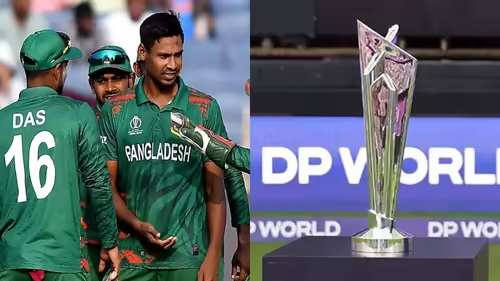
The countdown to the T20 World Cup 2026 was supposed to be filled with team announcements, pitch reports, and fantasy league buzz. Instead, it’s being overshadowed by high-stakes geopolitical tension. In a move that has sent shockwaves through the cricketing world, the Pakistan Cricket Board (PCB) has officially backed Bangladesh’s stance to avoid playing any matches in India during the upcoming tournament .
This isn’t just about logistics—it’s about sovereignty, security, and the fragile line between sport and statecraft. With the International Cricket Council (ICC) set to hold a critical meeting soon to decide Bangladesh’s fate, the entire structure of the T20 World Cup 2026 now hangs in the balance.
Table of Contents
- Bangladesh’s Stand and PCB’s Backing
- Why the T20 World Cup 2026 Is at a Crossroads
- Historical Context: India-Bangladesh-Pakistan Cricket Diplomacy
- What the ICC Can (and Cannot) Do
- Possible Scenarios for the Tournament
- Fan Reactions and Commercial Implications
- Conclusion: A Test for Cricket’s Global Unity
- Sources
Bangladesh’s Stand and PCB’s Backing
Bangladesh Cricket Board (BCB) recently informed the ICC that its national team would not travel to India for their scheduled fixtures in the T20 World Cup 2026, citing “political and security concerns” . While the BCB hasn’t publicly detailed the specific threats, regional tensions and past incidents have fueled longstanding anxieties among some visiting teams.
Enter the PCB. In a rare show of solidarity, Pakistan’s board has formally written to the ICC in support of Bangladesh’s position. This is significant—not only because Pakistan itself has a complex history with hosting and touring India, but because it adds diplomatic weight to Bangladesh’s request. The PCB’s letter reportedly urges the ICC to consider “alternative arrangements” to ensure all full members can participate without compromising their safety or national interests .
Why the T20 World Cup 2026 Is at a Crossroads
The ICC has repeatedly stated that the tournament schedule will not change. India, as a co-host (alongside Sri Lanka and possibly others), is expected to stage high-profile matches, including potential semi-finals. But if two major Asian teams—Bangladesh and potentially Pakistan—refuse to play on Indian soil, the integrity of the competition is compromised.
Imagine a World Cup where top-ranked teams are absent from key venues. It’s not just unfair to fans; it undermines the very concept of a global championship. The T20 World Cup 2026 could become a fragmented event, with neutral venues or last-minute relocations causing chaos in broadcasting, ticketing, and team preparations.
Historical Context: India-Bangladesh-Pakistan Cricket Diplomacy
This isn’t the first time politics has intruded on the cricket pitch:
- Pakistan vs. India: Since 2008, bilateral series between the two nations have been suspended due to political tensions. They only meet in ICC events.
- Bangladesh in India: While Bangladesh has toured India regularly, security concerns have occasionally flared—especially after incidents like the 2016 Dhaka cafe attack, which heightened regional anxiety.
- Neutral Venues: In the past, the ICC has moved matches to neutral locations (e.g., UAE, Sri Lanka) to accommodate political sensitivities, as seen during the 2009 Champions Trophy.
For more on how politics shapes cricket, see our deep dive on [INTERNAL_LINK:cricket-and-geopolitics-in-south-asia].
What the ICC Can (and Cannot) Do
The ICC operates under a delicate balance of commercial interests, sporting fairness, and member autonomy. Legally, it can:
- Relocate matches to neutral venues (e.g., UAE, Oman, or Sri Lanka).
- Impose fines or sanctions on boards that withdraw without valid cause.
- Declare forfeits if a team refuses to play.
However, forcing a sovereign nation to send its players into a perceived hostile environment is not within its power. The ICC’s own regulations recognize “force majeure” and “security risks” as legitimate grounds for withdrawal—if properly documented .
According to the ICC’s official communications, the governing body remains “committed to delivering a safe, inclusive, and competitive tournament for all participants.” But “inclusive” becomes meaningless if teams feel unsafe.
Possible Scenarios for the Tournament
As the ICC meeting approaches, three outcomes seem most likely:
- Full Relocation: All Bangladesh (and possibly Pakistan) matches are moved to a neutral hub like Colombo or Dubai. This preserves participation but disrupts the original hosting vision.
- Partial Compromise: Only high-risk matches (e.g., India vs. Bangladesh) are moved, while other games proceed in India. This is logistically messy but politically palatable.
- Hardline Stance: ICC refuses to budge, leading Bangladesh to withdraw. This would trigger a massive backlash and could prompt other nations to reconsider future tournaments in politically sensitive regions.
Fan Reactions and Commercial Implications
Cricket fans across South Asia are divided. Many Indian supporters argue that India has hosted international teams safely for decades and that the concerns are exaggerated. Meanwhile, fans in Bangladesh and Pakistan express solidarity with their boards’ cautionary approach.
Commercially, broadcasters like Star Sports and sponsors such as Adidas or PepsiCo face uncertainty. Ad revenue, viewership projections, and merchandise sales all hinge on marquee matchups—especially India vs. Bangladesh or India vs. Pakistan. If those games are moved to neutral venues or canceled, the financial impact could run into hundreds of millions of dollars .
Conclusion: A Test for Cricket’s Global Unity
The T20 World Cup 2026 was meant to celebrate the fastest-growing format of the game. Instead, it’s becoming a litmus test for whether cricket can transcend borders in an increasingly fractured world. The PCB’s support for Bangladesh isn’t just about one tournament—it’s a signal that smaller nations won’t be pressured into compromising their security for the sake of a schedule.
The ICC now faces its toughest challenge in years: uphold the spirit of global sport while respecting the real-world complexities its members navigate. One thing is certain—whatever decision is made in that upcoming meeting will shape the future of international cricket for years to come.
Sources
- Times of India: PCB backs Bangladesh in venue standoff, writes to ICC ahead of crucial meet
- ICC Official Website: International Cricket Council – Governance & Regulations
- ESPNcricinfo: Historical coverage of India-Bangladesh-Pakistan cricket relations
- SportBusiness: Commercial impact of geopolitical disruptions in sports