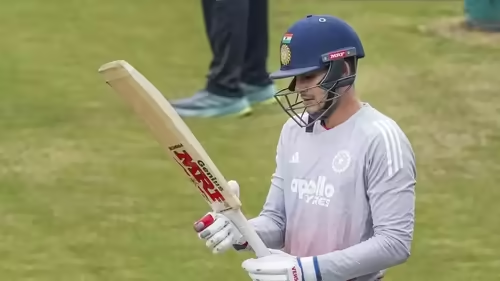
For decades, the Ranji Trophy was the sacred proving ground for Indian Test cricketers—a place where technique, temperament, and endurance were forged over five long days. But today, that legacy is under threat. The 2025–26 season has been fractured by a 63-day mid-season pause to accommodate white-ball tournaments, forcing players to abruptly switch from red-ball discipline to T20 explosiveness and back again.
The result? Confused batsmen, fatigued fast bowlers, and a growing sense among players that red-ball cricket is no longer a priority—even as India prepares for a packed Test calendar, including the World Test Championship cycle .
Table of Contents
- The Fractured Ranji Schedule
- Ranji Trophy: Why It Still Matters
- Players Struggle with Format Switching
- The Fast Bowler Workload Crisis
- Is Red-Ball Cricket Losing Relevance?
- What Needs to Change?
- Conclusion
- Sources
The Fractured Ranji Schedule
This season’s Ranji Trophy began in January, only to be halted in early February for the Syed Mushtaq Ali Trophy (T20) and Vijay Hazare Trophy (List A). Play won’t resume until April—creating a jarring 63-day gap in the middle of a first-class competition .
Compare this to England’s County Championship or Australia’s Sheffield Shield, which run uninterrupted blocks of red-ball cricket. In India, however, the domestic calendar bends to the commercial might of white-ball leagues, even at the cost of player development and competitive integrity.
Ranji Trophy: Why It Still Matters
Despite the rise of T20 leagues, the Ranji Trophy remains the primary pipeline for Test talent. Over 90% of India’s current Test squad—including stars like Jasprit Bumrah, Ravichandran Ashwin, and Shubman Gill—cut their teeth in this tournament .
Red-ball cricket teaches skills that T20 simply cannot: how to build an innings over sessions, how to read subtle pitch changes, and how to bowl sustained spells with control. These are non-negotiable for international success in the longest format.
Players Struggle with Format Switching
“It’s like asking a marathon runner to sprint, then go back to running 42 kilometers,” said one unnamed domestic all-rounder. “Your body and mind don’t reset that quickly.”
Batsmen report difficulty re-adjusting to the patience required in red-ball cricket after weeks of aggressive shot-making. Bowlers, especially spinners, find it hard to recalibrate line and length when they’ve been bowling flatter, quicker deliveries in T20s.
This whiplash effect is already visible in performance metrics. Early-season Ranji averages were solid, but post-break form is expected to dip sharply as players scramble to re-adapt.
The Fast Bowler Workload Crisis
Fast bowlers are hit hardest. They’re expected to bowl 15–20 overs in a Ranji match, then switch to 4-over T20 spells, then return to red-ball intensity—all without adequate recovery time.
Medical experts warn this erratic workload pattern increases injury risk. “The body thrives on consistency,” explains Dr. Abhijit Salvi, former BCCI physiotherapist. “Constantly shifting between high-intensity bursts and long spells disrupts biomechanical rhythm” .
With India’s pace attack already stretched thin across formats, this scheduling chaos could have long-term consequences for national team depth.
Is Red-Ball Cricket Losing Relevance?
The scheduling sends a clear message: white-ball cricket pays the bills; red-ball is an afterthought. Broadcast deals, sponsorships, and fan engagement all favor T20s, pressuring the BCCI to prioritize shorter formats.
But this short-term thinking could undermine India’s Test dominance. As legendary coach Ravi Shastri once said, “You can’t build a Test champion in a T20 lab” . Without a strong, uninterrupted Ranji Trophy, the pipeline dries up.
What Needs to Change?
Experts and players alike are calling for a complete overhaul of the domestic calendar:
- Run the Ranji Trophy in a single, uninterrupted block (e.g., November to February), before the IPL window.
- Limit white-ball tournaments to pre- or post-Ranji slots, not mid-season breaks.
- Introduce mandatory rest periods for fast bowlers during format transitions.
- Elevate broadcast and media coverage of the Ranji Trophy to restore its prestige .
Until then, India risks producing T20 specialists who can’t survive Day 4 of a Test match in England or Australia.
Conclusion
The Ranji Trophy isn’t just another tournament—it’s the bedrock of Indian Test cricket. By fracturing its season for the sake of white-ball convenience, the BCCI is sacrificing long-term excellence for short-term gains. Players are doing their best to adapt, but the system is working against them. If India wants to remain a red-ball powerhouse, it must treat its premier domestic competition with the respect it deserves. The clock is ticking. For more on India’s Test future, explore our deep dive into [INTERNAL_LINK:india-test-team-pipeline-crisis].
Sources
- Times of India: After white-ball glut, players return to red-ball cricket as Ranji resumes
- BCCI: Domestic Player Development Pathway
- ESPNCricinfo: India’s Fast Bowling Injury Crisis – What Needs to Change?
- The Guardian: Ravi Shastri on the Future of Test Cricket
- Cricbuzz: Why Ranji Trophy Needs a Revamp to Save Indian Test Cricket