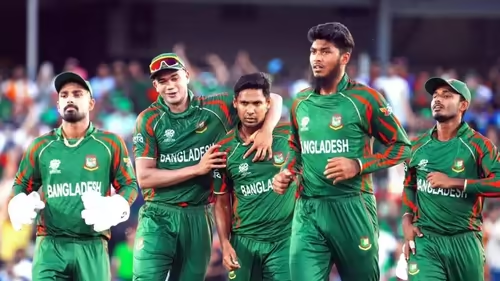
It’s a scene ripped straight from the history books, playing out once again on cricket’s grandest stage. The Bangladesh Cricket Board (BCB) has officially refused to send its national team to the ICC Men’s T20 World Cup 2026 in India, claiming a “lack of justice” from the global governing body . This bold move has thrown the tournament into disarray and triggered a high-stakes standoff with the ICC. The stakes couldn’t be higher: the ICC has issued a firm ultimatum, and all signs point to Scotland—the same nation that replaced Bangladesh in a previous ICC event row—being ready to step into the breach. This isn’t just a scheduling conflict; it’s a full-blown Bangladesh ICC boycott that threatens to reshape the tournament and strain international cricketing relations.
Table of Contents
- The Bangladesh ICC Boycott: A Déjà Vu Crisis
- Why Bangladesh Is Crying Foul Over ‘Venue Justice’
- The ICC Ultimatum and Scotland’s Ready Position
- A Look Back: The Last Time Bangladesh Was Replaced
- What This Means for the Future of Cricket Diplomacy
The Bangladesh ICC Boycott: A Déjà Vu Crisis
The core of the current dispute is Bangladesh’s refusal to play its scheduled matches in India. The BCB has formally requested that these games be moved to a neutral venue, a plea that the ICC has flatly rejected, citing the sanctity of the pre-approved tournament schedule . In response, Bangladesh has escalated its stance, framing the issue not just as a security concern but as a matter of fundamental fairness and justice from the ICC. This narrative of being wronged by the global body has hardened their position, making compromise seem increasingly unlikely. The resulting Bangladesh ICC boycott has created a massive logistical and political headache for the ICC, which is now faced with the unenviable task of either bending its rules or finding a replacement team at short notice.
Why Bangladesh Is Crying Foul Over ‘Venue Justice’
While security concerns have been mentioned, the BCB’s official language centers on a perceived lack of “justice.” This sentiment appears to stem from a series of recent events that have soured relations between the two cricketing boards. A major flashpoint was the abrupt removal of a key Bangladeshi player from the Indian Premier League (IPL), an incident that was widely seen in Dhaka as a diplomatic snub and a sign of a hostile environment . The BCB feels that the ICC has failed to address their grievances adequately, leading them to conclude that participating in India would be an act of submission rather than sport. This framing turns the issue from a simple travel advisory into a complex matter of national pride and institutional fairness.
The ICC Ultimatum and Scotland’s Ready Position
The ICC’s response has been swift and uncompromising. They have made it clear that the tournament will proceed as planned in India, and any team that refuses to participate will forfeit its spot. With this ultimatum hanging over them, Bangladesh’s time to reverse course is running out. Waiting in the wings is Scotland, a team that has been consistently performing well in the ICC’s qualification pathway and is fully prepared to take on the challenge . Their inclusion would not only maintain the tournament’s integrity but also provide a thrilling underdog story for fans. The ICC has already begun the necessary logistical preparations for this potential switch, signaling their confidence that Bangladesh will not back down.
A Look Back: The Last Time Bangladesh Was Replaced
This isn’t the first time Bangladesh has found itself on the outside looking in due to a political or administrative dispute. In a striking parallel, during a previous ICC event, Bangladesh was forced to withdraw, and Scotland was the team that stepped in to fill the void . That historical precedent is now being heavily cited by analysts and officials alike, as it provides a clear, tested blueprint for how the ICC can manage this exact scenario. The fact that history is repeating itself so closely adds a layer of irony and frustration to the current situation, suggesting that lessons from the past may not have been fully learned by the BCB. For more on the ICC’s event management protocols, you can refer to their official documentation on the ICC Governance portal.
What This Means for the Future of Cricket Diplomacy
The fallout from this Bangladesh ICC boycott will extend far beyond the boundaries of the 2026 T20 World Cup. It highlights a growing trend where bilateral political tensions are spilling over into the supposedly apolitical arena of international sport. The ICC is caught in the middle, trying to uphold the integrity of its global tournaments while respecting the sovereignty of its member nations. This crisis forces a critical question: can cricket remain a unifying force in an increasingly fragmented world? The answer will depend on whether boards like the BCB prioritize the spirit of the game over political posturing, and whether the ICC can develop more robust mechanisms to mediate such disputes before they reach a breaking point. You can explore more about the intersection of sports and politics in our feature on [INTERNAL_LINK:sports-diplomacy-in-the-modern-era].
Key Parallels: Then and Now
- Past Event: Bangladesh withdrew from an ICC event over a dispute.
- Current Event: Bangladesh refuses to tour India for T20 WC 2026.
- Past Replacement: Scotland was called in as the replacement team.
- Current Replacement: Scotland is again the frontrunner to replace them.
- ICC Stance: Firm on upholding the original tournament structure both times.
Conclusion
The Bangladesh ICC boycott is more than a logistical nightmare; it’s a test of the very principles that underpin international cricket. By choosing a path of confrontation over cooperation, the BCB risks not only its team’s place in a major tournament but also its long-term standing within the global cricket community. As Scotland sharpens its bats and awaits the final call, the cricketing world watches with a sense of déjà vu, hoping that this repeat performance ends with a renewed commitment to the game over grievance.
Sources
- Times of India: Last time Bangladesh was involved in an ICC event row, it led to a team replacement
- ICC Official Website: ICC Governance