Table of Contents
- The Milestone: Pandya Surpasses a Legend
- The Making of a T20I Stalwart
- The Exclusive Club of Most Capped Indian T20I Players
- What This Means for India’s T20 Future
- Conclusion: A Testament to Enduring Value
- Sources
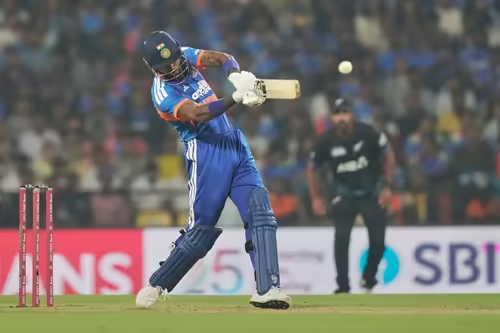
The landscape of Indian T20 cricket has just been redrawn. In a moment that signals a significant generational shift, Hardik Pandya has officially surpassed Virat Kohli to become the second-most capped player in India’s T20 International history. This isn’t just a number; it’s a powerful statement about Pandya’s indispensable role in the team’s strategy over the past decade.
This achievement places him in an elite circle, with only one giant left to climb: the ever-present Rohit Sharma. Let’s dive deep into what this milestone means, how he got here, and what it reveals about the future of Team India in the shortest format.
The Milestone: Pandya Surpasses a Legend
The record books have been updated. With his 126th appearance in a T20I jersey, Hardik Pandya has moved past Virat Kohli, who retired from the T20I format with 125 caps . This is a monumental feat, considering Kohli’s legendary status and his long-standing presence as the backbone of the Indian batting lineup.
Pandya’s journey to this point has been anything but smooth. From being a raw, explosive talent to a seasoned all-rounder and even a stand-in captain, his career has been a rollercoaster of highs and lows. Yet, his consistent selection speaks volumes about the unique skillset he brings to the table—a genuine pace-bowling all-rounder who can clear the boundary at will. This specific combination is a rare and highly valued commodity in modern T20 cricket, making him a coach’s dream for balancing the playing XI.
The Making of a T20I Stalwart
Pandya’s international journey began on a high note on January 26, 2016, against Australia in Adelaide, where he announced his arrival by picking up two crucial wickets . His fearless approach and ability to perform under pressure quickly made him a regular fixture in the side.
His value extends far beyond just statistics. He has been a key figure in multiple ICC tournaments, including the 2016 and 2024 T20 World Cups. His role often involves finishing games with the bat or breaking crucial partnerships with his clever seam-up bowling. This dual-threat capability has ensured his longevity in a format where roles are often hyper-specialized.
While his batting average may fluctuate, his strike rate and ability to find boundaries in the death overs are critical. Similarly, his bowling, though not always express, provides those vital 2-3 overs that allow the main bowlers to be rested. This balance is what has kept selectors coming back to him, game after game, series after series.
The Exclusive Club of Most Capped Indian T20I Players
Pandya’s entry into the top two is a testament to his endurance. Here’s a look at the current hierarchy of the most capped Indian players in T20Is:
| Rank | Player | T20I Caps |
|---|---|---|
| 1 | Rohit Sharma | 159 |
| 2 | Hardik Pandya | 126 |
| 3 | Virat Kohli | 125 |
Rohit Sharma, the ‘Hitman,’ remains in a league of his own with a staggering 159 appearances . His role as the primary opener for over a decade has given him unmatched consistency at the top of the order. Now, with Pandya in second place, the top of this list represents two very different but equally vital archetypes of the modern T20 cricketer.
This also highlights a fascinating transition. The era defined by the batting titans of Kohli and Sharma is gradually making way for a new generation of dynamic all-rounders and power-hitters like Pandya, Suryakumar Yadav, and others. For fans of [INTERNAL_LINK:indian-cricket-team-analysis], this shift is a key storyline to watch.
What This Means for India’s T20 Future
Pandya’s ascent to the second spot isn’t just a personal triumph; it’s a strategic indicator for the Indian team management. It underscores a clear move towards building a squad around versatile, multi-dimensional players who can adapt to any situation on the field.
As India looks ahead to future ICC events, the core of the team will likely revolve around such flexible assets. Pandya’s experience, having played in so many high-pressure games, is invaluable for mentoring younger talents. His leadership stints, even if temporary, have also shown his growing maturity and understanding of the game.
However, the challenge for Pandya will be to maintain his fitness and form. The physical demands of being a fast-bowling all-rounder are immense, and staying injury-free will be key to not just holding onto this position but potentially challenging Rohit Sharma’s record in the long run—a prospect that seems ambitious but not entirely impossible given his current trajectory.
Conclusion: A Testament to Enduring Value
Hardik Pandya surpassing Virat Kohli in Hardik Pandya T20I caps is more than a statistical footnote. It’s a symbol of the evolving DNA of the Indian T20I team. It celebrates the rise of the complete cricketer—the player who can contribute with both bat and ball, who can change the course of a game in a matter of minutes.
While Kohli’s legacy as a run-machine is untouchable, Pandya’s record speaks to a different kind of greatness: one built on versatility, resilience, and an unwavering ability to fill the gaps a team needs. As he stands just behind Rohit Sharma on the all-time list, the cricketing world watches with anticipation to see how much higher he can climb.
Sources
- Times of India: “Hardik Pandya surpasses Virat Kohli in T20Is, now only behind Rohit Sharma”
- ESPNcricinfo Player Profiles for Hardik Pandya, Virat Kohli, and Rohit Sharma
- International Cricket Council (ICC) Statistics