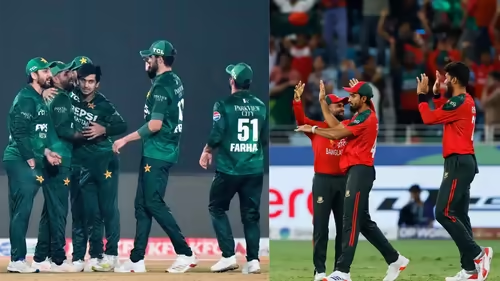
Cricket’s political undercurrents are surging again—and this time, a former legend is demanding nothing short of a revolution. In a bold and controversial move, ex-Pakistan captain **Rashid Latif** has urged the Pakistan Cricket Board (PCB) to **boycott the T20 World Cup 2026** in solidarity with Bangladesh, whose request to move its matches out of India was recently denied by the International Cricket Council (ICC) .
Latif’s rallying cry—“Stop the World Cup”—isn’t just rhetoric. It’s a calculated challenge to the global cricket power structure, one that hinges on a simple truth: without Pakistan, the T20 World Cup loses much of its viewership, revenue, and emotional intensity. Now, as tensions mount between boards and players, the sport stands at a crossroads between diplomacy and defiance.
Table of Contents
- Rashid Latif’s Bold Call for a T20 World Cup Boycott
- The Bangladesh Request and ICC Rejection
- Why Pakistan Holds the Keys to the Tournament
- Risks of Boycott: PCB Could Face ICC Sanctions
- Historical Precedents: When Boycotts Changed Cricket
- Public and Player Reactions in Pakistan
- Conclusion: A Moral Stand or a Strategic Blunder?
- Sources
Rashid Latif’s Bold Call for a T20 World Cup Boycott
In a fiery interview, Rashid Latif didn’t mince words. “If Bangladesh feels unsafe, and the ICC ignores them, then Pakistan must stand with them,” he declared. “We should say: ‘Stop the World Cup.’ Because without us, it’s not the same.”
Latif, known for his outspoken views on corruption and governance in cricket, framed the issue as one of **principle over profit**. He argued that the ICC’s dismissal of Bangladesh’s security concerns—while previously accommodating India’s refusal to play in Pakistan for the 2025 Champions Trophy—reveals a troubling double standard .
“This isn’t about politics,” Latif insisted. “It’s about fairness. If one nation’s fears are valid, all nations’ fears must be respected.”
The Bangladesh Request and ICC Rejection
The controversy began when the Bangladesh Cricket Board (BCB) formally requested the ICC to shift its group-stage matches from India to a neutral venue, citing unspecified but “genuine” security concerns for its players and officials. The request came amid rising regional tensions and followed the ICC’s decision to move the 2025 Champions Trophy out of Pakistan after India refused to travel there.
However, the ICC swiftly rejected Bangladesh’s appeal, stating that “India remains a safe and fully equipped host” and that “all teams will receive equal protection.” This inconsistency—accommodating India’s stance but not Bangladesh’s—has fueled accusations of bias among smaller cricketing nations .
Why Pakistan Holds the Keys to the Tournament
Rashid Latif’s strategy hinges on Pakistan’s outsized influence in global cricket:
- Viewership Power: Pakistan consistently ranks among the top three countries for TV and digital engagement during ICC events.
- Commercial Value: Broadcasters pay premium rights fees largely because of the India-Pakistan rivalry.
- Competitive Balance: As a former world champion, Pakistan’s presence adds legitimacy to the tournament.
“The ICC can fine us, suspend us—but they cannot afford to lose the Pakistan audience,” Latif said. “That’s our leverage.”
Risks of Boycott: PCB Could Face ICC Sanctions
While morally compelling, a boycott carries severe consequences. Under ICC regulations, any Full Member that withdraws from a mandated event without “force majeure” justification risks:
- Heavy financial penalties
- Suspension from future tournaments
- Loss of voting rights in ICC meetings
- Damage to player development pathways (e.g., U-19 and women’s teams)
Given Pakistan’s already fragile financial state and reliance on ICC funding, such sanctions could cripple domestic cricket for years. Critics argue that sacrificing an entire generation of players for a political statement may not be worth the cost.
Historical Precedents: When Boycotts Changed Cricket
Boycotts have shaped cricket before. In 1970, South Africa was expelled from international cricket due to apartheid—a move driven by global sporting protests. More recently, in 1996, Australia and the West Indies refused to play in Sri Lanka during the World Cup following a terrorist bombing, leading to forfeited matches but no long-term bans.
However, those cases involved clear, immediate threats. The current situation is murkier—based on perceived rather than proven danger—making it harder to justify a full withdrawal under ICC protocols.
For deeper context on past disputes, see our [INTERNAL_LINK:history-of-cricket-boycotts].
Public and Player Reactions in Pakistan
Latif’s comments have ignited fierce debate on Pakistani social media. While many fans applaud his “moral courage,” others warn against jeopardizing their team’s rare chance at T20 glory. Current players have remained silent—likely under PCB instructions—but retired stars like Shoaib Akhtar have expressed cautious support, saying, “Sometimes you must take a stand, even if it hurts.”
The PCB, meanwhile, has issued no official response. Insiders suggest the board is weighing public sentiment against the very real threat of ICC punishment—a delicate balancing act with no easy answer.
Conclusion: A Moral Stand or a Strategic Blunder?
Rashid Latif’s call to “stop the T20 World Cup” is more than a protest—it’s a test of whether cricket’s smaller nations can challenge the dominance of its wealthiest boards. While the moral argument for solidarity with Bangladesh is strong, the practical fallout for Pakistan could be devastating. In the end, the PCB must decide: is principle worth the price of exile?
Sources
- Times of India: ‘Stop the World Cup’: Pakistan urged to boycott T20 WC in support of Bangladesh
- International Cricket Council (ICC): Official Regulations and Sanctions Policy
- ESPNcricinfo: Historical Coverage of Cricket Boycotts
- Pakistan Cricket Board (PCB): Statements on International Participation