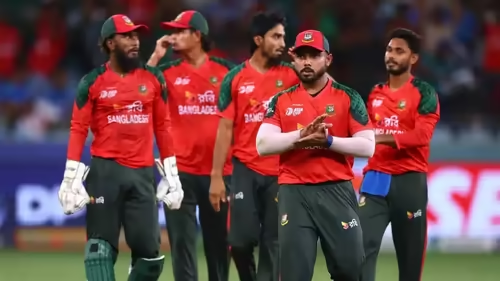
The cricketing world is reeling from a high-stakes political and administrative clash that has cost Bangladesh its place in the 2026 ICC Men’s T20 World Cup. In a stunning development, the Bangladesh Cricket Board (BCB) confirmed it was ready and willing to compete—but the national government blocked the team’s travel to India due to unresolved security concerns. The ICC, citing its commitment to the original tournament structure, refused to relocate Bangladesh’s matches, resulting in the nation’s unprecedented exclusion from the global event.
This isn’t just a scheduling dispute—it’s a collision between sport, diplomacy, and governance. And at the center of it all is a frustrated BCB, a rigid ICC, and a geopolitical reality that continues to shape international cricket in ways fans rarely see.
Table of Contents
- How Bangladesh Lost Its T20 World Cup Spot
- BCB: “We Wanted to Play, But Govt Said No”
- Why the ICC Refused to Relocate Matches
- Bangladesh Banned from T20 World Cup: A Deep Dive
- Scotland Steps In: What It Means for the Tournament
- Broader Implications for International Cricket
- Conclusion: A Loss for Cricket and Fans
- Sources
How Bangladesh Lost Its T20 World Cup Spot
The road to Bangladesh’s exclusion began months before the official announcement. The ICC had confirmed India as the sole host of the 2026 Men’s T20 World Cup, with all matches scheduled across major Indian cities. For most teams, this posed no issue—except for Bangladesh.
Due to longstanding political tensions and security assessments, the Bangladesh government has historically been cautious about sending national teams to India. In late 2025, despite repeated assurances from the BCB and ICC about safety protocols, Dhaka’s Ministry of Home Affairs formally denied the cricket team permission to travel. Without government clearance, the tour could not proceed under ICC regulations.
BCB: “We Wanted to Play, But Govt Said No”
In a rare public statement, BCB President Nazmul Hassan Papon clarified the board’s position: “We made every effort to participate. We even proposed playing our group-stage matches in a neutral venue like UAE or Sri Lanka.” According to the BCB, multiple written requests were sent to the ICC seeking fixture adjustments .
But the ICC stood firm. Citing logistical complexity, broadcast contracts, and fairness to other teams that had already planned their campaigns around the India schedule, the council declined all relocation proposals. With no path forward, the ICC officially removed Bangladesh from the tournament roster—and invited Scotland, the next highest-ranked non-qualified team, to take its place.
Why the ICC Refused to Relocate Matches
The ICC’s decision wasn’t made lightly—but it reflects a broader shift in how the governing body handles host-nation conflicts. After accommodating India’s refusal to play in Pakistan for the 2025 Champions Trophy by moving the entire event to a neutral venue, the ICC appears determined to avoid setting a precedent that could lead to constant fixture changes.
Key reasons for the refusal include:
- Contractual Obligations: Broadcasters and sponsors have locked in schedules based on India-hosted matches.
- Competitive Integrity: Allowing one team to play elsewhere could disadvantage others who must adapt to Indian conditions.
- Precedent Risk: If Bangladesh gets special treatment, future teams might demand similar concessions, fragmenting the tournament.
As one ICC insider noted anonymously, “Once you start bending the rules for one, you open the floodgates for all.”
Bangladesh Banned from T20 World Cup: A Deep Dive
While the phrase “Bangladesh banned from T20 World Cup” is widely used, it’s technically inaccurate. Bangladesh wasn’t penalized for misconduct—it was excluded due to an external political barrier beyond the BCB’s control. Yet the outcome is the same: no Tigers in the 2026 tournament.
This marks the first time a Full Member nation has missed a men’s T20 World Cup since the event’s inception in 2007. The absence is a blow to fans, players, and the global narrative of the game. Bangladesh, known for its passionate support and competitive performances (including a famous 2016 win over India), adds color and unpredictability to any ICC event.
Moreover, the financial impact on the BCB is significant. Participation guarantees revenue from ICC distributions, sponsorships, and media exposure—funds crucial for grassroots development.
Scotland Steps In: What It Means for the Tournament
Scotland, currently ranked 14th in T20Is, will now make its third consecutive T20 World Cup appearance. While not a traditional powerhouse, Scotland has produced thrilling upsets—like their 2021 win over Bangladesh itself.
Their inclusion maintains the 20-team format but shifts the group dynamics. Teams originally drawn against Bangladesh must now prepare for a different style of play—one built on grit, seam bowling, and lower-order hitting rather than spin-heavy subcontinental tactics.
For Scottish cricket, this is a golden opportunity. “[INTERNAL_LINK:scotland-cricket-rise]” has been a growing story, and this unexpected entry could accelerate investment and interest back home.
Broader Implications for International Cricket
This episode underscores a persistent vulnerability in global cricket: its dependence on geopolitics. When governments dictate sporting participation, the ICC’s authority is undermined. The situation also highlights the need for clearer contingency protocols.
Possible reforms could include:
- Mandatory neutral venues for tournaments involving high-risk bilateral tensions.
- Pre-tournament government clearance deadlines to avoid last-minute exclusions.
- Emergency replacement frameworks that prioritize competitive balance.
Without such measures, future ICC events risk similar disruptions.
Conclusion: A Loss for Cricket and Fans
The exclusion of Bangladesh from the 2026 T20 World Cup is more than an administrative footnote—it’s a stark reminder that cricket doesn’t exist in a vacuum. While the ICC’s stance on consistency is understandable, the human and sporting cost is real. Fans lose thrilling matchups, players lose career-defining moments, and the game loses a piece of its global soul.
As Jason Gillespie recently asked in another context: “Why are some teams accommodated while others are cast aside?” Until the ICC can answer that with fairness and transparency, the shadow of Bangladesh banned from T20 World Cup will linger over the sport.