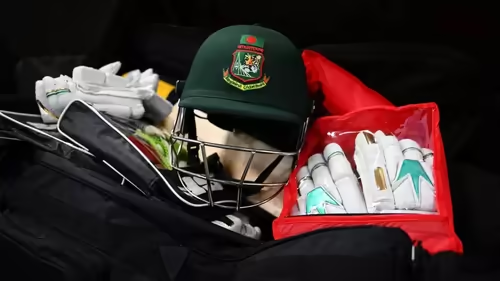
The cricketing world is reeling from a bombshell announcement. The Bangladesh Cricket Board (BCB) has made its final, unequivocal decision: their national team will not be participating in the upcoming ICC Men’s T20 World Cup in India. Their reason? A stark and chilling declaration: “India is not safe for us.”
This isn’t just a sporting withdrawal; it’s a geopolitical statement that has forced the International Cricket Council (ICC) to take the unprecedented step of replacing a top-tier cricketing nation with Scotland, a team that had already been eliminated from the main draw. This move has left fans, players, and administrators scrambling to understand the full implications.
Table of Contents
- The BCB Official Statement: Safety Over Sport
- ICC Response and Scotland’s Entry into the Tournament
- The Underlying Political Tensions
- Impact on the T20 World Cup and Group Dynamics
- What This Means for Bangladesh Cricket
- Conclusion: A Dark Day for the Gentleman’s Game
- Sources
The BCB Official Statement: Safety Over Sport
The BCB’s decision was not made in a vacuum. It came after what they described as “repeated efforts and alternative proposals” to the ICC, all of which were reportedly rejected. The board has firmly placed the responsibility on advice from the Government of Bangladesh, which has expressed serious concerns about the safety and well-being of its players and officials in India .
In their final communication, the BCB stated they have “accepted the ICC’s decision” to replace them, but stood by their core principle: the safety of their citizens is non-negotiable. This stance, while costly for their team’s competitive future, frames their withdrawal as a matter of national duty rather than a sporting choice .
ICC Response and Scotland’s Entry into the Tournament
The ICC, faced with a logistical and competitive nightmare just months before the tournament, had to act swiftly. Their official stance, as reported, is that there was an “absence of any credible or verifiable security threat” to the Bangladesh team in India . Despite this, they were left with no option but to find a replacement.
Scotland, who had finished second in their qualifying group behind the Netherlands, has been granted a reprieve and a spot in the main event. For the Scottish team, this is a dream come true, albeit under tragic circumstances for another nation. They now face the daunting task of preparing for a tournament they thought they had missed, stepping into a group that was not designed for them.
The Underlying Political Tensions
While the BCB and the Bangladeshi government cite general safety concerns, the decision cannot be viewed in isolation from the recent, well-documented political tensions between the two neighboring countries. Media reports suggest the refusal to tour is “based on legitimate security concerns” stemming from this broader context .
Cricket has long been a proxy for the complex relationship between India and Bangladesh. From on-field rivalries to off-field diplomatic spats, the sport often carries a weight far beyond the boundary ropes. This Bangladesh T20 World Cup pullout is perhaps the most severe manifestation of this tension in recent memory, blurring the lines between sport and statecraft in a way that leaves the game itself as a casualty.
Impact on the T20 World Cup and Group Dynamics
The ripple effects of this decision are massive. The tournament’s structure, broadcast schedules, and marketing campaigns—all meticulously planned for months—now require urgent revision. More importantly, the competitive balance of the group that contained Bangladesh is thrown into chaos.
Teams that were preparing to face a strong, experienced side like Bangladesh must now recalibrate their strategies for a completely different opponent in Scotland. This sudden shift is unfair to all parties involved and undermines the integrity of the competition that the ICC works so hard to protect.
What This Means for Bangladesh Cricket
The consequences for Bangladesh cricket could be severe and long-lasting. Beyond the immediate disappointment for their players, who lose a chance to compete on the world’s biggest stage, the BCB may face significant financial penalties from the ICC for breach of contract. Furthermore, their standing within the global cricketing community could be damaged, with questions raised about their reliability as a touring partner.
For fans of the Tigers, this is a moment of profound sadness. They are left wondering what might have been and whether their team’s absence will be used as a political tool, further isolating them from the international cricket circuit. To understand more about the team’s recent form, see our analysis on [INTERNAL_LINK:bangladesh-cricket-team-performance].
Conclusion: A Dark Day for the Gentleman’s Game
The Bangladesh T20 World Cup pullout is a stark reminder that cricket, for all its unifying power, remains vulnerable to the forces of geopolitics and national security. While the BCB’s primary duty is to its citizens, and the ICC’s is to its tournament, the end result is a loss for the sport itself. The beautiful game has been diminished, and its fans are left hoping that cooler heads will prevail before the next major event, ensuring that the bat and ball remain the only weapons on the field.
Sources
- Times of India: ‘India is not safe for us’: BCB’s final word as they say ‘accept ICC’s decision’
- ICC Official Website: International Cricket Council