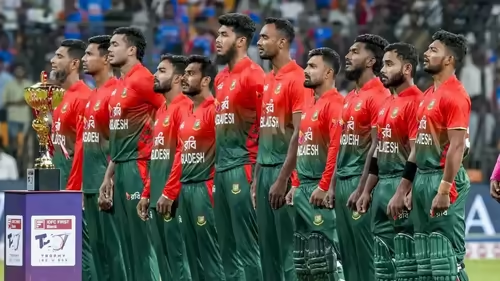
It was supposed to be a routine administrative day for Bangladesh cricket. Instead, January 24, 2026, became a date etched in infamy. Within hours of the International Cricket Council (ICC) announcing that **Bangladesh would be stripped of its spot in the 2026 Men’s T20 World Cup** for refusing to travel to India, BCB director Ishtiaque Sadeque submitted his resignation .
Officially, Sadeque said he was stepping down for “family and personal reasons” and denied any connection to the ICC’s historic decision. But in the high-stakes world of international cricket diplomacy, timing is everything. His abrupt exit—on the very day Bangladesh became the first Full Member nation ever disqualified from a World Cup for non-compliance—has sent shockwaves through the cricketing community and ignited fierce debate about governance, geopolitics, and the cost of principle over participation.
Table of Contents
- How Bangladesh Lost Its T20 World Cup Spot
- The Shock Resignation of Ishtiaque Sadeque
- Why Did Bangladesh Refuse to Play in India?
- Scotland Steps In: A Merit-Based Replacement
- Fallout for Bangladesh Cricket and Players
- Broader Implications for ICC and Global Cricket
- Conclusion: A Defining Moment for Bangladesh Cricket
- Sources
How Bangladesh Lost Its T20 World Cup Spot
The ICC’s decision wasn’t made lightly. As part of the 2026 T20 World Cup hosting agreement, all participating teams were required to commit to playing in all designated host countries—including India, one of the co-hosts . Bangladesh, citing unspecified “security concerns,” formally declined to confirm its availability for matches scheduled on Indian soil.
Despite repeated warnings and opportunities to reconsider, the BCB maintained its stance. The ICC, bound by its own regulations to ensure tournament integrity and fairness to other qualifiers, had no choice but to enforce Clause 7.3 of its Event Participation Agreement, which allows for disqualification in cases of non-compliance with venue commitments .
This marks the first time a Full Member nation has been removed from an ICC World Cup for such a reason—a precedent with far-reaching consequences.
The Shock Resignation of Ishtiaque Sadeque
Ishtiaque Sadeque, a prominent media figure and one of the most visible directors on the BCB board, announced his resignation via social media just hours after the ICC’s statement went public. “After much thought, I’ve decided to step away to focus on personal and family matters,” he wrote, adding that his departure was “not linked to any dispute or recent events” .
Yet, insiders suggest otherwise. Sadeque was known to advocate for a more pragmatic approach with the ICC, reportedly clashing with hardliners within the board who prioritized political alignment over sporting opportunity. His exit is widely interpreted as a protest against the BCB’s uncompromising stance—or a casualty of the resulting fallout.
Why Did Bangladesh Refuse to Play in India?
While the BCB has not publicly detailed its “security concerns,” analysts point to the tense geopolitical climate between Dhaka and New Delhi. Recent diplomatic friction over water-sharing disputes, trade imbalances, and regional influence may have influenced the decision .
However, critics argue that using a cricket tournament as a proxy for political messaging is reckless. Unlike bilateral series—which are discretionary—ICC events are binding commitments under the Future Tours Programme (FTP). By backing out, Bangladesh not only forfeited its spot but also jeopardized its standing within the ICC’s governance structure and risked financial penalties from lost broadcast revenue shares.
Scotland Steps In: A Merit-Based Replacement
In a move hailed as a victory for meritocracy, the ICC swiftly named **Scotland** as Bangladesh’s replacement. The Scots finished second in the last T20 World Cup Qualifier, behind only the Netherlands, and have consistently punched above their weight in global tournaments .
“This is what the pathway system is designed for,” said an ICC spokesperson. “Teams earn their place through performance, and Scotland has proven they belong.”
For Scottish players like Richie Berrington and Michael Leask, this is a career-defining opportunity. For Bangladesh’s stars—Shakib Al Hasan, Najmul Hossain Shanto, and Mustafizur Rahman—it’s a devastating blow. Many may never get another shot at a T20 World Cup, especially as the format’s future beyond 2026 remains uncertain.
Fallout for Bangladesh Cricket and Players
The consequences extend far beyond embarrassment:
- Financial Loss: The BCB stands to lose millions in ICC funding and sponsorship tied to World Cup participation.
- Player Morale: National team members expressed “heartbreak” in private messages, with some questioning leadership decisions.
- Governance Crisis: Sadeque’s resignation may trigger further board instability, potentially leading to calls for early elections or external intervention.
As one former Bangladesh captain told ESPNcricinfo anonymously: “We’ve sacrificed our players’ dreams for a political gesture no one outside the boardroom understands.”
Broader Implications for ICC and Global Cricket
The **T20 World Cup disqualification** sets a critical precedent. It signals that the ICC will enforce its rules uniformly—even against powerful Full Members. This strengthens the credibility of the qualification system and reinforces the principle that global tournaments must operate above national politics.
However, it also exposes a vulnerability: the lack of a clear conflict-resolution mechanism for politically sensitive hosting arrangements. Moving forward, the ICC may need to develop neutral venue protocols or enhanced security assurances to prevent similar standoffs. For more on how global sports bodies navigate geopolitics, see [INTERNAL_LINK:icc-governance-and-neutral-venues].
Conclusion: A Defining Moment for Bangladesh Cricket
The disqualification from the 2026 T20 World Cup isn’t just a logistical setback—it’s a profound identity crisis for Bangladesh cricket. Was the stand worth it? Did it protect national interest, or did it isolate the nation from the sport it loves? With a key director gone and players disillusioned, the BCB now faces its toughest test: rebuilding trust, both domestically and internationally. One thing is certain: in the world of modern cricket, you can’t play politics without paying a price on the pitch.
Sources
- Times of India: Hours after Scotland replace Bangladesh at T20 WC, BCB director quits
- International Cricket Council (ICC): ICC Event Regulations and Participation Agreements
- ESPNcricinfo – Governance & Policy Analysis: Cricket Administration and Geopolitics
Start sharing, start earning—become our affiliate today!