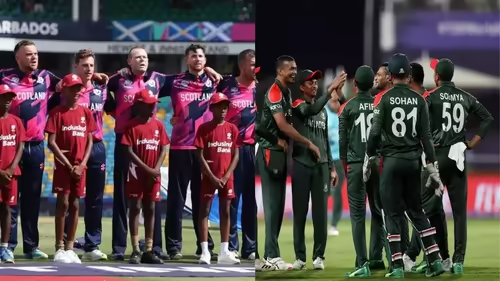
The cricketing world is reeling from a decision that has sent shockwaves through the sport. In an unprecedented move, the International Cricket Council (ICC) has officially replaced Bangladesh with Scotland in the upcoming T20 World Cup 2026. This isn’t just a simple team swap; it’s the culmination of a tense diplomatic standoff that has left players heartbroken and fans furious.
Table of Contents
- The Bangladesh Boycott: Security Concerns or Political Posturing?
- ICC Response: Firm and Final
- Why Scotland? The Unlikely Beneficiary
- Scotland’s Emotional and Pragmatic Response
- Broader Implications for World Cricket
- Conclusion: A Sad Day for the Game
- Sources
The Bangladesh Boycott: Security Concerns or Political Posturing?
The saga began when the Bangladesh Cricket Board (BCB) formally requested the ICC to relocate their group stage matches away from India, citing serious security concerns for their players and officials [[3]]. This request came amid heightened regional tensions. The BCB stood firm on its position, refusing to participate in the tournament under the published schedule that included fixtures in India [[10]].
This wasn’t a casual ask. The BCB had reportedly lobbied other ICC board members for support. However, at a crucial ICC Board meeting, their proposal was overwhelmingly rejected in a 14-2 vote, with only Pakistan backing their stance [[15]]. Despite this clear directive from the sport’s governing body, Bangladesh remained resolute, effectively choosing to withdraw from the competition.
ICC Response: Firm and Final
The ICC, known for its sometimes bureaucratic approach, took a remarkably hard line on this issue. Their message was unequivocal: the tournament schedule, including venues, is final and binding for all participating nations. By refusing to adhere to this, Bangladesh was in breach of its obligations as a Full Member nation.
In a formal statement, the ICC confirmed, “Bangladesh will no longer compete in the upcoming ICC Men’s T20 World Cup, after the Bangladesh Cricket Board (BCB) refused to participate… per the published playing conditions” [[10]]. The council wasted no time in activating its contingency plan, swiftly naming a replacement to maintain the integrity of the 20-team event.
T20 World Cup 2026: Why Scotland Was Chosen
For many fans, the choice of Scotland as Bangladesh’s replacement raised eyebrows. After all, Scotland had failed to qualify for the tournament through the official European Qualifier pathway, finishing behind the Netherlands and Italy [[21]]. So why them?
The answer lies in the ICC’s official selection criteria. According to the governing body, “Scotland are the highest-ranked T20I side not to originally qualify for the tournament” [[24]]. Currently ranked 14th in the world, they were ahead of seven other teams already in the competition, making them the logical next-in-line based on the established protocol [[24]]. This decision, while procedurally sound, has added another layer of complexity to an already messy situation, as Scotland now enters a global stage they didn’t earn on the field during the qualifiers.
Scotland’s Emotional and Pragmatic Response
Scotland’s reaction has been a masterclass in diplomacy and empathy. While thrilled at the unexpected opportunity to compete on cricket’s biggest T20 stage, their leadership has been quick to express deep sympathy for their Bangladeshi counterparts.
Cricket Scotland’s CEO publicly stated, “We do feel for Bangladesh players,” acknowledging that their own entry into the T20 World Cup 2026 was “far from ideal” [[1]]. The team is now in a frantic race against time to secure flights, visas, and prepare for a tournament they thought they had missed. They have already named their 15-member squad, showing their commitment to being ready for their opening match against the West Indies [[23]].
Broader Implications for World Cricket
This incident has far-reaching consequences beyond the fate of two teams. It has sparked a fierce debate about the intersection of politics and sport. The World Cricketers’ Association called Bangladesh’s withdrawal a “sad moment for our sport” and expressed concern over “broader trends” that could see more such withdrawals in the future [[8], [14]].
Critics argue that the ICC’s inflexibility could damage the game’s global appeal, while supporters believe a firm stance is necessary to prevent the tournament from becoming a political football. The core question remains: can international cricket truly be insulated from the geopolitical realities of its host nations? This controversy has cast a long shadow over what should be a celebration of the sport.
Conclusion: A Sad Day for the Game
At its heart, this is a story of lost dreams. For the talented players of Bangladesh, a chance to compete on the world stage has been sacrificed on the altar of a political dispute. For Scotland, a dream come true is tinged with the awkwardness of benefiting from another team’s misfortune. The T20 World Cup 2026 will go on, but it will be forever marked by this controversial chapter—a stark reminder that in today’s world, even the beautiful game of cricket is not immune to forces beyond the boundary ropes.
Sources
- [[1]] Times of India: ‘We do feel for Bangladesh players’: Scotland admit T20 WC entry was ‘far from ideal’
- [[3]] NDTV Sports: Why Scotland Have Been Picked As Bangladesh’s Replacement For T20 World Cup 2026
- [[8]] Wisden: World Cricketers’ Association ‘Increasingly Concerned’ About Broader Trends
- [[10]] NDTV Sports: ICC Releases Complete Statement After Replacing Bangladesh With Scotland
- [[14]] The Daily Star: Bangladesh absence from T20 World Cup a sad moment for the game: WCA
- [[15]] Times of India: T20 World Cup row: Bangladesh’s exit from tournament ‘a sad moment for our sport’
- [[21]] Sky Sports: T20 World Cup: Scotland ‘absolutely ready’ after last-minute call-up
- [[23]] Times of India: Bangladesh’s last-minute replacement, Scotland, name squad for T20 World Cup 2026
- [[24]] ICC Official Website: Scotland to replace Bangladesh in ICC Men’s T20 World Cup 2026