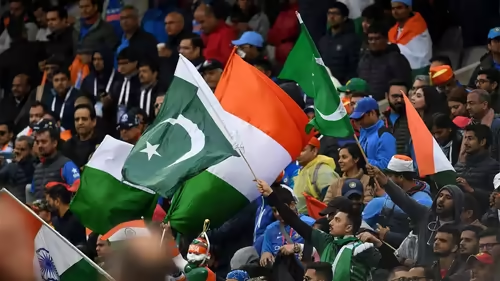
The future of the T20 World Cup 2026 is hanging by a thread, and former Pakistan wicketkeeper-batter Kamran Akmal isn’t holding back. In a powerful statement that cuts to the heart of cricket’s biggest dilemma, Akmal has declared that the International Cricket Council (ICC) simply cannot host a successful global tournament without its two most passionate and commercially vital nations: India and Pakistan [[7]].
This bold assertion comes at a time of unprecedented turmoil. The recent exclusion of Bangladesh from the tournament—after the Bangladesh Cricket Board (BCB) refused to travel to India for their matches due to security concerns—has sent shockwaves through the cricketing world [[10], [11]]. Now, Pakistan’s own participation is under a cloud of doubt, with the Pakistan Cricket Board (PCB) halting all team preparations and deferring a final decision to the government [[18], [19]].
Table of Contents
- The Bangladesh Exclusion and Its Ripple Effect
- Pakistan on the Brink of Withdrawal
- Kamran Akmal’s Blunt Warning to the ICC
- The Financial and Spiritual Cost of Absence
- Conclusion: Can the T20 World Cup Survive a Political Storm?
- Sources
The Bangladesh Exclusion and Its Ripple Effect
The ICC’s decision to replace Bangladesh with Scotland in the T20 World Cup 2026 was a direct consequence of the BCB’s refusal to comply with the tournament’s fixture list, which included matches in India [[10]]. This move, while upholding the ICC’s rules, has opened a dangerous precedent.
For Pakistan, a nation with its own complex political relationship with India, the Bangladesh situation has become a major point of concern. If one team can be excluded for refusing to play in India, what does that mean for Pakistan’s own potential stance? The PCB is now caught in a bind between sporting ambition and national politics.
Pakistan on the Brink of Withdrawal
The uncertainty has reached its peak. PCB Chairman Mohsin Naqvi has officially suspended all preparations for Pakistan’s T20 World Cup 2026 campaign [[18]]. A crucial meeting with the national squad has been held to address the growing anxiety within the camp [[16]].
Naqvi has made it clear that the final call on participation will not be a cricketing one, but a political one, to be made by Prime Minister Shehbaz Sharif [[17]]. The deadline for this monumental decision is expected to be early February 2026 [[19]]. This leaves the entire cricketing community in a state of anxious limbo.
Kamran Akmal’s Blunt Warning to the ICC
Amidst this chaos, Kamran Akmal has emerged as a vocal critic of any potential Pakistani withdrawal. His core argument is simple yet powerful: the essence of the T20 World Cup 2026 is its global appeal, and that appeal is intrinsically linked to the historic rivalry between India and Pakistan.
“ICC India aur Pakistan ke bina tournament nahi karwa sakti,” Akmal stated, emphasizing that the tournament would lose its soul without the passion, viewership, and revenue generated by this marquee clash [[7]]. He is urging the powers that be to keep politics out of the sport, reminding everyone that cricket belongs to the fans first and foremost.
The Financial and Spiritual Cost of Absence
Akmal’s warning isn’t just about sentiment; it’s about hard economics. The India-Pakistan match is consistently the highest-rated and most lucrative fixture in any ICC event. Broadcasters pay a premium for the rights, and sponsors clamor for association. The absence of either team, let alone both, would be a massive financial blow to the ICC and the entire ecosystem of the game.
Beyond the money, there’s the spiritual cost. For millions of fans across the subcontinent, an India-Pakistan match is more than a game; it’s a cultural event. Removing it from the World Cup would be a profound disappointment and could damage the long-term interest in the tournament.
Conclusion: Can the T20 World Cup Survive a Political Storm?
Kamran Akmal’s message is a desperate plea for sanity. The T20 World Cup 2026 stands at a crossroads. On one path lies a tournament diminished by the absence of its biggest stars and its most iconic rivalry, a victim of geopolitical tensions. On the other lies a celebration of the sport in its purest, most thrilling form.
The ball is now in the court of the Pakistani government and the ICC. Will they find a way to navigate the political minefield and deliver the tournament the world wants to see? Or will cricket once again be held hostage by forces beyond the boundary ropes? The next few weeks will be critical. For more context on the geopolitical tensions affecting cricket, see our analysis on [INTERNAL_LINK:india-pakistan-cricket-rivalry-history]. You can also track the official tournament updates on the ICC’s official website.
Sources
- [[7]] Observer Voice – T20 World Cup Controversy: Kamran Akmal Claims ICC Can’t Hold Tournament Without India and Pakistan
- [[10]] The Daily Star – ICC confirms Bangladesh’s exclusion from T20 World Cup 2026
- [[11]] Firstpost – Bangladesh T20 World Cup exit: ICC-BCB row explained
- [[16]] AP7am – PCB chief Naqvi to meet T20 WC squad amid uncertainty over participation
- [[17]] Instagram – PCB Chairman Mohsin Naqvi on Pakistan’s World Cup fate
- [[18]] Instagram – PCB Chairman Mohsin Naqvi suspends all preparations for T20 World Cup
- [[19]] ESPNcricinfo – Naqvi: Final call on Pakistan’s T20 World Cup participation by February 2