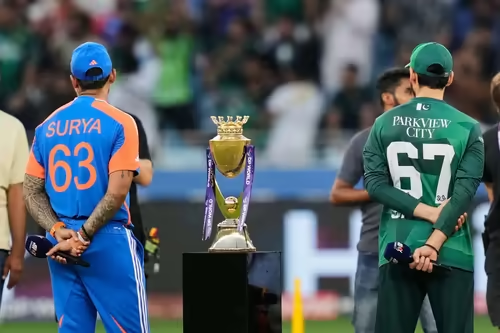
In a world where boundaries are often drawn by governments, one man is demanding they be erased on the cricket field. Former Pakistan off-spinner and legendary inventor of the ‘doosra’, Saqlain Mushtaq, has delivered a scathing indictment of the pervasive influence of politics in cricket, calling for its complete eradication.
His blunt message? “Politics is our enemy, and it’s not just harming cricket, but humanity as a whole.” This isn’t just a nostalgic lament from a former player; it’s a desperate cry for the soul of a sport that once served as a bridge between two estranged nations.
Table of Contents
- Saqlain Mushtaq’s Blunt Warning on Politics in Cricket
- The Lost Era of India-Pakistan Bilateral Cricket
- How Politics Actively Harms the Sport
- The ICC and the Fight Against Political Interference
- Conclusion: A United Plea for the Game’s Sake
Saqlain Mushtaq’s Blunt Warning on Politics in Cricket
Mushtaq’s recent comments, made in a series of interviews, leave no room for ambiguity. He believes the beautiful game has been hijacked by forces far beyond its boundary ropes. “I believe politics should be eradicated as it’s dangerous to humanity,” he stated emphatically [[3]].
For Mushtaq, cricket was never meant to be a proxy war. It was a platform for unity, entertainment, and shared passion. The current state, where a simple bilateral series between India and Pakistan is a distant dream, is a direct consequence of this toxic intrusion. He laments that the sport, which once brought smiles to millions, is now a battleground for geopolitical tensions, robbing fans and players of what could be the greatest rivalry in modern sport.
The Lost Era of India-Pakistan Bilateral Cricket
The history of cricket between India and Pakistan is a powerful narrative of highs and lows, intrinsically linked to the political climate of the subcontinent. From the early tours in the 1950s to the electrifying matches of the 80s and 90s, cricket was a rare channel of communication and goodwill.
Remember the iconic moments? Javed Miandad’s last-ball six in Sharjah, Sachin Tendulkar’s Desert Storm in the same venue, or the thrilling 2007 T20 World Cup final? These weren’t just matches; they were cultural events that transcended borders. The last full bilateral series between the two nations took place over a decade ago, with only occasional, high-stakes meetings at ICC events like the World Cup keeping the rivalry alive [[12]].
This prolonged absence is a massive loss for the sport, depriving a new generation of players of the unique pressure and prestige that comes from this historic contest. As Mushtaq points out, it’s a loss for the players who can’t showcase their talent in this ultimate theatre and for the fans who are denied their most anticipated fixture.
How Politics Actively Harms the Sport
The damage caused by politics in cricket extends far beyond just one bilateral relationship. It manifests in several destructive ways:
- Stifled Competition: When teams can’t play each other regularly, the quality of competition suffers. Players miss out on crucial experience against diverse playing styles.
- Financial Losses: India-Pakistan matches are the biggest revenue generators in the sport. Their absence impacts boards, broadcasters, and the entire cricketing ecosystem.
- Erosion of Spirit: The core spirit of cricket—fair play, respect, and camaraderie—is replaced by nationalistic fervor and hostility, turning a gentleman’s game into a political statement.
- Administrative Chaos: Political interference in cricket boards can lead to instability, poor governance, and a lack of long-term vision for the sport’s development [[21]].
The ICC and the Fight Against Political Interference
The International Cricket Council (ICC) has a clear stance on this issue, enshrined in its own regulations. The ICC’s charter explicitly requires its member boards to remain autonomous and free from government control to ensure the sport’s integrity and fairness [[23]].
This isn’t just theoretical. The ICC has taken concrete action in the past. In 2019, it suspended Zimbabwe Cricket due to “government interference” in its administration, a move that barred the nation from international competition until the issue was resolved [[25]]. Similarly, Sri Lanka Cricket faced a suspension in 2023 for the same reason [[24]].
While the ICC’s power to intervene in the complex India-Pakistan dynamic is limited, as it involves sovereign states rather than internal board governance, its official position aligns perfectly with Mushtaq’s plea. The global governing body recognizes that for cricket to thrive, it must be a sanctuary from the world’s political storms.
Conclusion: A United Plea for the Game’s Sake
Saqlain Mushtaq’s warning is more than just a personal opinion; it’s a reflection of a deep-seated frustration felt by millions of cricket fans across the globe. His call to “eradicate politics” is a call to return cricket to its purest form—a sport that unites, entertains, and inspires, regardless of nationality or political affiliation.
The prolonged silence in the India-Pakistan cricket corridor is a stark symbol of what we’ve lost. While the path to restoring bilateral ties is fraught with complexity, the voice of a respected figure like Mushtaq serves as a powerful reminder of what’s at stake. For the love of the game, and for the future of its greatest rivalries, it’s time to listen.
Sources
- Times of India: ‘Politics should be eradicated’: Ex-Pakistan cricketer issues blunt warning
- Sportsyaari: Saqlain Mushtaq blasts politics in cricket: ‘It’s harming humanity’
- ESPNCricinfo: The India-Pakistan cricket story: a timeline
- ICC: Zimbabwe Cricket suspended following ICC Annual Conference
- Sports Shorts: Afghanistan Cricket: An ICC Conundrum