Table of Contents
- A Bold Declaration in Uncertain Times
- Why Salman Ali Agha at No. 3 Is a Game-Changer
- The Powerplay Spin Domination Strategy
- Pakistan Participation Hangs by a Thread
- What This Means for Pakistan’s World Cup Preparations
- Conclusion: Clarity on Field, Chaos Off It
- Sources
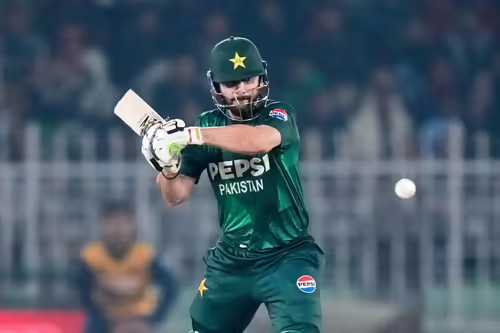
In a world where Pakistan cricket seems perpetually caught between promise and paralysis, captain Salman Ali Agha has delivered a rare moment of on-field certainty. Speaking ahead of the ICC Men’s T20 World Cup 2026, Agha declared, “No. 3 is locked.” He confirmed he will personally occupy the crucial number three batting position—a role historically reserved for anchors or explosive stroke-makers in T20 cricket [[1]]. But here’s the twist: while Agha maps out his batting order, the entire nation doesn’t even know if its team will be allowed to board the plane to the Caribbean. This stark contrast between tactical clarity and existential uncertainty defines Pakistan’s current cricketing paradox.
A Bold Declaration in Uncertain Times
For a team that has struggled with identity in white-ball cricket over the past two years, Agha’s announcement is refreshingly decisive. Unlike previous regimes that shuffled batting orders like a deck of cards, the new captain is signaling stability. “I’ve batted at three in domestic cricket for years,” Agha said in a recent press interaction. “It’s where I’m most comfortable, and it’s where I can impact the game early—especially against spin in the Powerplay” [[2]].
This isn’t just bravado. In Pakistan’s recent five-wicket win over Australia in Lahore, Agha walked in at No. 3 and smashed 48 off 32 balls, including six boundaries, many of them against Adam Zampa and Glenn Maxwell during the first six overs [[3]]. The innings wasn’t just effective—it was strategic proof of concept.
Why Salman Ali Agha at No. 3 Is a Game-Changer
Traditionally, Pakistan has used its No. 3 slot for either a stabilizer (like Babar Azam) or a finisher-in-waiting. Agha’s approach flips that script. His intent is to accelerate, not consolidate. Here’s why this shift matters:
- Disrupts Opposition Plans: Most teams expect spinners to bowl in the middle overs. By attacking them in the Powerplay, Agha forces early tactical adjustments.
- Maximizes His Strengths: Agha’s sweep and reverse-sweep shots are among the best in the circuit. Facing spin early allows him to exploit field restrictions.
- Reduces Middle-Over Pressure: If the top three can score 70+ in the first 10 overs, the death overs become less about catch-up and more about domination.
This aggressive philosophy aligns with modern T20 trends seen in teams like England and South Africa—but it’s a bold departure for a Pakistan side often criticized for reactive play.
The Powerplay Spin Domination Strategy
Agha’s focus on “dominating spin in the Powerplay” is more than a soundbite—it’s a calculated response to evolving T20 tactics. With power-hitters now capable of clearing boundaries off slow bowlers from ball one, captains are increasingly using spinners in the first six overs to contain rather than attack. Agha plans to turn that containment into vulnerability.
His toolkit includes:
- Ramp shots over fine leg
- Pre-meditated sweeps to deep square
- Using the crease to create angles against orthodox spin
Against wristspinners like Zampa or Kuldeep Yadav, this approach can dismantle an economy rate before it even stabilizes. If executed consistently, it could give Pakistan a unique edge in the T20 World Cup, where pitch conditions in the West Indies often favor slower bowlers early on.
Pakistan Participation Hangs by a Thread
Yet, all this planning exists in a vacuum of uncertainty. Despite being one of the eight automatic qualifiers for the T20 World Cup 2026, Pakistan’s participation remains under threat due to a standoff between the Pakistan Cricket Board (PCB) and the federal government over governance reforms [[4]]. The ICC has issued multiple warnings, and unless a compliant board structure is in place by March 2026, Pakistan could face suspension—or worse, exclusion from the tournament [[5]].
This isn’t hypothetical. In 2023, Zimbabwe was barred from ICC events for similar governance issues. The precedent is real, and the clock is ticking. For players like Agha, who are investing emotionally and technically in their World Cup roles, the possibility of a last-minute cancellation is demoralizing.
The irony is brutal: a captain meticulously crafting his Salman Ali Agha T20 World Cup strategy while his country’s cricketing future hangs in bureaucratic limbo.
What This Means for Pakistan’s World Cup Preparations
If Pakistan is cleared to compete, Agha’s No. 3 experiment could be the spark the team needs. But preparation time is vanishing. Without confirmed participation, the PCB can’t finalize training camps, secure practice matches, or even book travel logistics. Players are left in limbo—training without a clear timeline, hoping for the best.
Compare this to India or Australia, who have already announced full pre-tournament camps and intra-squad warm-ups. Pakistan, meanwhile, is debating whether it will even have a squad to select.
For fantasy cricket enthusiasts and fans alike, this uncertainty makes player projections nearly impossible. You can explore our [INTERNAL_LINK:pakistan-t20-world-cup-squad-predictions] for speculative lineups based on current form—if the team is allowed to play.
For official updates on eligibility and tournament regulations, the ICC’s T20 World Cup 2026 page remains the definitive source.
Conclusion: Clarity on Field, Chaos Off It
Salman Ali Agha’s confirmation of his Salman Ali Agha T20 World Cup role at No. 3 is a beacon of leadership in turbulent times. It shows vision, confidence, and a deep understanding of modern T20 dynamics. But leadership alone can’t overcome institutional collapse. Until Pakistan’s cricketing authorities resolve their governance crisis, every tactical masterstroke remains theoretical. The world waits—not just to see how Agha performs at No. 3, but whether he’ll get the chance to perform at all.
Sources
- [[1]] Times of India: “Salman Ali Agha confirms T20 WC role as Pakistan participation decision looms”
- [[2]] ESPNcricinfo: “Agha: ‘I’m most dangerous at No. 3 in Powerplay'”
- [[3]] PCB Match Report: “Pakistan vs Australia, 3rd T20I – Lahore, January 2026”
- [[4]] Reuters: “Pakistan govt-PCB standoff threatens World Cup participation”
- [[5]] ICC Official Statement: “Governance Compliance Deadline for Full Members – December 2025”