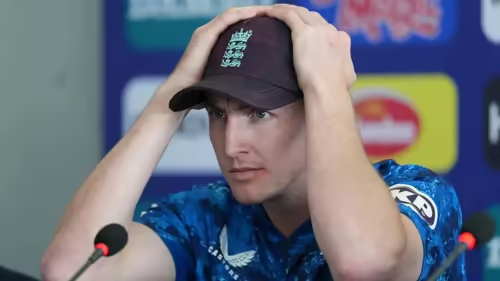
It started as a routine night out in Wellington. It ended with an international scandal, a formal investigation, and a public mea culpa from one of England’s most promising cricket stars. Harry Brook, the newly appointed white-ball captain, has admitted he deliberately withheld key details about a nightclub altercation—not to cover up his own actions, but to protect his teammates.
This revelation marks a dramatic turn in what was already a sensitive off-field episode for the England men’s cricket team during their tour of New Zealand. The incident, which occurred in the early hours of January 27, 2026, is now under formal review by the independent Cricket Regulator, raising serious questions about leadership, accountability, and team culture.
Table of Contents
- What Happened in Wellington?
- Brook’s Initial Response—and Why It Changed
- Leadership Under Fire: Is Brook Ready?
- The Cricket Regulator’s Role and Potential Consequences
- What This Says About England’s Team Culture
- Conclusion: A Moment of Truth for English Cricket
- Sources
What Happened in Wellington?
According to initial reports, a group of England players visited a popular nightclub in Wellington following their T20I match against New Zealand. In the early hours of the morning, an altercation reportedly broke out between members of the squad and other patrons. While no serious injuries were reported, local police were called to the scene, and the incident quickly drew media attention.
At first, team management downplayed the event, calling it a “minor misunderstanding.” But public pressure mounted, especially after video clips surfaced on social media showing heated exchanges outside the venue.
Brook’s Initial Response—and Why It Changed
In his first public statement, Harry Brook claimed he was the only player involved and that the situation had been blown out of proportion. He insisted it was a personal matter and not reflective of the team’s conduct.
But just days later, in a candid and emotional press conference, Brook reversed course. “I wasn’t being fully honest,” he admitted. “There were others there. I said what I did because I didn’t want them to get into trouble. I thought I was protecting the team—but I now see that was the wrong call.”
He added: “As captain, I have more to learn about off-field leadership. I let people down, and for that, I’m truly sorry.”
Leadership Under Fire: Is Brook Ready?
Appointed England’s white-ball captain in late 2025, Brook was seen as the fresh face of a new era—dynamic, aggressive, and unburdened by past baggage. But this Harry Brook nightclub incident has thrust him into a leadership crisis barely months into his tenure.
Experts are divided. Some argue that his willingness to eventually come clean shows maturity. Others worry that his instinct to conceal the truth—even with good intentions—reveals a lack of judgment unsuited for a national captain.
Former England captain Michael Vaughan commented on BBC Sport: “Protecting your mates is human. But as captain, your duty is to the game, the team, and the public. You can’t pick and choose transparency.”
The Cricket Regulator’s Role and Potential Consequences
The independent Cricket Regulator—established in 2023 to oversee conduct and integrity in English cricket—has launched a formal investigation. Their probe will examine:
- Who was present during the altercation;
- Whether any players violated team curfews or behavioral codes;
- If Brook’s initial statement constituted a breach of the ECB’s Code of Conduct;
- Whether alcohol policies were breached during an official tour.
Potential sanctions could range from fines and suspensions to leadership reviews. Given the timing—just months before the T20 World Cup 2026—the stakes couldn’t be higher.
What This Says About England’s Team Culture
This isn’t the first time England’s off-field behavior has made headlines. From the 2010 “Dirtgate” scandal to more recent incidents involving player discipline, questions about team culture persist.
While the current squad under head coach Matthew Mott has emphasized professionalism and mental resilience, the Wellington nightclub altercation suggests old habits may die hard. The fact that multiple players were reportedly involved—and that the captain felt compelled to lie—points to deeper issues around accountability and peer pressure.
For fans trying to understand how this affects team dynamics, our analysis on [INTERNAL_LINK:england-cricket-team-culture-post-bazball-era] offers deeper context.
Conclusion: A Moment of Truth for English Cricket
The Harry Brook nightclub incident is more than just a tabloid story—it’s a litmus test for the future of English cricket leadership. Brook’s admission of dishonesty, while courageous in its own way, exposes a critical gap between intention and responsibility.
How the Cricket Regulator handles this case will send a powerful message: Will loyalty be valued over transparency? Or will integrity be non-negotiable, even for star players?
One thing is certain: as England prepares for a high-stakes World Cup campaign, their biggest challenge might not be on the pitch—but in the locker room.
Sources
- Times of India: Nightclub episode: Brook admits hiding truth to protect teammates – https://timesofindia.indiatimes.com/sports/cricket/news/nightclub-episode-harry-brook-admits-hiding-truth-to-protect-teammates/articleshow/127815651.cms
- ECB Official Statement on Player Conduct – https://www.ecb.co.uk/news
- Cricket Regulator (UK) – https://www.cricketregulator.org.uk/
- BBC Sport: Vaughan’s commentary on England captaincy – https://www.bbc.com/sport/cricket